Learn how to establish a literature gap, write a focused research question, align method and analysis, address ethics and feasibility, and plan a study.
Table of Contents
- What is a research proposal?
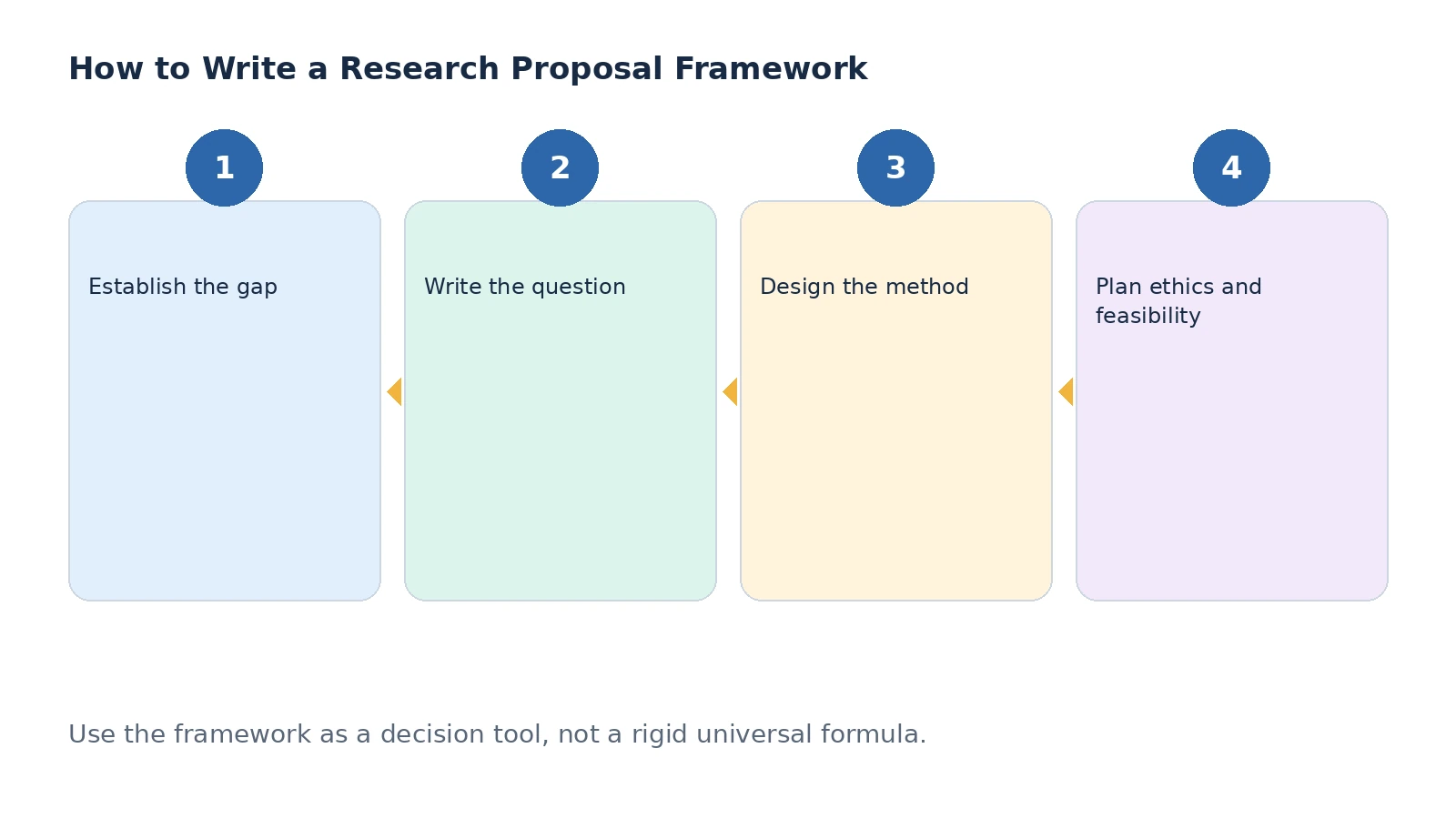
- 1. Define the research problem
- 2. Establish the literature gap
- 3. Write research questions or hypotheses
- 4. Choose a method that fits the question
- 5. Address ethics and data protection
- 6. Research proposal structure
- Mini research proposal example
- 7. Demonstrate feasibility
- 8. Anticipate limitations
- Common research proposal mistakes
- How to revise a research proposal
- Research proposal planning template
- Frequently asked questions
- Research proposal checklist
- What readers need from this guide
- Four decisions to make before drafting
- Weak and improved approaches
- Source-management workflow
- Paragraph workshop
- Using AI responsibly in research writing
- Practice topics and questions
- Internal-linking plan
- On-page quality, accessibility, and SEO
- Final research proposal quality questions
- Expert editorial guidance
- Efficient start-to-finish workflow
- Credibility and factual accuracy
- Submission and file checks
- Additional research-proposal practice
- Additional research-proposal practice
- Additional research-proposal practice
- Additional research-proposal practice
- Additional research-proposal practice
- Additional research-proposal practice
- Additional research-proposal practice
- Additional research-proposal practice
- Additional research-proposal practice
- Additional research-proposal practice
- Additional research-proposal practice
- Additional research-proposal practice
- Additional research-proposal practice
- Additional research-proposal practice
- Additional research-proposal practice
- Additional research-proposal practice
- Additional research-proposal practice
What is a research proposal?
A research proposal explains what a study will investigate, why the question matters, how the study will be conducted, and whether the plan is feasible and ethical. It is a plan and justification, not a report of completed findings.
Proposal requirements differ across courses, disciplines, and institutions. Common sections include introduction, problem statement, research question, literature review, method, ethics, timeline, budget, and expected contribution.
Use the literature review guide to establish the gap and the research paper guide for question and source development.
1. Define the research problem
Explain the specific condition, inconsistency, evidence gap, or practical problem the proposed study addresses. Provide context without claiming the study will solve an entire social issue.
Distinguish the broad problem from the researchable question. Food insecurity may be the broad issue; the proposal may examine how evening class schedules affect access to campus food support.
2. Establish the literature gap
Synthesize what existing research shows and identify the exact unresolved issue. A strong gap may involve population, context, method, measurement, timeframe, or conflicting findings.
Do not claim that no research exists unless the search supports that conclusion.
3. Write research questions or hypotheses
Questions should be specific, answerable, aligned with the method, and connected to the gap. Hypotheses should state predicted relationships where the design and discipline make them appropriate.
Weak question
How does food insecurity affect students?
Improved question
How do evening students describe the effect of campus food-service hours on their ability to access emergency food support?
4. Choose a method that fits the question
| Question type | Possible method |
|---|---|
| Experience or meaning | Qualitative interviews or focus groups |
| Prevalence or association | Survey or secondary data analysis |
| Effect of an intervention | Experimental or quasi-experimental design |
| Process or implementation | Case study, observation, mixed methods |
Explain participants, sampling, setting, data collection, measures or interview questions, analysis, and limitations.
5. Address ethics and data protection
Identify informed consent, privacy, confidentiality, risk, vulnerable populations, data storage, access, retention, and required institutional review. Do not promise anonymity when data collection or recruitment makes it impossible.
Explain how the proposal minimizes risk and protects participants.
6. Research proposal structure
- Title and introduction.
- Problem statement and significance.
- Focused literature review and gap.
- Research question or hypotheses.
- Method and participants.
- Data collection and analysis.
- Ethical considerations.
- Limitations.
- Timeline and resources.
- Expected contribution.
Mini research proposal example
Evening Students and Access to Campus Food Support
Campus food-insecurity programs often operate during standard business hours, yet evening students may attend after those services close. Existing research describes food insecurity among college students broadly, but fewer studies examine how service hours shape access for students enrolled primarily in evening courses.
This proposed qualitative study asks: How do evening students describe the effect of campus food-service hours on their ability to access emergency food support?
The study would recruit approximately fifteen adult evening students who have attempted to use or seek information about campus food resources. Semi-structured interviews would explore schedules, awareness, access barriers, alternative strategies, and recommendations.
Interviews would be transcribed and analyzed thematically. Participants would use pseudonyms, identifying details would be removed, and recordings would be stored securely with limited access. Participation would be voluntary and would not affect eligibility for services.
The study would not estimate the prevalence of food insecurity or evaluate program effectiveness. Its contribution would be a detailed account of scheduling and access barriers that could inform later service-design research.
7. Demonstrate feasibility
Explain access to participants or data, timeline, researcher skills, equipment, software, permissions, cost, and realistic recruitment. A valuable question is not enough if the proposed method cannot be completed.
Use a pilot, narrower population, or existing dataset when full-scale research exceeds available time or resources.
8. Anticipate limitations
Identify limitations created by design, sample, measurement, timeframe, and researcher role. Explain what the study can and cannot conclude.
Limitations do not invalidate a proposal; they define the appropriate interpretation.
Common research proposal mistakes
Writing a broad social problem instead of a study
Narrow the population, context, and question.
Choosing the method before the question
Let the question determine the design.
Claiming a gap without a review
Synthesize enough evidence to justify the gap.
Ignoring ethics and feasibility
Address participants, data, permissions, time, and resources.
Promising conclusions the design cannot support
Match expected contribution to method.
Need personalized research-writing support?
Submit the complete prompt, rubric, required sources, citation style, course level, and deadline through the StudyDoll order page. Use all support according to your institution’s academic-integrity requirements and verify every source and citation before submission.
How to revise a research proposal
Revise from large decisions to small corrections. First compare the draft with the prompt and rubric. Confirm that the research question, scope, purpose, source requirements, and genre are correct. Remove interesting material that does not help answer the central question.
Create a reverse outline by writing one sentence describing the job of every paragraph. The sequence should reveal a developing explanation, synthesis, or argument rather than a source-by-source list. Merge repeated sections, move misplaced evidence, and add missing analysis before editing sentences.
Next verify source use. Check that every quotation, paraphrase, statistic, and factual claim is represented accurately and cited. Then edit for clarity, concision, transitions, terminology, formatting, and reference consistency. Proofread after the final document format is complete.
Research proposal planning template
Broad problem:
Focused evidence gap:
Research question:
Why it matters:
Population and setting:
Method:
Sampling:
Data collection:
Analysis:
Ethical protections:
Limitations:
Timeline:
Resources or budget:
Expected contribution:
Download the free research proposal planning worksheet (PDF)
Frequently asked questions
Does a research proposal include results?
No completed results are reported, though expected contribution or possible outcomes may be discussed cautiously.
How long should the literature review be?
Follow the assignment. It should justify the question and method without becoming a full standalone review unless required.
Can a proposal use qualitative methods?
Yes when the question concerns experience, meaning, process, or context.
Do student proposals require ethics review?
Requirements vary by institution and activity. Follow institutional guidance before collecting data.
Should I include a budget?
Include one when required or when resources affect feasibility.
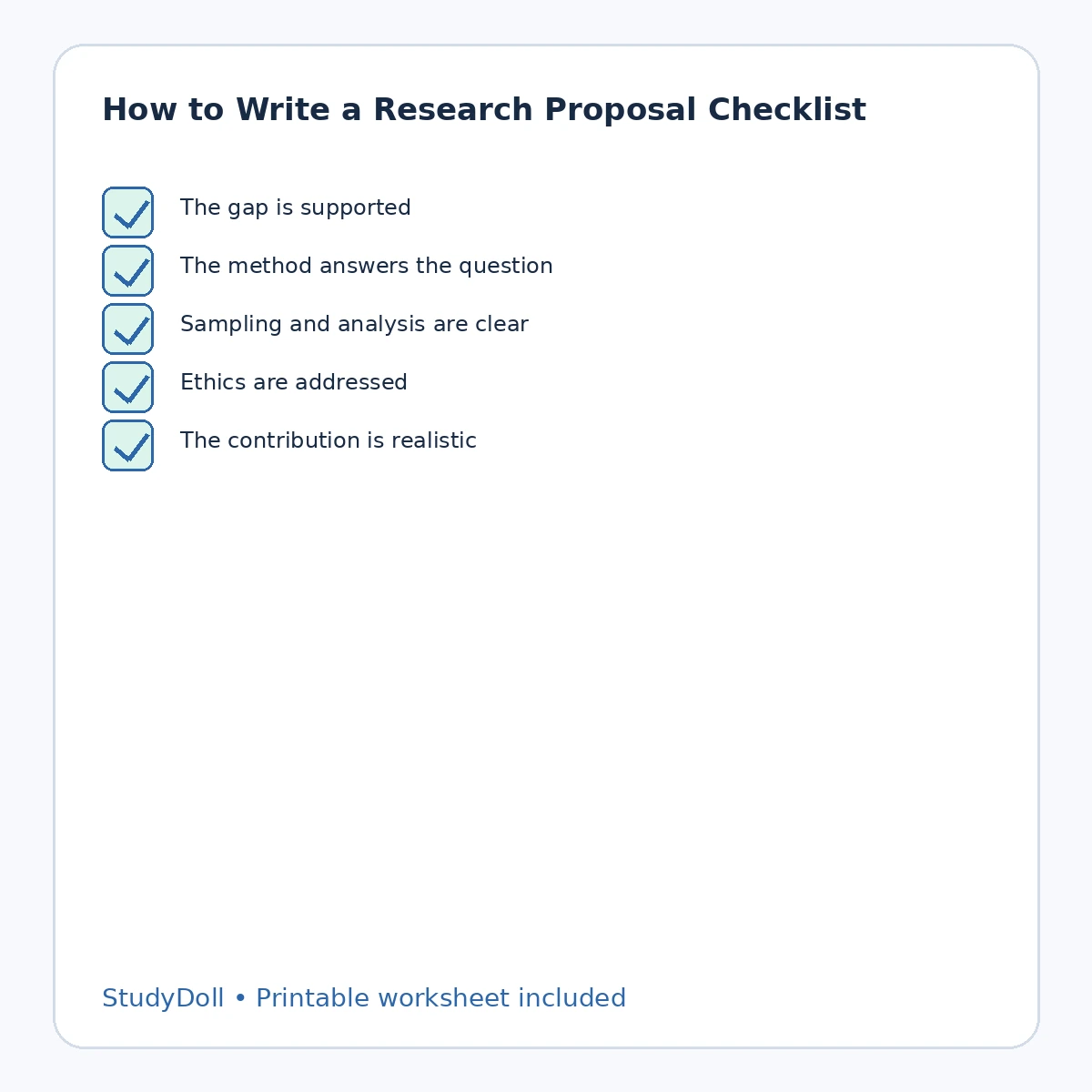
Research proposal checklist
- The problem is focused and evidenced.
- The literature review supports a specific gap.
- The research question aligns with the method.
- Participants, sampling, and setting are clear.
- Data collection and analysis are feasible.
- Ethics and privacy are addressed.
- Limitations match the design.
- The timeline and expected contribution are realistic.
What readers need from this guide
Readers need a complete plan for moving from a documented evidence gap to a focused question, aligned method, ethical protections, feasible timeline, and appropriately limited contribution.
A complete authority page should answer the central question early, then guide readers through planning, research, organization, drafting, source integration, revision, and submission. Examples must demonstrate decisions rather than provide material to copy.
Four decisions to make before drafting
| Decision | What to consider |
|---|---|
| Gap | What exact uncertainty or underrepresented context remains? |
| Question-method fit | What evidence would answer the question? |
| Feasibility | Can participants, data, time, and resources be obtained? |
| Ethics | What risks, privacy issues, and approvals apply? |
Write down each choice and explain why it fits the assignment. Many writing problems are unresolved research or scope decisions disguised as sentence problems.
Weak and improved approaches
| Weak approach | Improved direction |
|---|---|
| I will study student hunger. | The study will examine how evening service hours shape access to emergency food support. |
| I will interview many students. | The proposal will recruit approximately fifteen eligible evening students using stated criteria. |
| The study will prove the program should change. | The study will describe access barriers and inform later program evaluation. |
The improved examples are not sentences to copy. They demonstrate narrower scope, stronger source use, clearer analytical relationships, and more credible qualification.
Source-management workflow
Create a source log with the full citation, source type, key claim, method or authority, relevant page numbers, limitations, and intended use. Mark exact copied wording immediately with quotation marks.
Organize notes by themes, questions, methods, or findings rather than by article. This makes synthesis easier and prevents a paper where every paragraph reports a different source.
Use a reference manager when appropriate, but verify its output. Automated tools can misread capitalization, dates, authors, report numbers, and webpage details.
Paragraph workshop
Every paragraph should answer one question. It may define a concept, compare studies, explain a method, analyze evidence, identify a gap, or develop a recommendation. A paragraph should not become a storage place for loosely related citations.
Use claim, evidence, synthesis, analysis, and connection. The exact sequence can vary, but readers should understand why the evidence appears and how it changes the central answer.
Read only the topic sentences and paragraph endings. Together, they should create a compressed version of the paper’s reasoning.
Using AI responsibly in research writing
AI may help generate search terms, organize notes you provide, identify repetition, or suggest revision questions. It should not invent sources, quotations, findings, DOIs, data, or research participants. Open and verify every source independently.
Follow the institution’s rules on AI use and disclosure. Do not submit confidential, proprietary, clinical, or personally identifying data to an external tool without authorization.
The final writer remains responsible for factual accuracy, citation, argument, and compliance with the assignment.
Practice topics and questions
- How do evening students access campus food support?
- How do nurses experience a new documentation workflow?
- What predicts use of tutoring among first-year online students?
- How does a transit-pass pilot affect class attendance?
- How do small businesses prepare for data breaches?
- How do patients understand telehealth privacy notices?
Test each topic for available evidence, manageable scope, assignment fit, and a meaningful question. A topic identifies a subject; a research question gives the project direction.
Internal-linking plan
- Literature review guide – supports the gap and evidence context
- Research paper guide – helps form the question and evaluate sources
- APA essay format – supports proposal formatting when APA is required
Place links where the reader naturally needs the next guide. Avoid adding unrelated links solely to increase link count. Keep the StudyDoll order link in a clearly labeled support section.
On-page quality, accessibility, and SEO
Use one H1, descriptive H2 and H3 headings, a working table of contents, readable paragraphs, descriptive links, and correctly marked table headers. Keep keyword usage natural.
Use a unique SEO title and meta description that match the actual page. Preserve indexed URLs. Add descriptive alt text, compress images, and verify that visual text remains readable on mobile.
Preview the public page after publishing. Confirm the PDF download, internal links, tables, images, and order link. Remove all editor-only notes.
Final research proposal quality questions
- Does the literature justify the exact question?
- Can the proposed method answer that question?
- Is recruitment or data access realistic?
- Are risks, consent, privacy, and storage addressed?
- Does the proposal state what it cannot conclude?
- Could another researcher understand the planned procedure?
Answer each question with evidence from the finished draft. Identify the exact paragraph, source, table, or sentence that demonstrates the standard instead of checking the box automatically.
Expert editorial guidance
- Choose the question before the method.
- Make the gap specific and supported.
- Separate significance from unrealistic promises.
- Describe data collection and analysis concretely.
- Define ethical and feasibility limits early.
Apply these principles during revision rather than inserting them mechanically. The finished research proposal should remain coherent and adapted to the exact assignment.
Efficient start-to-finish workflow
- Problem: Identify the focused condition or uncertainty.
- Review: Synthesize evidence and establish the gap.
- Question: Write an answerable question or hypothesis.
- Design: Align method, participants, data, and analysis.
- Protect: Address ethics, privacy, and permissions.
- Plan: Build timeline, resources, and contingencies.
- Revise: Check question-method-feasibility alignment.
Keep question formation, research, drafting, structural revision, and proofreading distinct when possible. Searching without a focused question creates excess notes; proofreading before structural revision wastes effort on text that may be removed.
Credibility and factual accuracy
Verify every title, author, publication date, quotation, statistic, DOI, URL, and institutional requirement. Distinguish peer-reviewed research, government data, professional guidance, journalism, and opinion because each source type supports different claims.
Do not claim that a source proves more than its method permits. A cross-sectional association is not automatically causal, a small qualitative study does not estimate prevalence, and one institutional case does not establish universal effectiveness.
Submission and file checks
Confirm required file type, naming convention, citation style, page or word limit, title-page requirements, abstract requirements, table and figure rules, and whether appendices count toward length.
Open the final uploaded file before submitting. Keep a copy of exactly what was submitted and the sources used.
Additional research-proposal practice
Select one draft section and identify its purpose, source evidence, analytical contribution, and limitation. Rewrite the section so a reader can understand why each citation appears and how it contributes to the central question.
Then create a claim-evidence table. In the first column, list every major claim. In the second, identify the supporting source or reasoning. In the third, record the limitation or condition. Claims without support require evidence, revision, or removal.
Complete a final integrity check by opening every cited source, verifying the exact claim, and confirming that paraphrases do not preserve distinctive wording or structure too closely. Accuracy and transparent attribution matter more than the number of citations.
Additional research-proposal practice
Select one draft section and identify its purpose, source evidence, analytical contribution, and limitation. Rewrite the section so a reader can understand why each citation appears and how it contributes to the central question.
Then create a claim-evidence table. In the first column, list every major claim. In the second, identify the supporting source or reasoning. In the third, record the limitation or condition. Claims without support require evidence, revision, or removal.
Complete a final integrity check by opening every cited source, verifying the exact claim, and confirming that paraphrases do not preserve distinctive wording or structure too closely. Accuracy and transparent attribution matter more than the number of citations.
Additional research-proposal practice
Select one draft section and identify its purpose, source evidence, analytical contribution, and limitation. Rewrite the section so a reader can understand why each citation appears and how it contributes to the central question.
Then create a claim-evidence table. In the first column, list every major claim. In the second, identify the supporting source or reasoning. In the third, record the limitation or condition. Claims without support require evidence, revision, or removal.
Complete a final integrity check by opening every cited source, verifying the exact claim, and confirming that paraphrases do not preserve distinctive wording or structure too closely. Accuracy and transparent attribution matter more than the number of citations.
Additional research-proposal practice
Select one draft section and identify its purpose, source evidence, analytical contribution, and limitation. Rewrite the section so a reader can understand why each citation appears and how it contributes to the central question.
Then create a claim-evidence table. In the first column, list every major claim. In the second, identify the supporting source or reasoning. In the third, record the limitation or condition. Claims without support require evidence, revision, or removal.
Complete a final integrity check by opening every cited source, verifying the exact claim, and confirming that paraphrases do not preserve distinctive wording or structure too closely. Accuracy and transparent attribution matter more than the number of citations.
Additional research-proposal practice
Select one draft section and identify its purpose, source evidence, analytical contribution, and limitation. Rewrite the section so a reader can understand why each citation appears and how it contributes to the central question.
Then create a claim-evidence table. In the first column, list every major claim. In the second, identify the supporting source or reasoning. In the third, record the limitation or condition. Claims without support require evidence, revision, or removal.
Complete a final integrity check by opening every cited source, verifying the exact claim, and confirming that paraphrases do not preserve distinctive wording or structure too closely. Accuracy and transparent attribution matter more than the number of citations.
Additional research-proposal practice
Select one draft section and identify its purpose, source evidence, analytical contribution, and limitation. Rewrite the section so a reader can understand why each citation appears and how it contributes to the central question.
Then create a claim-evidence table. In the first column, list every major claim. In the second, identify the supporting source or reasoning. In the third, record the limitation or condition. Claims without support require evidence, revision, or removal.
Complete a final integrity check by opening every cited source, verifying the exact claim, and confirming that paraphrases do not preserve distinctive wording or structure too closely. Accuracy and transparent attribution matter more than the number of citations.
Additional research-proposal practice
Select one draft section and identify its purpose, source evidence, analytical contribution, and limitation. Rewrite the section so a reader can understand why each citation appears and how it contributes to the central question.
Then create a claim-evidence table. In the first column, list every major claim. In the second, identify the supporting source or reasoning. In the third, record the limitation or condition. Claims without support require evidence, revision, or removal.
Complete a final integrity check by opening every cited source, verifying the exact claim, and confirming that paraphrases do not preserve distinctive wording or structure too closely. Accuracy and transparent attribution matter more than the number of citations.
Additional research-proposal practice
Select one draft section and identify its purpose, source evidence, analytical contribution, and limitation. Rewrite the section so a reader can understand why each citation appears and how it contributes to the central question.
Then create a claim-evidence table. In the first column, list every major claim. In the second, identify the supporting source or reasoning. In the third, record the limitation or condition. Claims without support require evidence, revision, or removal.
Complete a final integrity check by opening every cited source, verifying the exact claim, and confirming that paraphrases do not preserve distinctive wording or structure too closely. Accuracy and transparent attribution matter more than the number of citations.
Additional research-proposal practice
Select one draft section and identify its purpose, source evidence, analytical contribution, and limitation. Rewrite the section so a reader can understand why each citation appears and how it contributes to the central question.
Then create a claim-evidence table. In the first column, list every major claim. In the second, identify the supporting source or reasoning. In the third, record the limitation or condition. Claims without support require evidence, revision, or removal.
Complete a final integrity check by opening every cited source, verifying the exact claim, and confirming that paraphrases do not preserve distinctive wording or structure too closely. Accuracy and transparent attribution matter more than the number of citations.
Additional research-proposal practice
Select one draft section and identify its purpose, source evidence, analytical contribution, and limitation. Rewrite the section so a reader can understand why each citation appears and how it contributes to the central question.
Then create a claim-evidence table. In the first column, list every major claim. In the second, identify the supporting source or reasoning. In the third, record the limitation or condition. Claims without support require evidence, revision, or removal.
Complete a final integrity check by opening every cited source, verifying the exact claim, and confirming that paraphrases do not preserve distinctive wording or structure too closely. Accuracy and transparent attribution matter more than the number of citations.
Additional research-proposal practice
Select one draft section and identify its purpose, source evidence, analytical contribution, and limitation. Rewrite the section so a reader can understand why each citation appears and how it contributes to the central question.
Then create a claim-evidence table. In the first column, list every major claim. In the second, identify the supporting source or reasoning. In the third, record the limitation or condition. Claims without support require evidence, revision, or removal.
Complete a final integrity check by opening every cited source, verifying the exact claim, and confirming that paraphrases do not preserve distinctive wording or structure too closely. Accuracy and transparent attribution matter more than the number of citations.
Additional research-proposal practice
Select one draft section and identify its purpose, source evidence, analytical contribution, and limitation. Rewrite the section so a reader can understand why each citation appears and how it contributes to the central question.
Then create a claim-evidence table. In the first column, list every major claim. In the second, identify the supporting source or reasoning. In the third, record the limitation or condition. Claims without support require evidence, revision, or removal.
Complete a final integrity check by opening every cited source, verifying the exact claim, and confirming that paraphrases do not preserve distinctive wording or structure too closely. Accuracy and transparent attribution matter more than the number of citations.
Additional research-proposal practice
Select one draft section and identify its purpose, source evidence, analytical contribution, and limitation. Rewrite the section so a reader can understand why each citation appears and how it contributes to the central question.
Then create a claim-evidence table. In the first column, list every major claim. In the second, identify the supporting source or reasoning. In the third, record the limitation or condition. Claims without support require evidence, revision, or removal.
Complete a final integrity check by opening every cited source, verifying the exact claim, and confirming that paraphrases do not preserve distinctive wording or structure too closely. Accuracy and transparent attribution matter more than the number of citations.
Additional research-proposal practice
Select one draft section and identify its purpose, source evidence, analytical contribution, and limitation. Rewrite the section so a reader can understand why each citation appears and how it contributes to the central question.
Then create a claim-evidence table. In the first column, list every major claim. In the second, identify the supporting source or reasoning. In the third, record the limitation or condition. Claims without support require evidence, revision, or removal.
Complete a final integrity check by opening every cited source, verifying the exact claim, and confirming that paraphrases do not preserve distinctive wording or structure too closely. Accuracy and transparent attribution matter more than the number of citations.
Additional research-proposal practice
Select one draft section and identify its purpose, source evidence, analytical contribution, and limitation. Rewrite the section so a reader can understand why each citation appears and how it contributes to the central question.
Then create a claim-evidence table. In the first column, list every major claim. In the second, identify the supporting source or reasoning. In the third, record the limitation or condition. Claims without support require evidence, revision, or removal.
Complete a final integrity check by opening every cited source, verifying the exact claim, and confirming that paraphrases do not preserve distinctive wording or structure too closely. Accuracy and transparent attribution matter more than the number of citations.
Additional research-proposal practice
Select one draft section and identify its purpose, source evidence, analytical contribution, and limitation. Rewrite the section so a reader can understand why each citation appears and how it contributes to the central question.
Then create a claim-evidence table. In the first column, list every major claim. In the second, identify the supporting source or reasoning. In the third, record the limitation or condition. Claims without support require evidence, revision, or removal.
Complete a final integrity check by opening every cited source, verifying the exact claim, and confirming that paraphrases do not preserve distinctive wording or structure too closely. Accuracy and transparent attribution matter more than the number of citations.
Additional research-proposal practice
Select one draft section and identify its purpose, source evidence, analytical contribution, and limitation. Rewrite the section so a reader can understand why each citation appears and how it contributes to the central question.
Then create a claim-evidence table. In the first column, list every major claim. In the second, identify the supporting source or reasoning. In the third, record the limitation or condition. Claims without support require evidence, revision, or removal.
Complete a final integrity check by opening every cited source, verifying the exact claim, and confirming that paraphrases do not preserve distinctive wording or structure too closely. Accuracy and transparent attribution matter more than the number of citations.