Learn how transitions show addition, contrast, cause, effect, qualification, sequence, and synthesis at sentence and paragraph level.
Table of Contents
- What is a transition?
- Core structure
- Step-by-step method
- Worked examples
- Transition categories
- Common mistakes
- How to revise a transition
- Using AI and feedback responsibly
- Common professor comments
- People-first page quality
- Editable planning template
- Frequently asked questions
- Final checklist
- Related StudyDoll guides
- Practice and self-grading
- Efficient workflow
- WordPress publication review
- Practice and self-grading
- Efficient workflow
- WordPress publication review
- Practice and self-grading
- Efficient workflow
- WordPress publication review
- Practice and self-grading
- Efficient workflow
- WordPress publication review
- Practice and self-grading
- Efficient workflow
- WordPress publication review
- Practice and self-grading
- Efficient workflow
- WordPress publication review
- Practice and self-grading
- Efficient workflow
- WordPress publication review
- Practice and self-grading
- Efficient workflow
- WordPress publication review
- Practice and self-grading
- Efficient workflow
- WordPress publication review
- Practice and self-grading
- Efficient workflow
- WordPress publication review
- Practice and self-grading
- Efficient workflow
- WordPress publication review
- Practice and self-grading
- Efficient workflow
- WordPress publication review
- Practice and self-grading
- Efficient workflow
- WordPress publication review
- Practice and self-grading
- Efficient workflow
- WordPress publication review
- Practice and self-grading
- Efficient workflow
- WordPress publication review
- Practice and self-grading
- Efficient workflow
- WordPress publication review
- Practice and self-grading
- Efficient workflow
- WordPress publication review
- Practice and self-grading
- Efficient workflow
- WordPress publication review
- Practice and self-grading
- Efficient workflow
- WordPress publication review
- Practice and self-grading
- Efficient workflow
- WordPress publication review
What is a transition?
Transition words and phrases make relationships between ideas visible, including addition, contrast, cause, result, example, qualification, sequence, and synthesis.
Use the complete essay guide, essay outline guide, and thesis statement guide when planning the full paper.
Core structure
| Part | Purpose |
|---|---|
| Relationship | Names addition, contrast, cause, or another connection |
| Scale | Works within a sentence, between paragraphs, or between sections |
| Concept | May name both ideas instead of using one connector |
| Punctuation | Matches the sentence structure |
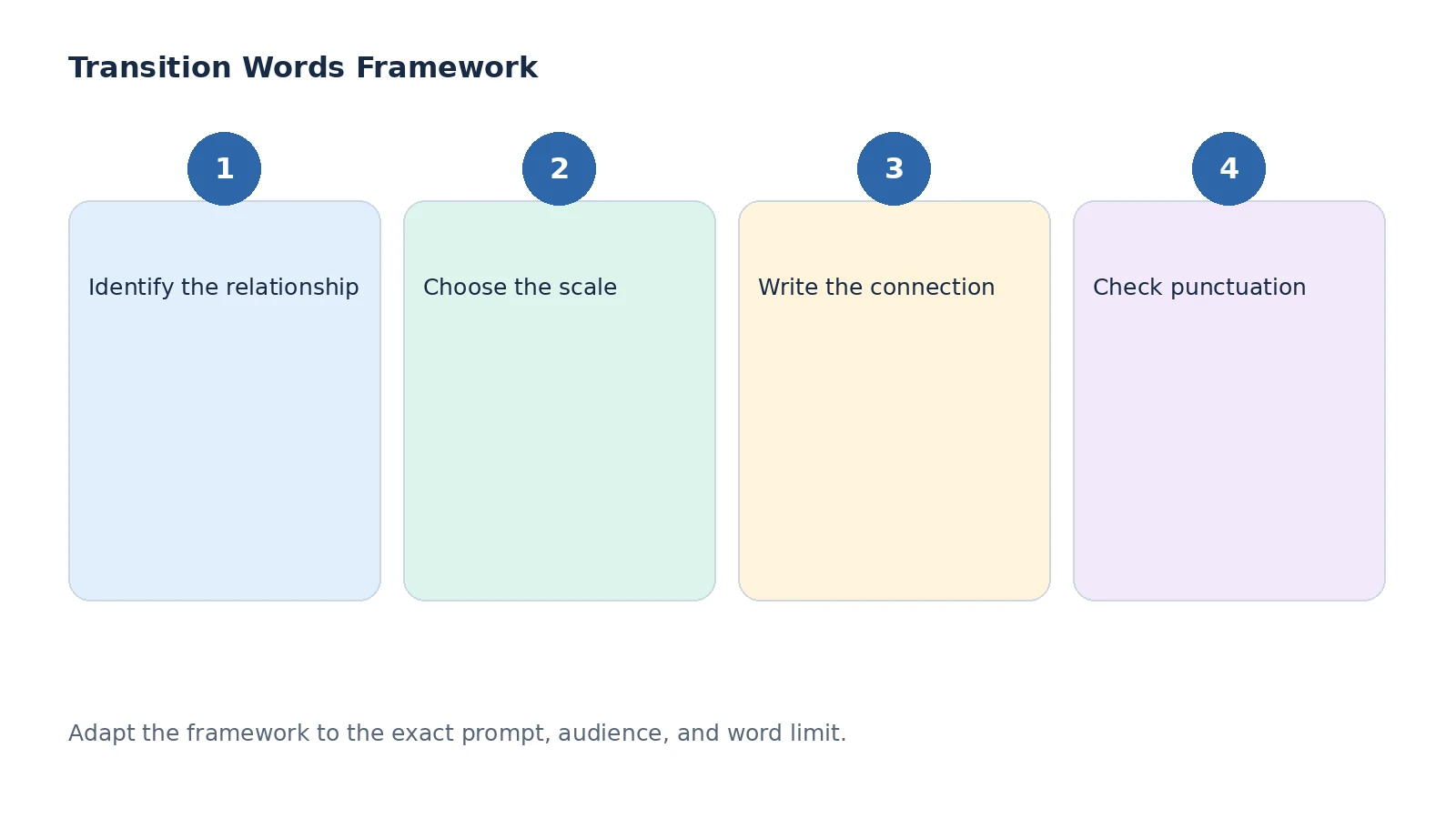
Step-by-step method
1. Identify the relationship
Decide whether the next idea adds, contrasts, causes, qualifies, or synthesizes.
2. Check organization
Make sure the paragraph order is logical before adding words.
3. Choose the scale
Use a connector for a local move or a conceptual sentence for a major shift.
4. Write the connection
Name the ideas when one word is too vague.
5. Check punctuation
Identify independent and dependent clauses.
Worked examples
Weak
Also, another issue is cost.
Improved
Access may improve under the proposal, but cost determines whether the service can be sustained.
Weak
Therefore, the character is afraid.
Improved
Because the final door remains open, the narrator’s continued hesitation shifts the obstacle from confinement to fear.
Conceptual transition
Scheduling control favors recorded delivery, but the need for immediate clarification shifts the comparison toward live instruction.
Transition categories
| Relationship | Examples |
|---|---|
| Addition | also, furthermore, in addition |
| Contrast | however, whereas, by contrast |
| Cause | because, since, through |
| Effect | therefore, consequently, as a result |
| Example | for example, specifically |
| Qualification | although, under these conditions |
| Sequence | first, next, after, finally |
| Synthesis | taken together, viewed alongside |
Common mistakes
Using however repeatedly
Vary language and use conceptual transitions.
Choosing the wrong relationship
Do not use therefore when no result exists.
Starting every paragraph with a connector
Use claim-based topic sentences.
Adding transitions to weak organization
Fix the outline first.
Using first and second without sequence
Number only when order matters.
Need personalized writing support?
Submit the complete prompt, rubric, required sources, citation style, and deadline through the StudyDoll order page. Use support according to your institution’s academic-integrity rules and review the final work carefully.
How to revise a transition
Revise purpose and structure before proofreading. Compare the section with the prompt and thesis, identify the job of every paragraph, and remove material that does not advance the paper.
Read the section beside what comes before and after it. The connection should be visible. Add explanation where readers would otherwise need to infer why a detail matters.
Then edit for specificity, concision, grammar, citation, and formatting. Read aloud and complete one final proof after the complete document layout is stable.
Using AI and feedback responsibly
AI may help generate revision questions, identify repetition, or organize material you provide. It should not invent sources, quotations, experiences, data, grades, or instructor requirements. Follow the institution’s policy and verify every factual claim.
Ask reviewers where they became confused, what they understood the main point to be, and which sentences felt repetitive. Keep ownership of every final change.
Common professor comments
Too broad: narrow the subject, population, time, or claim. Needs analysis: explain how the evidence supports the point. Weak transition: name the actual logical relationship. Repetitive: keep the strongest version and use the saved space for development.
People-first page quality
Answer the main question early, use descriptive headings, provide original examples, connect readers to relevant internal resources, and add visuals only when they teach. Keep titles and descriptions accurate rather than sensational.
Use meaningful alt text, preserve stable URLs, check mobile readability, and verify that every link and downloadable resource works. Remove editor-only notes before publishing.
Editable planning template
Prompt or paragraph question:
Working thesis:
Section purpose:
Necessary evidence or context:
Main analytical move:
Transition or final connection:
Revision priority:
Download the free transition words planning worksheet (PDF)
Frequently asked questions
Can I use but in academic writing?
Yes. Clear ordinary conjunctions are often best.
Can a paragraph begin with However?
Yes when the contrast and punctuation are correct.
How many transitions should I use?
Use enough for clarity, not a fixed number.
What is a conceptual transition?
It names the ideas and their relationship.
Can transitions fix organization?
They clarify sound organization but cannot repair a weak sequence.
Final checklist
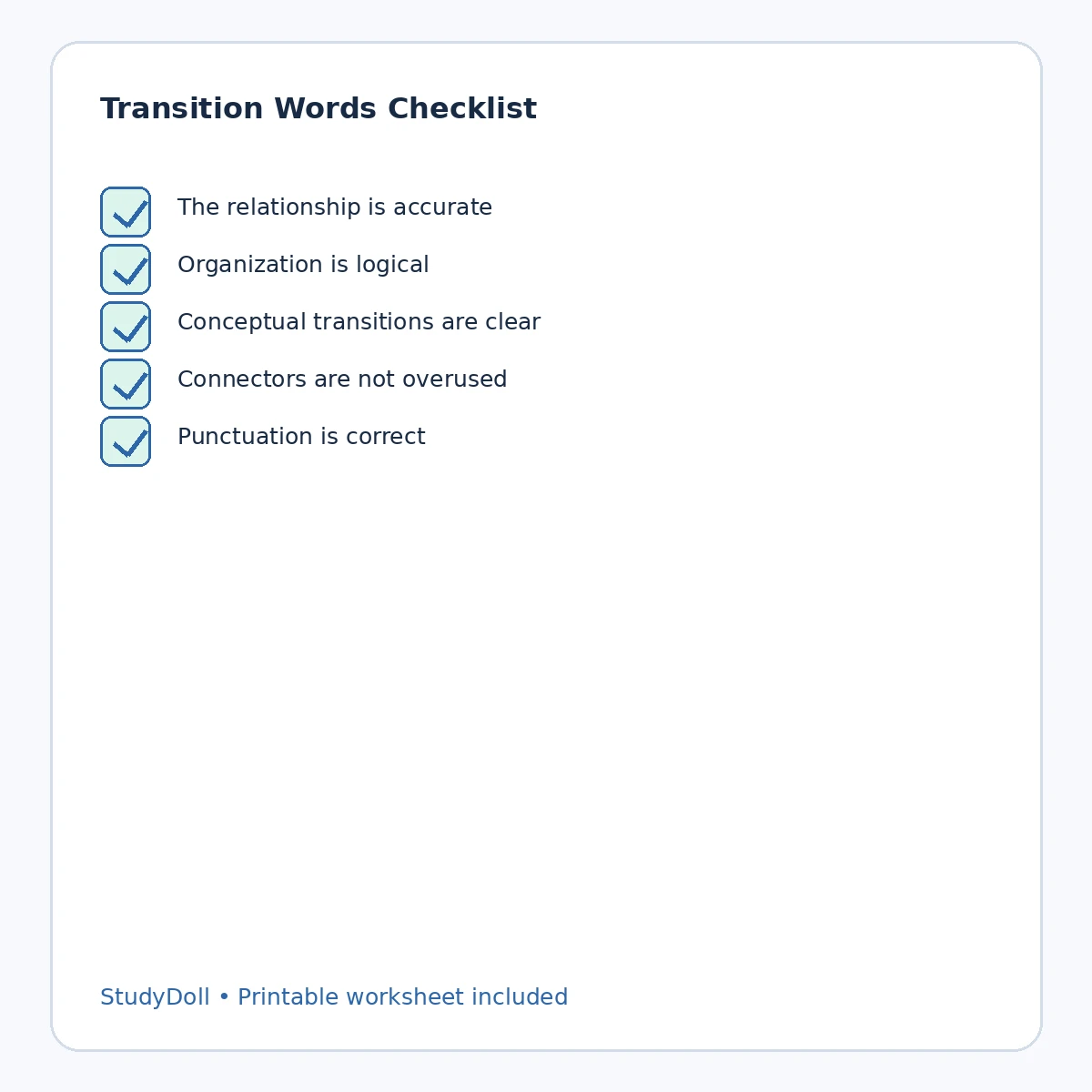
- The relationship is accurate
- The connector fits
- Paragraph order is logical
- Conceptual transitions appear at major shifts
- No word is overused
- Punctuation is correct
- Transitions do not replace analysis
- The prose sounds natural
Related StudyDoll guides
- Body paragraphs — shows where transitions support development
- Essay outline — helps fix organization
- Essay conclusion — uses synthesis transitions
Practice and self-grading
Choose one paragraph from an earlier paper and label the function of every sentence. Mark opening, context, claim, evidence, analysis, qualification, transition, and repetition. Revise sentences whose function is unclear.
Write the same function for a different topic. This transfer exercise shows whether the skill can adapt beyond one memorized template.
| Criterion | Developing | Strong |
|---|---|---|
| Purpose | The section names a topic | The section performs one clear job |
| Development | Details appear without explanation | Evidence and examples are interpreted |
| Coherence | Connections are implied | Relationships are named accurately |
| Specificity | Language is broad | Claims define subject, condition, and significance |
Efficient workflow
- Decode the prompt and task verb.
- Write the focused question and working answer.
- Plan the section’s exact purpose.
- Draft without polishing every sentence.
- Reverse-outline and strengthen explanation.
- Proofread and verify requirements.
WordPress publication review
Check the H1, slug, SEO title, meta description, table of contents, images, alt text, PDF link, internal links, and order link. Preview desktop and mobile, then open the public URL after publication.
Practice and self-grading
Choose one paragraph from an earlier paper and label the function of every sentence. Mark opening, context, claim, evidence, analysis, qualification, transition, and repetition. Revise sentences whose function is unclear.
Write the same function for a different topic. This transfer exercise shows whether the skill can adapt beyond one memorized template.
| Criterion | Developing | Strong |
|---|---|---|
| Purpose | The section names a topic | The section performs one clear job |
| Development | Details appear without explanation | Evidence and examples are interpreted |
| Coherence | Connections are implied | Relationships are named accurately |
| Specificity | Language is broad | Claims define subject, condition, and significance |
Efficient workflow
- Decode the prompt and task verb.
- Write the focused question and working answer.
- Plan the section’s exact purpose.
- Draft without polishing every sentence.
- Reverse-outline and strengthen explanation.
- Proofread and verify requirements.
WordPress publication review
Check the H1, slug, SEO title, meta description, table of contents, images, alt text, PDF link, internal links, and order link. Preview desktop and mobile, then open the public URL after publication.
Practice and self-grading
Choose one paragraph from an earlier paper and label the function of every sentence. Mark opening, context, claim, evidence, analysis, qualification, transition, and repetition. Revise sentences whose function is unclear.
Write the same function for a different topic. This transfer exercise shows whether the skill can adapt beyond one memorized template.
| Criterion | Developing | Strong |
|---|---|---|
| Purpose | The section names a topic | The section performs one clear job |
| Development | Details appear without explanation | Evidence and examples are interpreted |
| Coherence | Connections are implied | Relationships are named accurately |
| Specificity | Language is broad | Claims define subject, condition, and significance |
Efficient workflow
- Decode the prompt and task verb.
- Write the focused question and working answer.
- Plan the section’s exact purpose.
- Draft without polishing every sentence.
- Reverse-outline and strengthen explanation.
- Proofread and verify requirements.
WordPress publication review
Check the H1, slug, SEO title, meta description, table of contents, images, alt text, PDF link, internal links, and order link. Preview desktop and mobile, then open the public URL after publication.
Practice and self-grading
Choose one paragraph from an earlier paper and label the function of every sentence. Mark opening, context, claim, evidence, analysis, qualification, transition, and repetition. Revise sentences whose function is unclear.
Write the same function for a different topic. This transfer exercise shows whether the skill can adapt beyond one memorized template.
| Criterion | Developing | Strong |
|---|---|---|
| Purpose | The section names a topic | The section performs one clear job |
| Development | Details appear without explanation | Evidence and examples are interpreted |
| Coherence | Connections are implied | Relationships are named accurately |
| Specificity | Language is broad | Claims define subject, condition, and significance |
Efficient workflow
- Decode the prompt and task verb.
- Write the focused question and working answer.
- Plan the section’s exact purpose.
- Draft without polishing every sentence.
- Reverse-outline and strengthen explanation.
- Proofread and verify requirements.
WordPress publication review
Check the H1, slug, SEO title, meta description, table of contents, images, alt text, PDF link, internal links, and order link. Preview desktop and mobile, then open the public URL after publication.
Practice and self-grading
Choose one paragraph from an earlier paper and label the function of every sentence. Mark opening, context, claim, evidence, analysis, qualification, transition, and repetition. Revise sentences whose function is unclear.
Write the same function for a different topic. This transfer exercise shows whether the skill can adapt beyond one memorized template.
| Criterion | Developing | Strong |
|---|---|---|
| Purpose | The section names a topic | The section performs one clear job |
| Development | Details appear without explanation | Evidence and examples are interpreted |
| Coherence | Connections are implied | Relationships are named accurately |
| Specificity | Language is broad | Claims define subject, condition, and significance |
Efficient workflow
- Decode the prompt and task verb.
- Write the focused question and working answer.
- Plan the section’s exact purpose.
- Draft without polishing every sentence.
- Reverse-outline and strengthen explanation.
- Proofread and verify requirements.
WordPress publication review
Check the H1, slug, SEO title, meta description, table of contents, images, alt text, PDF link, internal links, and order link. Preview desktop and mobile, then open the public URL after publication.
Practice and self-grading
Choose one paragraph from an earlier paper and label the function of every sentence. Mark opening, context, claim, evidence, analysis, qualification, transition, and repetition. Revise sentences whose function is unclear.
Write the same function for a different topic. This transfer exercise shows whether the skill can adapt beyond one memorized template.
| Criterion | Developing | Strong |
|---|---|---|
| Purpose | The section names a topic | The section performs one clear job |
| Development | Details appear without explanation | Evidence and examples are interpreted |
| Coherence | Connections are implied | Relationships are named accurately |
| Specificity | Language is broad | Claims define subject, condition, and significance |
Efficient workflow
- Decode the prompt and task verb.
- Write the focused question and working answer.
- Plan the section’s exact purpose.
- Draft without polishing every sentence.
- Reverse-outline and strengthen explanation.
- Proofread and verify requirements.
WordPress publication review
Check the H1, slug, SEO title, meta description, table of contents, images, alt text, PDF link, internal links, and order link. Preview desktop and mobile, then open the public URL after publication.
Practice and self-grading
Choose one paragraph from an earlier paper and label the function of every sentence. Mark opening, context, claim, evidence, analysis, qualification, transition, and repetition. Revise sentences whose function is unclear.
Write the same function for a different topic. This transfer exercise shows whether the skill can adapt beyond one memorized template.
| Criterion | Developing | Strong |
|---|---|---|
| Purpose | The section names a topic | The section performs one clear job |
| Development | Details appear without explanation | Evidence and examples are interpreted |
| Coherence | Connections are implied | Relationships are named accurately |
| Specificity | Language is broad | Claims define subject, condition, and significance |
Efficient workflow
- Decode the prompt and task verb.
- Write the focused question and working answer.
- Plan the section’s exact purpose.
- Draft without polishing every sentence.
- Reverse-outline and strengthen explanation.
- Proofread and verify requirements.
WordPress publication review
Check the H1, slug, SEO title, meta description, table of contents, images, alt text, PDF link, internal links, and order link. Preview desktop and mobile, then open the public URL after publication.
Practice and self-grading
Choose one paragraph from an earlier paper and label the function of every sentence. Mark opening, context, claim, evidence, analysis, qualification, transition, and repetition. Revise sentences whose function is unclear.
Write the same function for a different topic. This transfer exercise shows whether the skill can adapt beyond one memorized template.
| Criterion | Developing | Strong |
|---|---|---|
| Purpose | The section names a topic | The section performs one clear job |
| Development | Details appear without explanation | Evidence and examples are interpreted |
| Coherence | Connections are implied | Relationships are named accurately |
| Specificity | Language is broad | Claims define subject, condition, and significance |
Efficient workflow
- Decode the prompt and task verb.
- Write the focused question and working answer.
- Plan the section’s exact purpose.
- Draft without polishing every sentence.
- Reverse-outline and strengthen explanation.
- Proofread and verify requirements.
WordPress publication review
Check the H1, slug, SEO title, meta description, table of contents, images, alt text, PDF link, internal links, and order link. Preview desktop and mobile, then open the public URL after publication.
Practice and self-grading
Choose one paragraph from an earlier paper and label the function of every sentence. Mark opening, context, claim, evidence, analysis, qualification, transition, and repetition. Revise sentences whose function is unclear.
Write the same function for a different topic. This transfer exercise shows whether the skill can adapt beyond one memorized template.
| Criterion | Developing | Strong |
|---|---|---|
| Purpose | The section names a topic | The section performs one clear job |
| Development | Details appear without explanation | Evidence and examples are interpreted |
| Coherence | Connections are implied | Relationships are named accurately |
| Specificity | Language is broad | Claims define subject, condition, and significance |
Efficient workflow
- Decode the prompt and task verb.
- Write the focused question and working answer.
- Plan the section’s exact purpose.
- Draft without polishing every sentence.
- Reverse-outline and strengthen explanation.
- Proofread and verify requirements.
WordPress publication review
Check the H1, slug, SEO title, meta description, table of contents, images, alt text, PDF link, internal links, and order link. Preview desktop and mobile, then open the public URL after publication.
Practice and self-grading
Choose one paragraph from an earlier paper and label the function of every sentence. Mark opening, context, claim, evidence, analysis, qualification, transition, and repetition. Revise sentences whose function is unclear.
Write the same function for a different topic. This transfer exercise shows whether the skill can adapt beyond one memorized template.
| Criterion | Developing | Strong |
|---|---|---|
| Purpose | The section names a topic | The section performs one clear job |
| Development | Details appear without explanation | Evidence and examples are interpreted |
| Coherence | Connections are implied | Relationships are named accurately |
| Specificity | Language is broad | Claims define subject, condition, and significance |
Efficient workflow
- Decode the prompt and task verb.
- Write the focused question and working answer.
- Plan the section’s exact purpose.
- Draft without polishing every sentence.
- Reverse-outline and strengthen explanation.
- Proofread and verify requirements.
WordPress publication review
Check the H1, slug, SEO title, meta description, table of contents, images, alt text, PDF link, internal links, and order link. Preview desktop and mobile, then open the public URL after publication.
Practice and self-grading
Choose one paragraph from an earlier paper and label the function of every sentence. Mark opening, context, claim, evidence, analysis, qualification, transition, and repetition. Revise sentences whose function is unclear.
Write the same function for a different topic. This transfer exercise shows whether the skill can adapt beyond one memorized template.
| Criterion | Developing | Strong |
|---|---|---|
| Purpose | The section names a topic | The section performs one clear job |
| Development | Details appear without explanation | Evidence and examples are interpreted |
| Coherence | Connections are implied | Relationships are named accurately |
| Specificity | Language is broad | Claims define subject, condition, and significance |
Efficient workflow
- Decode the prompt and task verb.
- Write the focused question and working answer.
- Plan the section’s exact purpose.
- Draft without polishing every sentence.
- Reverse-outline and strengthen explanation.
- Proofread and verify requirements.
WordPress publication review
Check the H1, slug, SEO title, meta description, table of contents, images, alt text, PDF link, internal links, and order link. Preview desktop and mobile, then open the public URL after publication.
Practice and self-grading
Choose one paragraph from an earlier paper and label the function of every sentence. Mark opening, context, claim, evidence, analysis, qualification, transition, and repetition. Revise sentences whose function is unclear.
Write the same function for a different topic. This transfer exercise shows whether the skill can adapt beyond one memorized template.
| Criterion | Developing | Strong |
|---|---|---|
| Purpose | The section names a topic | The section performs one clear job |
| Development | Details appear without explanation | Evidence and examples are interpreted |
| Coherence | Connections are implied | Relationships are named accurately |
| Specificity | Language is broad | Claims define subject, condition, and significance |
Efficient workflow
- Decode the prompt and task verb.
- Write the focused question and working answer.
- Plan the section’s exact purpose.
- Draft without polishing every sentence.
- Reverse-outline and strengthen explanation.
- Proofread and verify requirements.
WordPress publication review
Check the H1, slug, SEO title, meta description, table of contents, images, alt text, PDF link, internal links, and order link. Preview desktop and mobile, then open the public URL after publication.
Practice and self-grading
Choose one paragraph from an earlier paper and label the function of every sentence. Mark opening, context, claim, evidence, analysis, qualification, transition, and repetition. Revise sentences whose function is unclear.
Write the same function for a different topic. This transfer exercise shows whether the skill can adapt beyond one memorized template.
| Criterion | Developing | Strong |
|---|---|---|
| Purpose | The section names a topic | The section performs one clear job |
| Development | Details appear without explanation | Evidence and examples are interpreted |
| Coherence | Connections are implied | Relationships are named accurately |
| Specificity | Language is broad | Claims define subject, condition, and significance |
Efficient workflow
- Decode the prompt and task verb.
- Write the focused question and working answer.
- Plan the section’s exact purpose.
- Draft without polishing every sentence.
- Reverse-outline and strengthen explanation.
- Proofread and verify requirements.
WordPress publication review
Check the H1, slug, SEO title, meta description, table of contents, images, alt text, PDF link, internal links, and order link. Preview desktop and mobile, then open the public URL after publication.
Practice and self-grading
Choose one paragraph from an earlier paper and label the function of every sentence. Mark opening, context, claim, evidence, analysis, qualification, transition, and repetition. Revise sentences whose function is unclear.
Write the same function for a different topic. This transfer exercise shows whether the skill can adapt beyond one memorized template.
| Criterion | Developing | Strong |
|---|---|---|
| Purpose | The section names a topic | The section performs one clear job |
| Development | Details appear without explanation | Evidence and examples are interpreted |
| Coherence | Connections are implied | Relationships are named accurately |
| Specificity | Language is broad | Claims define subject, condition, and significance |
Efficient workflow
- Decode the prompt and task verb.
- Write the focused question and working answer.
- Plan the section’s exact purpose.
- Draft without polishing every sentence.
- Reverse-outline and strengthen explanation.
- Proofread and verify requirements.
WordPress publication review
Check the H1, slug, SEO title, meta description, table of contents, images, alt text, PDF link, internal links, and order link. Preview desktop and mobile, then open the public URL after publication.
Practice and self-grading
Choose one paragraph from an earlier paper and label the function of every sentence. Mark opening, context, claim, evidence, analysis, qualification, transition, and repetition. Revise sentences whose function is unclear.
Write the same function for a different topic. This transfer exercise shows whether the skill can adapt beyond one memorized template.
| Criterion | Developing | Strong |
|---|---|---|
| Purpose | The section names a topic | The section performs one clear job |
| Development | Details appear without explanation | Evidence and examples are interpreted |
| Coherence | Connections are implied | Relationships are named accurately |
| Specificity | Language is broad | Claims define subject, condition, and significance |
Efficient workflow
- Decode the prompt and task verb.
- Write the focused question and working answer.
- Plan the section’s exact purpose.
- Draft without polishing every sentence.
- Reverse-outline and strengthen explanation.
- Proofread and verify requirements.
WordPress publication review
Check the H1, slug, SEO title, meta description, table of contents, images, alt text, PDF link, internal links, and order link. Preview desktop and mobile, then open the public URL after publication.
Practice and self-grading
Choose one paragraph from an earlier paper and label the function of every sentence. Mark opening, context, claim, evidence, analysis, qualification, transition, and repetition. Revise sentences whose function is unclear.
Write the same function for a different topic. This transfer exercise shows whether the skill can adapt beyond one memorized template.
| Criterion | Developing | Strong |
|---|---|---|
| Purpose | The section names a topic | The section performs one clear job |
| Development | Details appear without explanation | Evidence and examples are interpreted |
| Coherence | Connections are implied | Relationships are named accurately |
| Specificity | Language is broad | Claims define subject, condition, and significance |
Efficient workflow
- Decode the prompt and task verb.
- Write the focused question and working answer.
- Plan the section’s exact purpose.
- Draft without polishing every sentence.
- Reverse-outline and strengthen explanation.
- Proofread and verify requirements.
WordPress publication review
Check the H1, slug, SEO title, meta description, table of contents, images, alt text, PDF link, internal links, and order link. Preview desktop and mobile, then open the public URL after publication.
Practice and self-grading
Choose one paragraph from an earlier paper and label the function of every sentence. Mark opening, context, claim, evidence, analysis, qualification, transition, and repetition. Revise sentences whose function is unclear.
Write the same function for a different topic. This transfer exercise shows whether the skill can adapt beyond one memorized template.
| Criterion | Developing | Strong |
|---|---|---|
| Purpose | The section names a topic | The section performs one clear job |
| Development | Details appear without explanation | Evidence and examples are interpreted |
| Coherence | Connections are implied | Relationships are named accurately |
| Specificity | Language is broad | Claims define subject, condition, and significance |
Efficient workflow
- Decode the prompt and task verb.
- Write the focused question and working answer.
- Plan the section’s exact purpose.
- Draft without polishing every sentence.
- Reverse-outline and strengthen explanation.
- Proofread and verify requirements.
WordPress publication review
Check the H1, slug, SEO title, meta description, table of contents, images, alt text, PDF link, internal links, and order link. Preview desktop and mobile, then open the public URL after publication.
Practice and self-grading
Choose one paragraph from an earlier paper and label the function of every sentence. Mark opening, context, claim, evidence, analysis, qualification, transition, and repetition. Revise sentences whose function is unclear.
Write the same function for a different topic. This transfer exercise shows whether the skill can adapt beyond one memorized template.
| Criterion | Developing | Strong |
|---|---|---|
| Purpose | The section names a topic | The section performs one clear job |
| Development | Details appear without explanation | Evidence and examples are interpreted |
| Coherence | Connections are implied | Relationships are named accurately |
| Specificity | Language is broad | Claims define subject, condition, and significance |
Efficient workflow
- Decode the prompt and task verb.
- Write the focused question and working answer.
- Plan the section’s exact purpose.
- Draft without polishing every sentence.
- Reverse-outline and strengthen explanation.
- Proofread and verify requirements.
WordPress publication review
Check the H1, slug, SEO title, meta description, table of contents, images, alt text, PDF link, internal links, and order link. Preview desktop and mobile, then open the public URL after publication.
Practice and self-grading
Choose one paragraph from an earlier paper and label the function of every sentence. Mark opening, context, claim, evidence, analysis, qualification, transition, and repetition. Revise sentences whose function is unclear.
Write the same function for a different topic. This transfer exercise shows whether the skill can adapt beyond one memorized template.
| Criterion | Developing | Strong |
|---|---|---|
| Purpose | The section names a topic | The section performs one clear job |
| Development | Details appear without explanation | Evidence and examples are interpreted |
| Coherence | Connections are implied | Relationships are named accurately |
| Specificity | Language is broad | Claims define subject, condition, and significance |
Efficient workflow
- Decode the prompt and task verb.
- Write the focused question and working answer.
- Plan the section’s exact purpose.
- Draft without polishing every sentence.
- Reverse-outline and strengthen explanation.
- Proofread and verify requirements.
WordPress publication review
Check the H1, slug, SEO title, meta description, table of contents, images, alt text, PDF link, internal links, and order link. Preview desktop and mobile, then open the public URL after publication.
Practice and self-grading
Choose one paragraph from an earlier paper and label the function of every sentence. Mark opening, context, claim, evidence, analysis, qualification, transition, and repetition. Revise sentences whose function is unclear.
Write the same function for a different topic. This transfer exercise shows whether the skill can adapt beyond one memorized template.
| Criterion | Developing | Strong |
|---|---|---|
| Purpose | The section names a topic | The section performs one clear job |
| Development | Details appear without explanation | Evidence and examples are interpreted |
| Coherence | Connections are implied | Relationships are named accurately |
| Specificity | Language is broad | Claims define subject, condition, and significance |
Efficient workflow
- Decode the prompt and task verb.
- Write the focused question and working answer.
- Plan the section’s exact purpose.
- Draft without polishing every sentence.
- Reverse-outline and strengthen explanation.
- Proofread and verify requirements.
WordPress publication review
Check the H1, slug, SEO title, meta description, table of contents, images, alt text, PDF link, internal links, and order link. Preview desktop and mobile, then open the public URL after publication.