Learn how to define scope, search and screen studies, build a literature matrix, synthesize themes and methods, identify gaps, and revise a literature review.
Table of Contents
- What is a literature review?
- Types of literature reviews
- 1. Define the review question and scope
- 2. Search transparently
- 3. Build a literature matrix
- 4. Identify patterns and debates
- 5. Write a literature-review thesis
- 6. Literature review structure
- 7. Write synthesis paragraphs
- Mini literature review example
- 8. Identify gaps responsibly
- Common literature review mistakes
- How to revise a literature review
- Literature review planning template
- Frequently asked questions
- Literature review checklist
- What readers need from this guide
- Four decisions to make before drafting
- Weak and improved approaches
- Source-management workflow
- Paragraph workshop
- Using AI responsibly in research writing
- Practice topics and questions
- Internal-linking plan
- On-page quality, accessibility, and SEO
- Final literature review quality questions
- Expert editorial guidance
- Efficient start-to-finish workflow
- Credibility and factual accuracy
- Submission and file checks
- Additional literature-review practice
- Additional literature-review practice
- Additional literature-review practice
- Additional literature-review practice
- Additional literature-review practice
- Additional literature-review practice
- Additional literature-review practice
- Additional literature-review practice
- Additional literature-review practice
- Additional literature-review practice
- Additional literature-review practice
- Additional literature-review practice
- Additional literature-review practice
- Additional literature-review practice
- Additional literature-review practice
- Additional literature-review practice
What is a literature review?
A literature review identifies, evaluates, and synthesizes existing scholarship on a focused question or topic. It explains what researchers have found, how they studied the issue, where they agree or disagree, and what remains uncertain.
It is not an annotated list of articles. The writer organizes the field into patterns, debates, methods, theories, or gaps.
Use the research paper guide for the larger research process and the annotated bibliography guide for source-level evaluation.
Types of literature reviews
| Type | Typical purpose |
|---|---|
| Narrative review | Synthesizes a focused body of literature using a transparent but flexible approach |
| Systematic review | Uses a predefined protocol to locate, select, appraise, and synthesize studies |
| Scoping review | Maps the breadth, concepts, and gaps in a field |
| Integrative review | Combines diverse methods or evidence types |
| Theoretical review | Examines competing frameworks or concepts |
Do not label a review systematic unless the process meets the relevant standards and assignment expectations.
1. Define the review question and scope
Specify population, concept, context, timeframe, discipline, or outcome as needed. A scope that is too broad produces superficial summaries; one that is too narrow may yield too little evidence.
Write inclusion and exclusion criteria before final searching. Record publication dates, source types, languages, populations, and settings that qualify.
2. Search transparently
Identify databases appropriate to the discipline and document key search concepts, synonyms, subject headings, Boolean operators, filters, and search dates. Review reference lists and citation networks when appropriate.
Save search results and remove duplicates. Screening titles and abstracts is more efficient when the criteria are visible.
3. Build a literature matrix
| Field | What to record |
|---|---|
| Citation | Complete reference and identifier |
| Purpose | Research question or objective |
| Method | Design, sample, measures, and analysis |
| Findings | Main results relevant to the review |
| Limitations | Scope, bias, method, or transfer concerns |
| Theme | How the study contributes to synthesis |
4. Identify patterns and debates
Look across studies for recurring findings, contradictions, methodological differences, theoretical perspectives, populations, and missing areas. A theme should be an analytical pattern, not a broad noun.
“Technology” is not a useful theme. “Technology improves access when devices and broadband are available, but design and support determine sustained participation” is.
5. Write a literature-review thesis
Weak thesis
This review discusses research on online student support.
Improved thesis
Research consistently links proactive academic contact with stronger online-student engagement, but variation in definitions, short follow-up periods, and underrepresentation of part-time adult learners limit conclusions about long-term retention.
6. Literature review structure
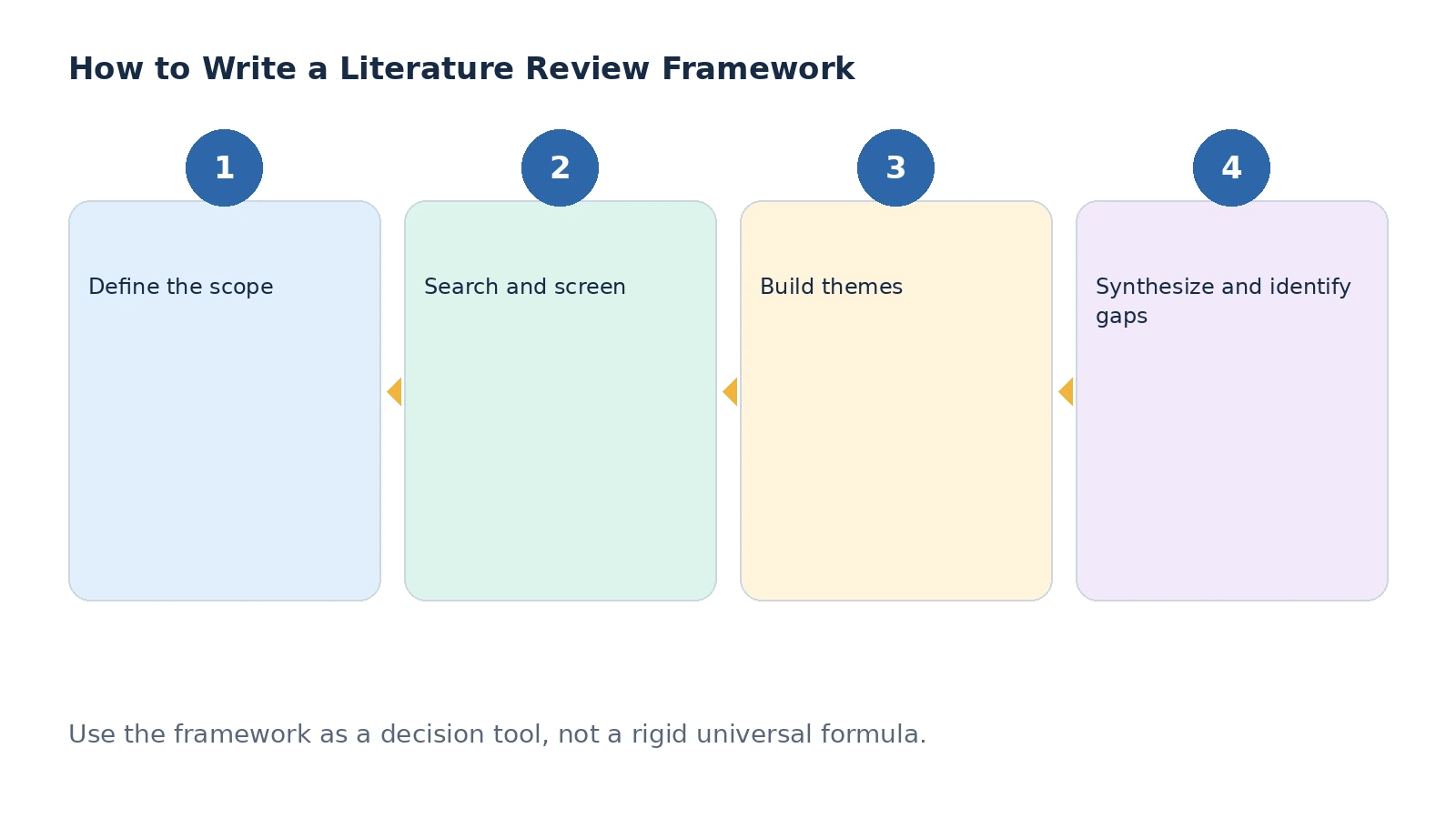
- Introduction and scope.
- Search or selection approach where required.
- Theme one: proactive contact and engagement.
- Theme two: peer connection and belonging.
- Theme three: technology and service access.
- Methodological limitations and underrepresented populations.
- Gap and implications.
- Conclusion.
7. Write synthesis paragraphs
Start with a pattern or claim, bring several studies into conversation, explain differences in findings or methods, and end with the significance for the review question.
Theme claim: Proactive contact reduces the effort required to seek help.
Synthesis: Several studies may report improved engagement after adviser outreach, while others find no long-term retention effect.
Analysis: Differences may reflect intervention intensity, student population, and follow-up length.
Implication: Evidence supports short-term engagement more clearly than long-term completion.
Mini literature review example
Support and Persistence in Online Learning
Research on online-student support generally identifies proactive academic contact, peer connection, and accessible technology as important conditions for engagement. However, inconsistent definitions of support and short follow-up periods make long-term retention effects less certain.
Proactive adviser or instructor contact appears to reduce the effort students must expend to seek help. Studies commonly report improved response, course participation, or service use after targeted outreach. Yet interventions vary from automated reminders to sustained coaching, limiting direct comparison.
Peer connection is also associated with belonging and persistence intentions. Discussion groups and peer mentoring may reduce isolation, but participation is uneven and some designs add communication burden rather than support.
Technology access remains necessary but insufficient. Devices and connectivity enable participation, while course design, digital skills, and technical support shape whether access becomes sustained engagement.
The literature therefore supports multi-part support systems more strongly than single interventions. Future research needs consistent outcome definitions, longer follow-up, and greater representation of part-time adult learners.
8. Identify gaps responsibly
A gap is not simply a topic you did not find. It may involve an underrepresented population, inconsistent measurement, weak method, missing comparison, unresolved contradiction, or limited timeframe.
Explain why the gap matters and what kind of study could address it. Avoid claiming no research exists unless the search was broad and transparent enough to support that statement.
Common literature review mistakes
Writing one paragraph per source
Organize by patterns, debates, methods, or gaps.
Summarizing without evaluation
Explain method, scope, and limitations where relevant.
Calling absence a research gap too quickly
Verify the search and define the exact missing evidence.
Mixing inclusion criteria during screening
Use consistent criteria and document exceptions.
Overstating consensus
Represent disagreement and uncertainty.
Need personalized research-writing support?
Submit the complete prompt, rubric, required sources, citation style, course level, and deadline through the StudyDoll order page. Use all support according to your institution’s academic-integrity requirements and verify every source and citation before submission.
How to revise a literature review
Revise from large decisions to small corrections. First compare the draft with the prompt and rubric. Confirm that the research question, scope, purpose, source requirements, and genre are correct. Remove interesting material that does not help answer the central question.
Create a reverse outline by writing one sentence describing the job of every paragraph. The sequence should reveal a developing explanation, synthesis, or argument rather than a source-by-source list. Merge repeated sections, move misplaced evidence, and add missing analysis before editing sentences.
Next verify source use. Check that every quotation, paraphrase, statistic, and factual claim is represented accurately and cited. Then edit for clarity, concision, transitions, terminology, formatting, and reference consistency. Proofread after the final document format is complete.
Literature review planning template
Review question:
Scope:
Databases:
Search concepts:
Inclusion criteria:
Exclusion criteria:
Themes:
Areas of agreement:
Areas of disagreement:
Methodological limitations:
Research gap:
Overall synthesis:
Download the free literature review planning worksheet (PDF)
Frequently asked questions
How many sources belong in a literature review?
Follow the assignment and scope. The goal is sufficient coverage, not an arbitrary number.
Does a literature review need a thesis?
Yes, it usually needs an overall synthesis of the field.
Can I include older sources?
Yes when they are foundational or historically important, while current evidence should reflect the field’s present state.
What is a literature matrix?
It is a table used to compare purpose, method, findings, limitations, and themes across sources.
What is a research gap?
A specific unresolved issue in evidence, method, theory, population, or context.
Literature review checklist
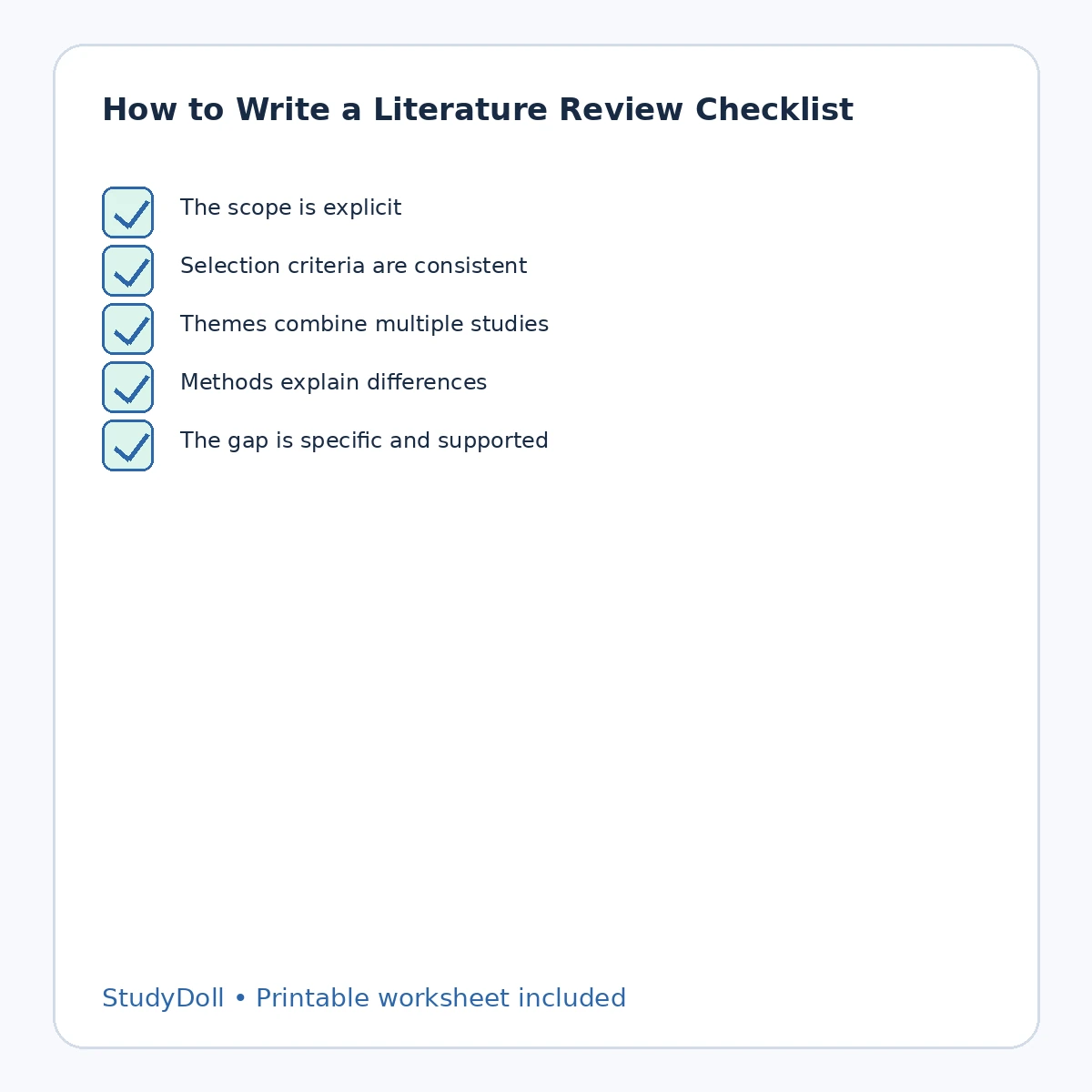
- The review question and scope are clear.
- Search and selection decisions are consistent.
- Sources are evaluated and organized in a matrix.
- Sections synthesize multiple sources.
- Agreements and disagreements are represented.
- Methods and limitations are considered.
- The gap is specific and justified.
- The conclusion gives an overall field-level synthesis.
What readers need from this guide
Readers need help defining scope, searching transparently, building a matrix, identifying themes, writing synthesis paragraphs, evaluating methods, and identifying a defensible research gap.
A complete authority page should answer the central question early, then guide readers through planning, research, organization, drafting, source integration, revision, and submission. Examples must demonstrate decisions rather than provide material to copy.
Four decisions to make before drafting
| Decision | What to consider |
|---|---|
| Scope | Which population, concept, context, and period are included? |
| Selection | Which source types and criteria qualify? |
| Synthesis | Which patterns or debates organize the review? |
| Gap | What specific evidence or method remains unresolved? |
Write down each choice and explain why it fits the assignment. Many writing problems are unresolved research or scope decisions disguised as sentence problems.
Weak and improved approaches
| Weak approach | Improved direction |
|---|---|
| Smith studied support. Jones studied support. | Across studies, proactive contact improves short-term engagement, although intervention intensity and follow-up length vary. |
| There is no research on adult learners. | Adult learners are underrepresented in the selected samples, limiting conclusions for part-time students. |
| All studies agree. | Most studies report improved engagement, while long-term retention findings remain mixed. |
The improved examples are not sentences to copy. They demonstrate narrower scope, stronger source use, clearer analytical relationships, and more credible qualification.
Source-management workflow
Create a source log with the full citation, source type, key claim, method or authority, relevant page numbers, limitations, and intended use. Mark exact copied wording immediately with quotation marks.
Organize notes by themes, questions, methods, or findings rather than by article. This makes synthesis easier and prevents a paper where every paragraph reports a different source.
Use a reference manager when appropriate, but verify its output. Automated tools can misread capitalization, dates, authors, report numbers, and webpage details.
Paragraph workshop
Every paragraph should answer one question. It may define a concept, compare studies, explain a method, analyze evidence, identify a gap, or develop a recommendation. A paragraph should not become a storage place for loosely related citations.
Use claim, evidence, synthesis, analysis, and connection. The exact sequence can vary, but readers should understand why the evidence appears and how it changes the central answer.
Read only the topic sentences and paragraph endings. Together, they should create a compressed version of the paper’s reasoning.
Using AI responsibly in research writing
AI may help generate search terms, organize notes you provide, identify repetition, or suggest revision questions. It should not invent sources, quotations, findings, DOIs, data, or research participants. Open and verify every source independently.
Follow the institution’s rules on AI use and disclosure. Do not submit confidential, proprietary, clinical, or personally identifying data to an external tool without authorization.
The final writer remains responsible for factual accuracy, citation, argument, and compliance with the assignment.
Practice topics and questions
- What support strategies improve online-student engagement?
- How is burnout measured in nursing students?
- What methods are used to study remote-work productivity?
- How does the literature define digital privacy?
- What factors shape telehealth adoption in rural areas?
- How have researchers studied food insecurity among college students?
Test each topic for available evidence, manageable scope, assignment fit, and a meaningful question. A topic identifies a subject; a research question gives the project direction.
Internal-linking plan
- Research paper guide – provides the broader question and evidence workflow
- Annotated bibliography guide – supports source-level evaluation
- Research proposal guide – uses the gap to justify a new study
Place links where the reader naturally needs the next guide. Avoid adding unrelated links solely to increase link count. Keep the StudyDoll order link in a clearly labeled support section.
On-page quality, accessibility, and SEO
Use one H1, descriptive H2 and H3 headings, a working table of contents, readable paragraphs, descriptive links, and correctly marked table headers. Keep keyword usage natural.
Use a unique SEO title and meta description that match the actual page. Preserve indexed URLs. Add descriptive alt text, compress images, and verify that visual text remains readable on mobile.
Preview the public page after publishing. Confirm the PDF download, internal links, tables, images, and order link. Remove all editor-only notes.
Final literature review quality questions
- Does the review synthesize the field rather than summarize sources separately?
- Are inclusion and exclusion decisions consistent?
- Do themes express analytical patterns?
- Are methodological differences used to explain conflicting findings?
- Is the gap specific and supported by the search?
- Does the conclusion state what is known and uncertain?
Answer each question with evidence from the finished draft. Identify the exact paragraph, source, table, or sentence that demonstrates the standard instead of checking the box automatically.
Expert editorial guidance
- Define the review type accurately.
- Use a literature matrix before writing prose.
- Build themes from relationships among studies.
- Distinguish evidence gaps from topic gaps.
- Use cautious language when the search is not systematic.
Apply these principles during revision rather than inserting them mechanically. The finished literature review should remain coherent and adapted to the exact assignment.
Efficient start-to-finish workflow
- Scope: Define the review question and boundaries.
- Search: Document databases, concepts, filters, and dates.
- Screen: Apply inclusion and exclusion criteria.
- Extract: Record method, findings, and limitations.
- Synthesize: Build themes and debates.
- Gap: Identify the specific unresolved issue.
- Revise: Check field-level coherence and citation accuracy.
Keep question formation, research, drafting, structural revision, and proofreading distinct when possible. Searching without a focused question creates excess notes; proofreading before structural revision wastes effort on text that may be removed.
Credibility and factual accuracy
Verify every title, author, publication date, quotation, statistic, DOI, URL, and institutional requirement. Distinguish peer-reviewed research, government data, professional guidance, journalism, and opinion because each source type supports different claims.
Do not claim that a source proves more than its method permits. A cross-sectional association is not automatically causal, a small qualitative study does not estimate prevalence, and one institutional case does not establish universal effectiveness.
Submission and file checks
Confirm required file type, naming convention, citation style, page or word limit, title-page requirements, abstract requirements, table and figure rules, and whether appendices count toward length.
Open the final uploaded file before submitting. Keep a copy of exactly what was submitted and the sources used.
Additional literature-review practice
Select one draft section and identify its purpose, source evidence, analytical contribution, and limitation. Rewrite the section so a reader can understand why each citation appears and how it contributes to the central question.
Then create a claim-evidence table. In the first column, list every major claim. In the second, identify the supporting source or reasoning. In the third, record the limitation or condition. Claims without support require evidence, revision, or removal.
Complete a final integrity check by opening every cited source, verifying the exact claim, and confirming that paraphrases do not preserve distinctive wording or structure too closely. Accuracy and transparent attribution matter more than the number of citations.
Additional literature-review practice
Select one draft section and identify its purpose, source evidence, analytical contribution, and limitation. Rewrite the section so a reader can understand why each citation appears and how it contributes to the central question.
Then create a claim-evidence table. In the first column, list every major claim. In the second, identify the supporting source or reasoning. In the third, record the limitation or condition. Claims without support require evidence, revision, or removal.
Complete a final integrity check by opening every cited source, verifying the exact claim, and confirming that paraphrases do not preserve distinctive wording or structure too closely. Accuracy and transparent attribution matter more than the number of citations.
Additional literature-review practice
Select one draft section and identify its purpose, source evidence, analytical contribution, and limitation. Rewrite the section so a reader can understand why each citation appears and how it contributes to the central question.
Then create a claim-evidence table. In the first column, list every major claim. In the second, identify the supporting source or reasoning. In the third, record the limitation or condition. Claims without support require evidence, revision, or removal.
Complete a final integrity check by opening every cited source, verifying the exact claim, and confirming that paraphrases do not preserve distinctive wording or structure too closely. Accuracy and transparent attribution matter more than the number of citations.
Additional literature-review practice
Select one draft section and identify its purpose, source evidence, analytical contribution, and limitation. Rewrite the section so a reader can understand why each citation appears and how it contributes to the central question.
Then create a claim-evidence table. In the first column, list every major claim. In the second, identify the supporting source or reasoning. In the third, record the limitation or condition. Claims without support require evidence, revision, or removal.
Complete a final integrity check by opening every cited source, verifying the exact claim, and confirming that paraphrases do not preserve distinctive wording or structure too closely. Accuracy and transparent attribution matter more than the number of citations.
Additional literature-review practice
Select one draft section and identify its purpose, source evidence, analytical contribution, and limitation. Rewrite the section so a reader can understand why each citation appears and how it contributes to the central question.
Then create a claim-evidence table. In the first column, list every major claim. In the second, identify the supporting source or reasoning. In the third, record the limitation or condition. Claims without support require evidence, revision, or removal.
Complete a final integrity check by opening every cited source, verifying the exact claim, and confirming that paraphrases do not preserve distinctive wording or structure too closely. Accuracy and transparent attribution matter more than the number of citations.
Additional literature-review practice
Select one draft section and identify its purpose, source evidence, analytical contribution, and limitation. Rewrite the section so a reader can understand why each citation appears and how it contributes to the central question.
Then create a claim-evidence table. In the first column, list every major claim. In the second, identify the supporting source or reasoning. In the third, record the limitation or condition. Claims without support require evidence, revision, or removal.
Complete a final integrity check by opening every cited source, verifying the exact claim, and confirming that paraphrases do not preserve distinctive wording or structure too closely. Accuracy and transparent attribution matter more than the number of citations.
Additional literature-review practice
Select one draft section and identify its purpose, source evidence, analytical contribution, and limitation. Rewrite the section so a reader can understand why each citation appears and how it contributes to the central question.
Then create a claim-evidence table. In the first column, list every major claim. In the second, identify the supporting source or reasoning. In the third, record the limitation or condition. Claims without support require evidence, revision, or removal.
Complete a final integrity check by opening every cited source, verifying the exact claim, and confirming that paraphrases do not preserve distinctive wording or structure too closely. Accuracy and transparent attribution matter more than the number of citations.
Additional literature-review practice
Select one draft section and identify its purpose, source evidence, analytical contribution, and limitation. Rewrite the section so a reader can understand why each citation appears and how it contributes to the central question.
Then create a claim-evidence table. In the first column, list every major claim. In the second, identify the supporting source or reasoning. In the third, record the limitation or condition. Claims without support require evidence, revision, or removal.
Complete a final integrity check by opening every cited source, verifying the exact claim, and confirming that paraphrases do not preserve distinctive wording or structure too closely. Accuracy and transparent attribution matter more than the number of citations.
Additional literature-review practice
Select one draft section and identify its purpose, source evidence, analytical contribution, and limitation. Rewrite the section so a reader can understand why each citation appears and how it contributes to the central question.
Then create a claim-evidence table. In the first column, list every major claim. In the second, identify the supporting source or reasoning. In the third, record the limitation or condition. Claims without support require evidence, revision, or removal.
Complete a final integrity check by opening every cited source, verifying the exact claim, and confirming that paraphrases do not preserve distinctive wording or structure too closely. Accuracy and transparent attribution matter more than the number of citations.
Additional literature-review practice
Select one draft section and identify its purpose, source evidence, analytical contribution, and limitation. Rewrite the section so a reader can understand why each citation appears and how it contributes to the central question.
Then create a claim-evidence table. In the first column, list every major claim. In the second, identify the supporting source or reasoning. In the third, record the limitation or condition. Claims without support require evidence, revision, or removal.
Complete a final integrity check by opening every cited source, verifying the exact claim, and confirming that paraphrases do not preserve distinctive wording or structure too closely. Accuracy and transparent attribution matter more than the number of citations.
Additional literature-review practice
Select one draft section and identify its purpose, source evidence, analytical contribution, and limitation. Rewrite the section so a reader can understand why each citation appears and how it contributes to the central question.
Then create a claim-evidence table. In the first column, list every major claim. In the second, identify the supporting source or reasoning. In the third, record the limitation or condition. Claims without support require evidence, revision, or removal.
Complete a final integrity check by opening every cited source, verifying the exact claim, and confirming that paraphrases do not preserve distinctive wording or structure too closely. Accuracy and transparent attribution matter more than the number of citations.
Additional literature-review practice
Select one draft section and identify its purpose, source evidence, analytical contribution, and limitation. Rewrite the section so a reader can understand why each citation appears and how it contributes to the central question.
Then create a claim-evidence table. In the first column, list every major claim. In the second, identify the supporting source or reasoning. In the third, record the limitation or condition. Claims without support require evidence, revision, or removal.
Complete a final integrity check by opening every cited source, verifying the exact claim, and confirming that paraphrases do not preserve distinctive wording or structure too closely. Accuracy and transparent attribution matter more than the number of citations.
Additional literature-review practice
Select one draft section and identify its purpose, source evidence, analytical contribution, and limitation. Rewrite the section so a reader can understand why each citation appears and how it contributes to the central question.
Then create a claim-evidence table. In the first column, list every major claim. In the second, identify the supporting source or reasoning. In the third, record the limitation or condition. Claims without support require evidence, revision, or removal.
Complete a final integrity check by opening every cited source, verifying the exact claim, and confirming that paraphrases do not preserve distinctive wording or structure too closely. Accuracy and transparent attribution matter more than the number of citations.
Additional literature-review practice
Select one draft section and identify its purpose, source evidence, analytical contribution, and limitation. Rewrite the section so a reader can understand why each citation appears and how it contributes to the central question.
Then create a claim-evidence table. In the first column, list every major claim. In the second, identify the supporting source or reasoning. In the third, record the limitation or condition. Claims without support require evidence, revision, or removal.
Complete a final integrity check by opening every cited source, verifying the exact claim, and confirming that paraphrases do not preserve distinctive wording or structure too closely. Accuracy and transparent attribution matter more than the number of citations.
Additional literature-review practice
Select one draft section and identify its purpose, source evidence, analytical contribution, and limitation. Rewrite the section so a reader can understand why each citation appears and how it contributes to the central question.
Then create a claim-evidence table. In the first column, list every major claim. In the second, identify the supporting source or reasoning. In the third, record the limitation or condition. Claims without support require evidence, revision, or removal.
Complete a final integrity check by opening every cited source, verifying the exact claim, and confirming that paraphrases do not preserve distinctive wording or structure too closely. Accuracy and transparent attribution matter more than the number of citations.
Additional literature-review practice
Select one draft section and identify its purpose, source evidence, analytical contribution, and limitation. Rewrite the section so a reader can understand why each citation appears and how it contributes to the central question.
Then create a claim-evidence table. In the first column, list every major claim. In the second, identify the supporting source or reasoning. In the third, record the limitation or condition. Claims without support require evidence, revision, or removal.
Complete a final integrity check by opening every cited source, verifying the exact claim, and confirming that paraphrases do not preserve distinctive wording or structure too closely. Accuracy and transparent attribution matter more than the number of citations.
📚 How to Write a Literature Review: A Comprehensive Guide
A literature review is more than just a summary of existing research; it’s a critical analysis that showcases your understanding of scholarly work related to your topic. Whether you’re working on a thesis, dissertation, or research paper, mastering the literature review is essential. Let’s delve into the steps to create an effective literature review.
🔍 What is a Literature Review?
A literature review surveys scholarly articles, books, and other sources relevant to a particular area of research. It provides a critical evaluation of these works, identifying trends, gaps, and relationships among studies. This process helps establish a theoretical framework and context for your own research.
🧭 Steps to Writing an Effective Literature Review
1. Define Your Research Question
Begin by clearly articulating your research question or hypothesis. A focused question will guide your literature search and help you stay on track.
2. Conduct a Comprehensive Literature Search
Utilize academic databases like JSTOR, PubMed, and Google Scholar to find relevant sources. Use keywords and boolean operators to refine your search. Keep track of your sources for citation purposes.
3. Evaluate and Select Sources
Not all sources are created equal. Assess the credibility, relevance, and quality of each source. Prioritize peer-reviewed articles and publications from reputable journals.
4. Organize the Literature
Group the literature based on themes, methodologies, or chronological order. This organization will help you identify patterns and relationships among studies.
5. Develop a Thesis or Purpose Statement
Your literature review should have a clear thesis or purpose statement that reflects the scope and direction of your review. This statement will guide the structure of your writing.
6. Write the Literature Review
Begin with an introduction that outlines the purpose and scope of your review. In the body, discuss each theme or category, summarizing and synthesizing the findings. Conclude by highlighting the gaps in the literature and how your research will address them.
7. Revise and Proofread
Review your literature review for coherence, clarity, and conciseness. Ensure proper citation of sources and adherence to the required formatting style (APA, MLA, Chicago, etc.).
📊 Sample Literature Review Structure
| Section | Content Description |
|---|---|
| Introduction | Purpose, scope, and organization of the review |
| Thematic Sections | Grouped discussions of literature based on themes |
| Synthesis | Analysis of patterns, relationships, and gaps in studies |
| Conclusion | Summary of findings and implications for your research |
💡 Tips for a Successful Literature Review
-
Be Critical: Don’t just summarize studies; analyze and critique them.
-
Stay Organized: Use citation management tools like Zotero or EndNote.
-
Be Current: Include the most recent research to ensure relevance.
-
Avoid Plagiarism: Always cite your sources properly.University of Arizona Libraries
📘 Recommended Resources
-
Writing the Literature Review: A Practical Guide by Sara Efrat Efron and Ruth Ravid
-
Conducting Research Literature Reviews by Arlene Fink
-
The Literature Review: Six Steps to Success by Lawrence A. Machi and Brenda T. McEvoy
🚀 Need Assistance with Your Literature Review?
Crafting a literature review can be challenging, but you’re not alone. Our expert writers at StudyDoll.com are here to help you create a compelling and well-structured literature review tailored to your research needs.
👉 Order Your Custom Literature Review Now
Achieve academic excellence with personalized support! 🎓