Learn how to select sources, format citations, summarize findings, evaluate method and credibility, explain relevance, and create consistent annotations.
Table of Contents
- What is an annotated bibliography?
- 1. Decode the annotation requirements
- 2. Select purposeful sources
- 3. Format the citation first
- 4. Annotation structure
- Complete annotation example
- 5. Evaluate credibility and method
- 6. Explain relevance
- 7. Compare sources across annotations
- Common annotated bibliography mistakes
- How to revise a annotated bibliography
- Annotation template
- Frequently asked questions
- Annotated bibliography checklist
- What readers need from this guide
- Four decisions to make before drafting
- Weak and improved approaches
- Source-management workflow
- Paragraph workshop
- Using AI responsibly in research writing
- Practice topics and questions
- Internal-linking plan
- On-page quality, accessibility, and SEO
- Final annotated bibliography quality questions
- Expert editorial guidance
- Efficient start-to-finish workflow
- Credibility and factual accuracy
- Submission and file checks
- Additional annotated-bibliography practice
- Additional annotated-bibliography practice
- Additional annotated-bibliography practice
- Additional annotated-bibliography practice
- Additional annotated-bibliography practice
- Additional annotated-bibliography practice
- Additional annotated-bibliography practice
- Additional annotated-bibliography practice
- Additional annotated-bibliography practice
- Additional annotated-bibliography practice
- Additional annotated-bibliography practice
- Additional annotated-bibliography practice
- Additional annotated-bibliography practice
- Additional annotated-bibliography practice
- Additional annotated-bibliography practice
- Additional annotated-bibliography practice
- Additional annotated-bibliography practice
- Additional annotated-bibliography practice
What is an annotated bibliography?
An annotated bibliography is a list of citations followed by concise annotations that summarize, evaluate, and explain the relevance of each source. It helps a writer understand the evidence base before drafting a paper or literature review.
Requirements vary. Some annotations are descriptive, some evaluative, and some combine summary, assessment, and reflection. Follow the assignment’s required length and citation style.
Use the literature review guide to turn source-level notes into synthesis and the APA format guide when the assignment uses APA Style.
1. Decode the annotation requirements
Record the citation style, number and type of sources, date range, annotation length, paragraph or heading format, and whether the instructor requires summary, credibility, method, bias, limitations, relevance, or comparison.
Do not assume every annotated bibliography uses the same structure.
2. Select purposeful sources
Choose sources that contribute different forms of evidence: foundational theory, recent empirical research, official data, a review article, a contrasting perspective, or a primary document.
A source should be credible and relevant. A famous article may not fit the exact research question.
3. Format the citation first
Create and verify the complete reference entry before writing the annotation. Follow the required style for author order, capitalization, italics, dates, DOI or URL, and hanging indentation.
Do not copy database export formatting without checking it.
4. Annotation structure
| Component | Question |
|---|---|
| Summary | What does the source argue, study, or report? |
| Method or evidence | How was the conclusion produced? |
| Evaluation | What are the source’s strengths and limitations? |
| Relevance | How will the source contribute to the project? |
| Relationship | How does it compare with other sources? |
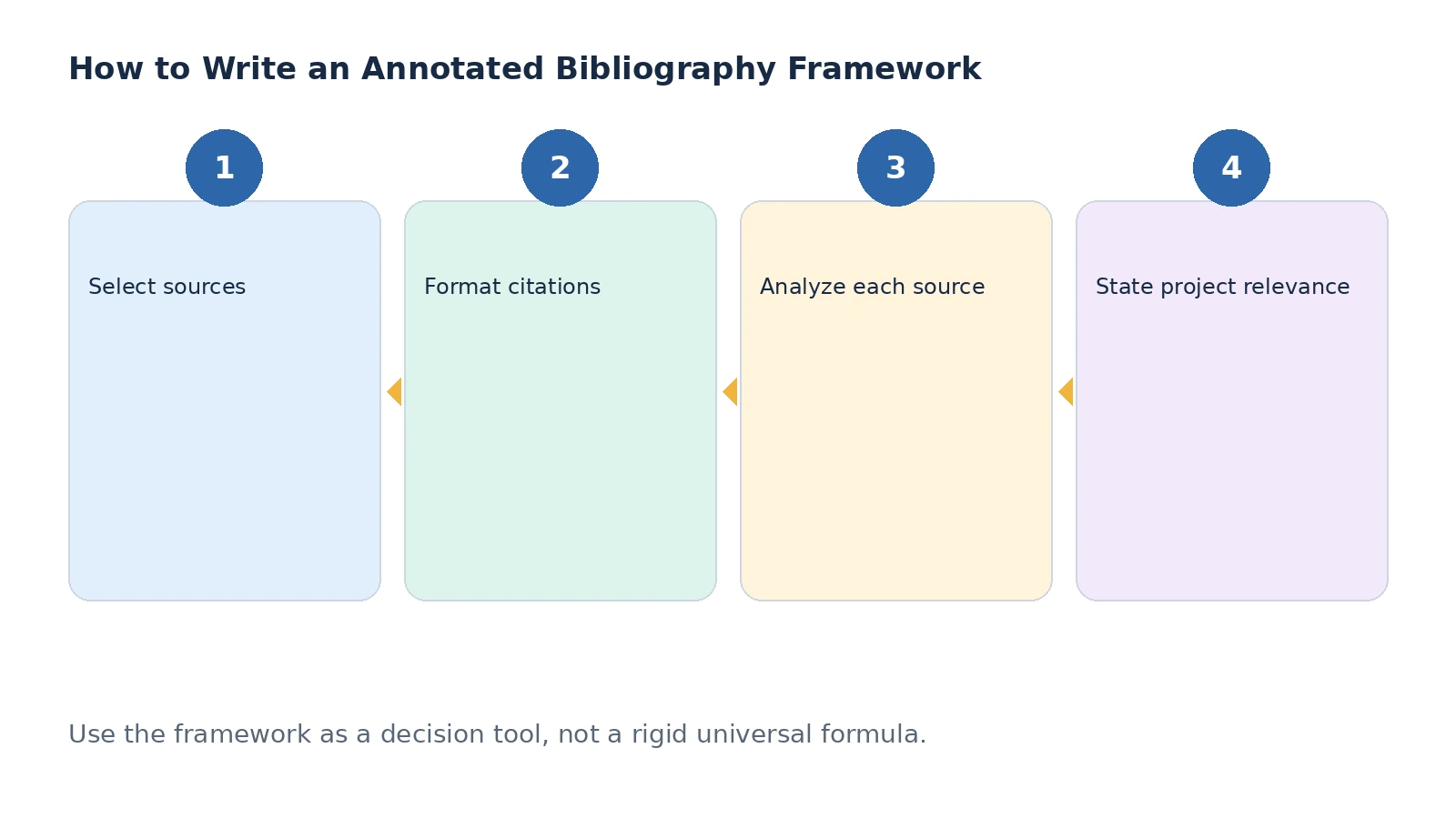
Complete annotation example
Example reference entry in the required citation style.
The study examines how proactive adviser messages influence online students’ use of academic support. Using survey and course-participation data from one institution, the authors report higher short-term service use among students who received targeted contact. The design provides a useful comparison, although the single-institution sample and short follow-up limit conclusions about retention. This source will support the literature-review theme that proactive contact lowers help-seeking barriers while also illustrating the need for longer-term and multi-institution research.
The annotation summarizes purpose and finding, identifies method and limitation, and states how the source will be used.
5. Evaluate credibility and method
Assess the author or organization, publication context, evidence, method, sample, date, purpose, and transparency. Evaluation should be specific. “This source is credible” is less useful than explaining that the study appears in a peer-reviewed journal, uses validated measures, and reports limitations.
Do not dismiss a source simply because it has a limitation. Every source has scope; explain how that scope affects use.
6. Explain relevance
State the exact role the source may play: defining a term, supporting a claim, providing data, explaining a method, offering a counterargument, or identifying a gap.
A relevance statement should refer to the actual project rather than saying the source is “useful.”
7. Compare sources across annotations
When permitted, mention how one source confirms, complicates, or differs from another. These notes create a bridge to the literature review or research paper.
Keep comparisons concise because each annotation must still explain its own source.
Common annotated bibliography mistakes
Writing only a summary
Include evaluation and relevance when required.
Using generic credibility claims
Name the method, authority, evidence, and limitation.
Copying an abstract
Write an original concise account focused on the project.
Forgetting citation formatting
Verify entries and hanging indentation.
Repeating the same relevance sentence
Assign each source a specific role.
Need personalized research-writing support?
Submit the complete prompt, rubric, required sources, citation style, course level, and deadline through the StudyDoll order page. Use all support according to your institution’s academic-integrity requirements and verify every source and citation before submission.
How to revise a annotated bibliography
Revise from large decisions to small corrections. First compare the draft with the prompt and rubric. Confirm that the research question, scope, purpose, source requirements, and genre are correct. Remove interesting material that does not help answer the central question.
Create a reverse outline by writing one sentence describing the job of every paragraph. The sequence should reveal a developing explanation, synthesis, or argument rather than a source-by-source list. Merge repeated sections, move misplaced evidence, and add missing analysis before editing sentences.
Next verify source use. Check that every quotation, paraphrase, statistic, and factual claim is represented accurately and cited. Then edit for clarity, concision, transitions, terminology, formatting, and reference consistency. Proofread after the final document format is complete.
Annotation template
Full citation:

Purpose or research question:
Method or evidence:
Main finding or argument:
Strength:
Limitation:
Relevance to my question:
Relationship to another source:
Download the free annotated bibliography planning worksheet (PDF)
Frequently asked questions
How long should each annotation be?
Follow the assignment. Common lengths vary widely.
Should annotations be in first person?
Follow the instructor’s preference. Relevance can often be stated directly without “I.”
Is an abstract the same as an annotation?
No. An annotation may evaluate and explain relevance, while an abstract usually summarizes the source.
Do I alphabetize entries?
Usually yes according to the required citation style, unless the instructor specifies another organization.
Can I include quotations?
Usually annotations rely on concise paraphrase, though a brief quotation may be used when relevant and permitted.
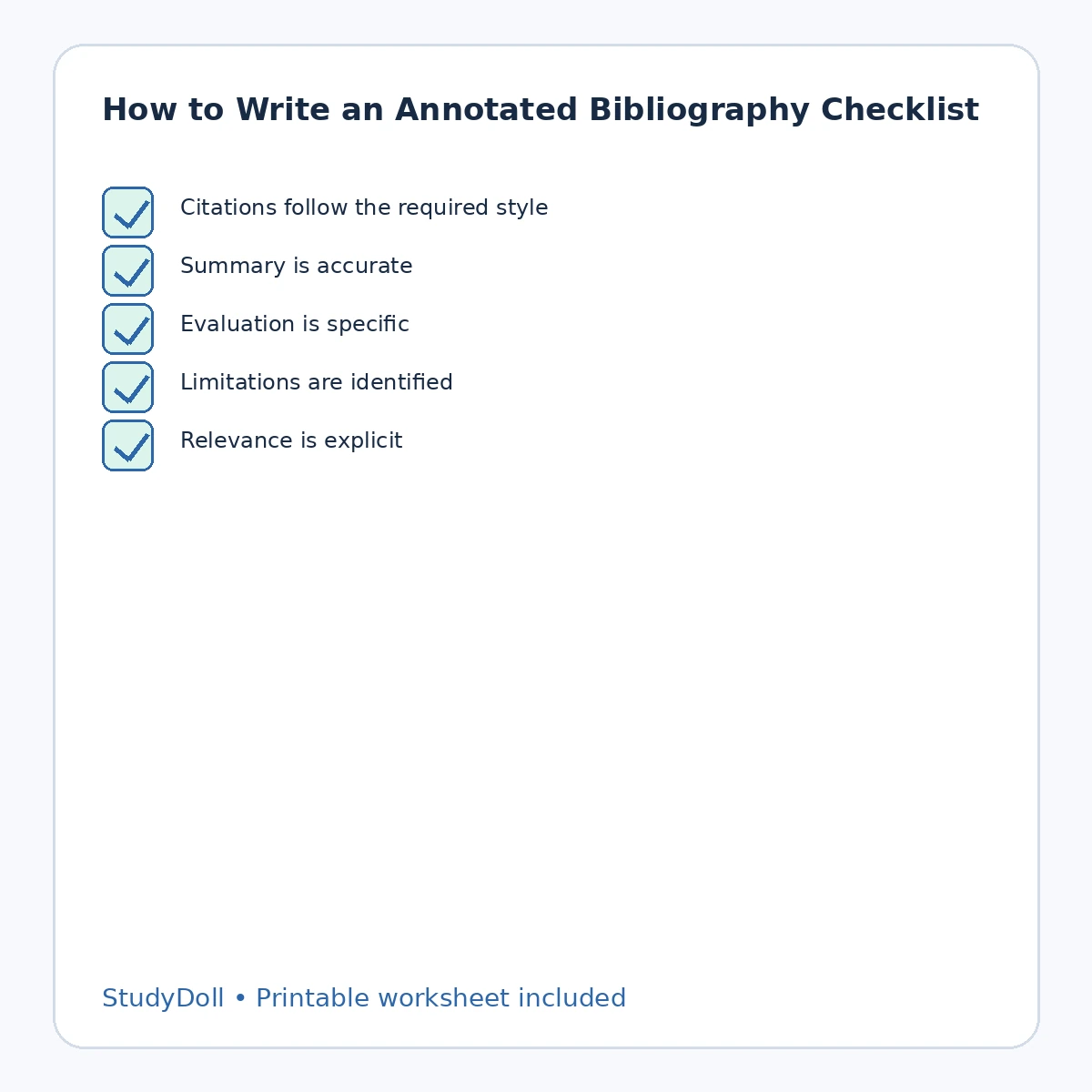
Annotated bibliography checklist
- Every source meets the assignment criteria.
- Citations follow the required style.
- Annotations are original and concise.
- Purpose and main finding are clear.
- Method or evidence is identified.
- Strengths and limitations are specific.
- Relevance to the project is explicit.
- Entries are ordered and formatted consistently.
What readers need from this guide
Readers need help selecting sources, formatting citations, summarizing accurately, evaluating credibility and method, explaining project relevance, and preparing notes that can later support synthesis.
A complete authority page should answer the central question early, then guide readers through planning, research, organization, drafting, source integration, revision, and submission. Examples must demonstrate decisions rather than provide material to copy.
Four decisions to make before drafting
| Decision | What to consider |
|---|---|
| Source role | What unique evidence or perspective does the source add? |
| Annotation type | Does the assignment require summary, evaluation, reflection, or all three? |
| Evaluation | Which method, authority, scope, or limitation matters? |
| Relevance | Where could the source appear in the future paper? |
Write down each choice and explain why it fits the assignment. Many writing problems are unresolved research or scope decisions disguised as sentence problems.
Weak and improved approaches
| Weak approach | Improved direction |
|---|---|
| This is a credible source. | The peer-reviewed study uses validated measures, though its single-institution sample limits transfer. |
| This source will be useful. | The source will support the claim that proactive contact lowers short-term help-seeking barriers. |
| The article talks about online students. | The authors examine targeted adviser messages and course participation among online undergraduates. |
The improved examples are not sentences to copy. They demonstrate narrower scope, stronger source use, clearer analytical relationships, and more credible qualification.
Source-management workflow
Create a source log with the full citation, source type, key claim, method or authority, relevant page numbers, limitations, and intended use. Mark exact copied wording immediately with quotation marks.
Organize notes by themes, questions, methods, or findings rather than by article. This makes synthesis easier and prevents a paper where every paragraph reports a different source.
Use a reference manager when appropriate, but verify its output. Automated tools can misread capitalization, dates, authors, report numbers, and webpage details.
Paragraph workshop
Every paragraph should answer one question. It may define a concept, compare studies, explain a method, analyze evidence, identify a gap, or develop a recommendation. A paragraph should not become a storage place for loosely related citations.
Use claim, evidence, synthesis, analysis, and connection. The exact sequence can vary, but readers should understand why the evidence appears and how it changes the central answer.
Read only the topic sentences and paragraph endings. Together, they should create a compressed version of the paper’s reasoning.
Using AI responsibly in research writing
AI may help generate search terms, organize notes you provide, identify repetition, or suggest revision questions. It should not invent sources, quotations, findings, DOIs, data, or research participants. Open and verify every source independently.
Follow the institution’s rules on AI use and disclosure. Do not submit confidential, proprietary, clinical, or personally identifying data to an external tool without authorization.
The final writer remains responsible for factual accuracy, citation, argument, and compliance with the assignment.
Practice topics and questions
- Build an annotated bibliography on online-student support.
- Evaluate sources about food insecurity on college campuses.
- Compare research on remote work and productivity.
- Annotate sources about rural telehealth access.
- Prepare sources for a policy paper on predictable scheduling.
- Evaluate research on sleep and academic attention.
Test each topic for available evidence, manageable scope, assignment fit, and a meaningful question. A topic identifies a subject; a research question gives the project direction.
Internal-linking plan
- Literature review guide – shows how to synthesize annotation notes
- Research paper guide – uses sources to answer a focused question
- APA essay format – supports APA citations and reference presentation
Place links where the reader naturally needs the next guide. Avoid adding unrelated links solely to increase link count. Keep the StudyDoll order link in a clearly labeled support section.
On-page quality, accessibility, and SEO
Use one H1, descriptive H2 and H3 headings, a working table of contents, readable paragraphs, descriptive links, and correctly marked table headers. Keep keyword usage natural.
Use a unique SEO title and meta description that match the actual page. Preserve indexed URLs. Add descriptive alt text, compress images, and verify that visual text remains readable on mobile.
Preview the public page after publishing. Confirm the PDF download, internal links, tables, images, and order link. Remove all editor-only notes.
Final annotated bibliography quality questions
- Does each annotation do everything the assignment requires?
- Is the summary accurate and written in original language?
- Is the evaluation specific rather than generic?
- Does the relevance statement identify a precise project use?
- Are citations and hanging indents consistent?
- Could the annotations support later synthesis?
Answer each question with evidence from the finished draft. Identify the exact paragraph, source, table, or sentence that demonstrates the standard instead of checking the box automatically.
Expert editorial guidance
- Format and verify the citation before annotating.
- Read beyond the abstract when evaluating a study.
- Name the source's method and scope.
- Give every source a distinct project role.
- Use concise comparison notes to prepare for synthesis.
Apply these principles during revision rather than inserting them mechanically. The finished annotated bibliography should remain coherent and adapted to the exact assignment.
Efficient start-to-finish workflow
- Requirements: Record style, source count, types, and annotation length.
- Search: Find sources that fill purposeful roles.
- Read: Identify question, method, evidence, and conclusion.
- Evaluate: Assess authority, method, scope, and limits.
- Annotate: Summarize, evaluate, and state relevance.
- Format: Apply order, spacing, and hanging indent.
- Verify: Check every reference detail.
Keep question formation, research, drafting, structural revision, and proofreading distinct when possible. Searching without a focused question creates excess notes; proofreading before structural revision wastes effort on text that may be removed.
Credibility and factual accuracy
Verify every title, author, publication date, quotation, statistic, DOI, URL, and institutional requirement. Distinguish peer-reviewed research, government data, professional guidance, journalism, and opinion because each source type supports different claims.
Do not claim that a source proves more than its method permits. A cross-sectional association is not automatically causal, a small qualitative study does not estimate prevalence, and one institutional case does not establish universal effectiveness.
Submission and file checks
Confirm required file type, naming convention, citation style, page or word limit, title-page requirements, abstract requirements, table and figure rules, and whether appendices count toward length.
Open the final uploaded file before submitting. Keep a copy of exactly what was submitted and the sources used.
Additional annotated-bibliography practice
Select one draft section and identify its purpose, source evidence, analytical contribution, and limitation. Rewrite the section so a reader can understand why each citation appears and how it contributes to the central question.
Then create a claim-evidence table. In the first column, list every major claim. In the second, identify the supporting source or reasoning. In the third, record the limitation or condition. Claims without support require evidence, revision, or removal.
Complete a final integrity check by opening every cited source, verifying the exact claim, and confirming that paraphrases do not preserve distinctive wording or structure too closely. Accuracy and transparent attribution matter more than the number of citations.
Additional annotated-bibliography practice
Select one draft section and identify its purpose, source evidence, analytical contribution, and limitation. Rewrite the section so a reader can understand why each citation appears and how it contributes to the central question.
Then create a claim-evidence table. In the first column, list every major claim. In the second, identify the supporting source or reasoning. In the third, record the limitation or condition. Claims without support require evidence, revision, or removal.
Complete a final integrity check by opening every cited source, verifying the exact claim, and confirming that paraphrases do not preserve distinctive wording or structure too closely. Accuracy and transparent attribution matter more than the number of citations.
Additional annotated-bibliography practice
Select one draft section and identify its purpose, source evidence, analytical contribution, and limitation. Rewrite the section so a reader can understand why each citation appears and how it contributes to the central question.
Then create a claim-evidence table. In the first column, list every major claim. In the second, identify the supporting source or reasoning. In the third, record the limitation or condition. Claims without support require evidence, revision, or removal.
Complete a final integrity check by opening every cited source, verifying the exact claim, and confirming that paraphrases do not preserve distinctive wording or structure too closely. Accuracy and transparent attribution matter more than the number of citations.
Additional annotated-bibliography practice
Select one draft section and identify its purpose, source evidence, analytical contribution, and limitation. Rewrite the section so a reader can understand why each citation appears and how it contributes to the central question.
Then create a claim-evidence table. In the first column, list every major claim. In the second, identify the supporting source or reasoning. In the third, record the limitation or condition. Claims without support require evidence, revision, or removal.
Complete a final integrity check by opening every cited source, verifying the exact claim, and confirming that paraphrases do not preserve distinctive wording or structure too closely. Accuracy and transparent attribution matter more than the number of citations.
Additional annotated-bibliography practice
Select one draft section and identify its purpose, source evidence, analytical contribution, and limitation. Rewrite the section so a reader can understand why each citation appears and how it contributes to the central question.
Then create a claim-evidence table. In the first column, list every major claim. In the second, identify the supporting source or reasoning. In the third, record the limitation or condition. Claims without support require evidence, revision, or removal.
Complete a final integrity check by opening every cited source, verifying the exact claim, and confirming that paraphrases do not preserve distinctive wording or structure too closely. Accuracy and transparent attribution matter more than the number of citations.
Additional annotated-bibliography practice
Select one draft section and identify its purpose, source evidence, analytical contribution, and limitation. Rewrite the section so a reader can understand why each citation appears and how it contributes to the central question.
Then create a claim-evidence table. In the first column, list every major claim. In the second, identify the supporting source or reasoning. In the third, record the limitation or condition. Claims without support require evidence, revision, or removal.
Complete a final integrity check by opening every cited source, verifying the exact claim, and confirming that paraphrases do not preserve distinctive wording or structure too closely. Accuracy and transparent attribution matter more than the number of citations.
Additional annotated-bibliography practice
Select one draft section and identify its purpose, source evidence, analytical contribution, and limitation. Rewrite the section so a reader can understand why each citation appears and how it contributes to the central question.
Then create a claim-evidence table. In the first column, list every major claim. In the second, identify the supporting source or reasoning. In the third, record the limitation or condition. Claims without support require evidence, revision, or removal.
Complete a final integrity check by opening every cited source, verifying the exact claim, and confirming that paraphrases do not preserve distinctive wording or structure too closely. Accuracy and transparent attribution matter more than the number of citations.
Additional annotated-bibliography practice
Select one draft section and identify its purpose, source evidence, analytical contribution, and limitation. Rewrite the section so a reader can understand why each citation appears and how it contributes to the central question.
Then create a claim-evidence table. In the first column, list every major claim. In the second, identify the supporting source or reasoning. In the third, record the limitation or condition. Claims without support require evidence, revision, or removal.
Complete a final integrity check by opening every cited source, verifying the exact claim, and confirming that paraphrases do not preserve distinctive wording or structure too closely. Accuracy and transparent attribution matter more than the number of citations.
Additional annotated-bibliography practice
Select one draft section and identify its purpose, source evidence, analytical contribution, and limitation. Rewrite the section so a reader can understand why each citation appears and how it contributes to the central question.
Then create a claim-evidence table. In the first column, list every major claim. In the second, identify the supporting source or reasoning. In the third, record the limitation or condition. Claims without support require evidence, revision, or removal.
Complete a final integrity check by opening every cited source, verifying the exact claim, and confirming that paraphrases do not preserve distinctive wording or structure too closely. Accuracy and transparent attribution matter more than the number of citations.
Additional annotated-bibliography practice
Select one draft section and identify its purpose, source evidence, analytical contribution, and limitation. Rewrite the section so a reader can understand why each citation appears and how it contributes to the central question.
Then create a claim-evidence table. In the first column, list every major claim. In the second, identify the supporting source or reasoning. In the third, record the limitation or condition. Claims without support require evidence, revision, or removal.
Complete a final integrity check by opening every cited source, verifying the exact claim, and confirming that paraphrases do not preserve distinctive wording or structure too closely. Accuracy and transparent attribution matter more than the number of citations.
Additional annotated-bibliography practice
Select one draft section and identify its purpose, source evidence, analytical contribution, and limitation. Rewrite the section so a reader can understand why each citation appears and how it contributes to the central question.
Then create a claim-evidence table. In the first column, list every major claim. In the second, identify the supporting source or reasoning. In the third, record the limitation or condition. Claims without support require evidence, revision, or removal.
Complete a final integrity check by opening every cited source, verifying the exact claim, and confirming that paraphrases do not preserve distinctive wording or structure too closely. Accuracy and transparent attribution matter more than the number of citations.
Additional annotated-bibliography practice
Select one draft section and identify its purpose, source evidence, analytical contribution, and limitation. Rewrite the section so a reader can understand why each citation appears and how it contributes to the central question.
Then create a claim-evidence table. In the first column, list every major claim. In the second, identify the supporting source or reasoning. In the third, record the limitation or condition. Claims without support require evidence, revision, or removal.
Complete a final integrity check by opening every cited source, verifying the exact claim, and confirming that paraphrases do not preserve distinctive wording or structure too closely. Accuracy and transparent attribution matter more than the number of citations.
Additional annotated-bibliography practice
Select one draft section and identify its purpose, source evidence, analytical contribution, and limitation. Rewrite the section so a reader can understand why each citation appears and how it contributes to the central question.
Then create a claim-evidence table. In the first column, list every major claim. In the second, identify the supporting source or reasoning. In the third, record the limitation or condition. Claims without support require evidence, revision, or removal.
Complete a final integrity check by opening every cited source, verifying the exact claim, and confirming that paraphrases do not preserve distinctive wording or structure too closely. Accuracy and transparent attribution matter more than the number of citations.
Additional annotated-bibliography practice
Select one draft section and identify its purpose, source evidence, analytical contribution, and limitation. Rewrite the section so a reader can understand why each citation appears and how it contributes to the central question.
Then create a claim-evidence table. In the first column, list every major claim. In the second, identify the supporting source or reasoning. In the third, record the limitation or condition. Claims without support require evidence, revision, or removal.
Complete a final integrity check by opening every cited source, verifying the exact claim, and confirming that paraphrases do not preserve distinctive wording or structure too closely. Accuracy and transparent attribution matter more than the number of citations.
Additional annotated-bibliography practice
Select one draft section and identify its purpose, source evidence, analytical contribution, and limitation. Rewrite the section so a reader can understand why each citation appears and how it contributes to the central question.
Then create a claim-evidence table. In the first column, list every major claim. In the second, identify the supporting source or reasoning. In the third, record the limitation or condition. Claims without support require evidence, revision, or removal.
Complete a final integrity check by opening every cited source, verifying the exact claim, and confirming that paraphrases do not preserve distinctive wording or structure too closely. Accuracy and transparent attribution matter more than the number of citations.
Additional annotated-bibliography practice
Select one draft section and identify its purpose, source evidence, analytical contribution, and limitation. Rewrite the section so a reader can understand why each citation appears and how it contributes to the central question.
Then create a claim-evidence table. In the first column, list every major claim. In the second, identify the supporting source or reasoning. In the third, record the limitation or condition. Claims without support require evidence, revision, or removal.
Complete a final integrity check by opening every cited source, verifying the exact claim, and confirming that paraphrases do not preserve distinctive wording or structure too closely. Accuracy and transparent attribution matter more than the number of citations.
Additional annotated-bibliography practice
Select one draft section and identify its purpose, source evidence, analytical contribution, and limitation. Rewrite the section so a reader can understand why each citation appears and how it contributes to the central question.
Then create a claim-evidence table. In the first column, list every major claim. In the second, identify the supporting source or reasoning. In the third, record the limitation or condition. Claims without support require evidence, revision, or removal.
Complete a final integrity check by opening every cited source, verifying the exact claim, and confirming that paraphrases do not preserve distinctive wording or structure too closely. Accuracy and transparent attribution matter more than the number of citations.
Additional annotated-bibliography practice
Select one draft section and identify its purpose, source evidence, analytical contribution, and limitation. Rewrite the section so a reader can understand why each citation appears and how it contributes to the central question.
Then create a claim-evidence table. In the first column, list every major claim. In the second, identify the supporting source or reasoning. In the third, record the limitation or condition. Claims without support require evidence, revision, or removal.
Complete a final integrity check by opening every cited source, verifying the exact claim, and confirming that paraphrases do not preserve distinctive wording or structure too closely. Accuracy and transparent attribution matter more than the number of citations.