Learn how to answer multi-part prompts, prove readiness, research program fit, explain credible goals, show contribution, and verify every application detail.
Table of Contents
- What is an admission essay?
- 1. Separate every question in the prompt
- 2. Research the program precisely
- 3. Build a two-way fit argument
- 4. Admission essay structure
- Complete admission essay example
- 5. Present experience as evidence of readiness
- 6. Write credible goals
- Common admission essay mistakes
- How to revise a admission essay
- Editable admission essay template
- Frequently asked questions
- Admission essay checklist
- What readers need from this guide
- Four decisions to make before drafting
- Weak and improved approaches
- Paragraph workshop
- Using AI and outside feedback responsibly
- Practice topics and prompts
- StudyDoll internal-linking plan
- On-page quality and SEO review
- Final admission essay quality questions
- Expert editorial guidance
- An efficient start-to-finish workflow
- Credibility, privacy, and factual accuracy
- Submission and portal checks
- Expert editorial guidance
- An efficient start-to-finish workflow
- Credibility, privacy, and factual accuracy
- Submission and portal checks
- Expert editorial guidance
- An efficient start-to-finish workflow
- Credibility, privacy, and factual accuracy
- Submission and portal checks
- Expert editorial guidance
- An efficient start-to-finish workflow
- Credibility, privacy, and factual accuracy
- Submission and portal checks
- Expert editorial guidance
- An efficient start-to-finish workflow
- Credibility, privacy, and factual accuracy
- Submission and portal checks
- Expert editorial guidance
- An efficient start-to-finish workflow
- Credibility, privacy, and factual accuracy
- Submission and portal checks
What is an admission essay?
An admission essay is an application response used by a college, graduate program, professional school, certificate program, or other institution to understand an applicant’s preparation, motivation, fit, goals, and potential contribution.
Unlike a general college personal essay, many admission essays ask direct questions about why this program, why this field, relevant experience, career goals, or readiness. The response should combine personal evidence with program-specific research.
See the college essay guide for narrative responses and the personal statement guide for graduate and professional applications.
1. Separate every question in the prompt
An admission prompt may contain four tasks in one paragraph. Number them and create a planning note for each. Committees should not need to infer why you are applying or how your background prepares you.
Watch for verbs such as describe, explain, evaluate, discuss, and demonstrate. A prompt asking how you will contribute requires evidence about the community, not only personal goals.
2. Research the program precisely
Use official program pages, curriculum, concentration descriptions, faculty interests, clinical or field opportunities, and stated mission. Verify that every name and feature remains current before submitting.
Do not praise the program with generic language such as prestigious, world-class, or perfect. Explain which specific resources fit the applicant’s preparation and goals.
3. Build a two-way fit argument
| What the program offers | What the applicant brings |
|---|---|
| Relevant curriculum or training | Preparation and a clear reason to use it |
| Research, clinical, or field opportunities | Skills, questions, or experience |
| Program mission or community | Values and potential contribution |
| Career preparation | Realistic goals and next steps |
4. Admission essay structure
- Motivating question, experience, or professional problem.
- Relevant preparation and evidence of readiness.
- Specific program fit.
- Goals and how the program supports them.
- Contribution to the cohort, field, or community.
- Forward-looking conclusion.
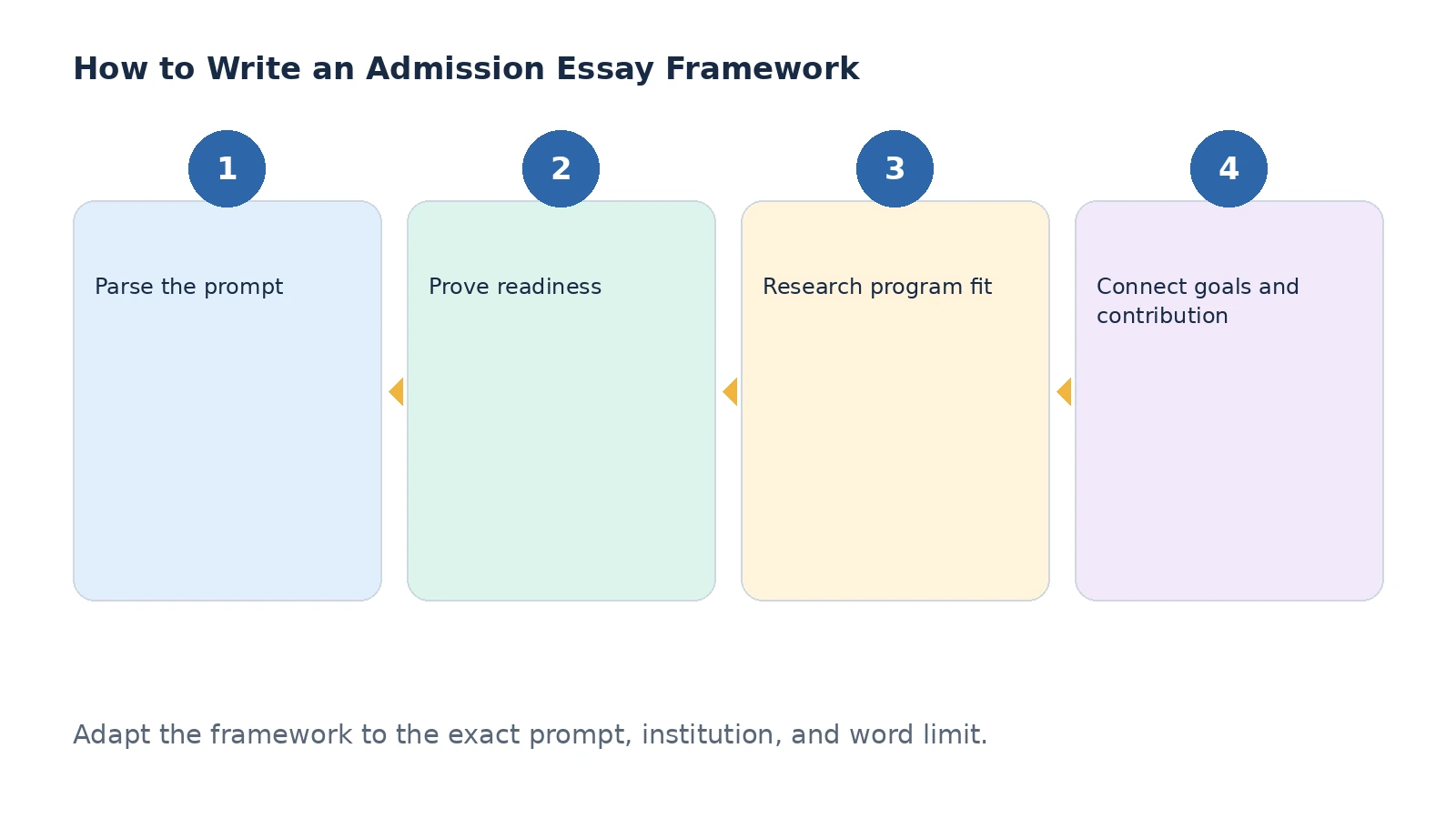
Complete admission essay example
From Records to Care Decisions
During a hospital records review, I noticed that the same patient appeared in three systems with different contact information. The error looked administrative, but it affected follow-up calls and delayed communication. That experience changed my view of health information from documentation after care to infrastructure that shapes care.
My training in health records and experience reviewing patient data have prepared me to understand classification, privacy, workflow, and accuracy. They have also shown me the limits of solving information problems without broader management and policy knowledge.
I am applying to the Master of Healthcare Management program because its coursework in quality improvement, health policy, and organizational leadership connects directly with the problems I want to address. The applied management project is especially relevant because I want to examine how organizations reduce duplicate records while protecting access and privacy.
I would bring experience with frontline information systems and an awareness of how small documentation errors affect staff and patients. In group projects, I can contribute a perspective that connects data quality with daily operations.
My long-term goal is to lead health-information and quality initiatives that make patient data more reliable across services. The program would help me move from identifying record problems to designing organizational responses that improve communication and continuity of care.
5. Present experience as evidence of readiness
Do not list every job or course. Select experiences that show preparation, increasing responsibility, relevant questions, or skills. Explain what you did, what you learned, and why the experience leads logically to the next program.
When discussing a weakness or gap, provide context, action, and current evidence. Avoid excuses or dramatic overexplanation.
6. Write credible goals
Goals should be specific enough to show direction but flexible enough to remain realistic. Explain the kind of work, problem, population, or field you hope to pursue and how the program supports that path.
Avoid promising achievements that no program can guarantee. Admission essays should demonstrate preparation and fit, not certainty about the future.
Common admission essay mistakes
Using one essay for every program
Adapt program fit, curriculum, mission, and goals carefully.
Listing program features
Explain why specific features matter for your preparation and plans.
Repeating the resume
Interpret relevant experiences and show progression.
Making goals too vague or too grand
Name a credible direction and the next professional step.
Ignoring contribution
Explain what perspective or experience you bring to the cohort.
Need personalized writing support?
Submit the complete prompt, rubric or application instructions, word limit, deadline, and any required background through the StudyDoll order page. Use support in accordance with institutional rules and make sure the final submission remains accurate and authentically yours.
How to revise a admission essay
Revise in layers. First confirm that the draft answers the exact prompt and presents the most relevant evidence about the applicant or argument. Remove interesting material that does not serve that purpose.
Next create a reverse outline by describing the job of every paragraph in one sentence. The sequence should reveal development, not a list of accomplishments or repeated claims. Merge overlapping sections and add missing transitions.
Then strengthen specificity. Replace broad claims with scenes, decisions, examples, evidence, or precise language. Finally edit for voice, concision, grammar, word count, formatting, and factual accuracy. Read aloud and obtain feedback from someone who will protect your voice rather than rewrite it into theirs.
Editable admission essay template
Program and exact prompt:
Motivating experience/problem:
Relevant preparation:
Evidence of readiness:
Specific curriculum/resources:
Why those resources matter:
Short-term goal:
Long-term direction:
Contribution to cohort/community:
Final forward-looking connection:
Download the free admission essay planning worksheet (PDF).
Frequently asked questions
Is an admission essay the same as a personal statement?
The terms overlap, but admission essays may ask more specific program questions.
How much program research should I include?
Use enough specific information to demonstrate fit without turning the essay into a catalog.
Can I discuss low grades?
Only when relevant or requested. Be concise, factual, and focused on response and current readiness.
Should I name faculty?
Only when the connection is genuine and current, and the program encourages that level of specificity.
How formal should the tone be?
Professional and clear, while still allowing a personal voice.
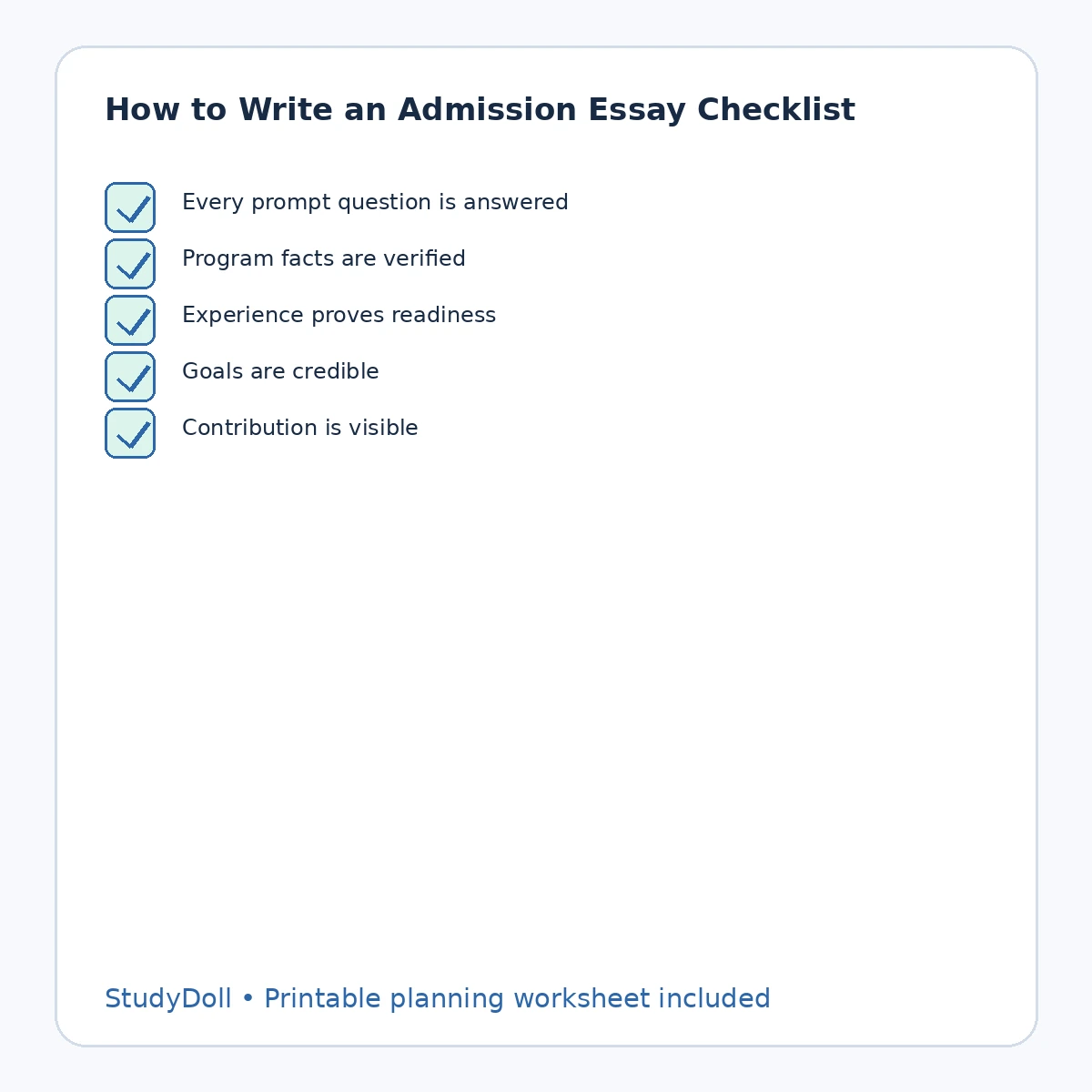
Admission essay checklist
- Every prompt question is answered.
- Experience is interpreted rather than listed.
- Program details are accurate and specific.
- Fit works in both directions.
- Goals are credible and connected to the program.
- The applicant’s contribution is visible.
- The tone is professional and personal.
- Names, dates, word limits, and portal fields are verified.
What readers need from this guide
Readers need help answering multi-part prompts, researching programs accurately, presenting relevant preparation, explaining two-way fit, setting credible goals, and avoiding a generic essay.
A strong authority page should provide the answer near the top, then help readers brainstorm, select, structure, draft, revise, and submit. Examples should demonstrate decisions rather than give language to copy. Worksheets and graphics should add practical value rather than repeat the article.
Four decisions to make before drafting
| Decision | What to consider |
|---|---|
| Prompt coverage | Which paragraph answers each required question? |
| Readiness | Which experiences prove preparation for the program? |
| Program fit | Which verified resources connect with the applicant's goals? |
| Contribution | What perspective, skill, or experience will the applicant bring? |
Write down each decision before drafting. When a paragraph feels difficult, return to this table. The problem is often an unresolved choice about purpose, evidence, audience, or scope rather than a lack of vocabulary.
Weak and improved approaches
| Weak approach | Improved direction |
|---|---|
| Your prestigious program is perfect for me. | The applied quality-improvement project connects directly with my experience identifying duplicate patient records. |
| I have many relevant skills. | Reviewing records across three systems taught me to connect data accuracy with follow-up care. |
| I will transform healthcare. | I want to lead information-quality projects that improve communication across services. |
The improved examples are not formulas. They reveal editorial choices such as narrower focus, stronger evidence, clearer causation, or more credible qualification.
Paragraph workshop
Give each paragraph one clear purpose. A paragraph may establish context, develop a scene, explain growth, connect experience to a future goal, address fit, or present a central reason. It should not attempt all of these at once.
Before drafting, write the question the paragraph will answer. After drafting, underline the sentence that answers it. If no sentence does, revise the paragraph’s focus. Read topic sentences in sequence to confirm that the paper develops rather than repeats.
Use paragraph endings to interpret. Do not end immediately after an example. Explain what the event, evidence, or detail reveals and how it advances the central idea.
Using AI and outside feedback responsibly
AI can help brainstorm questions, organize notes, identify repetition, or suggest revision questions. It should not invent experiences, awards, hardships, research findings, or institutional facts. For application writing, the final voice and claims must remain authentic to the applicant.
Do not paste confidential personal information into tools without understanding their privacy practices. Verify all dates, program names, requirements, and factual claims. Follow the relevant institution’s rules about AI-assisted writing and disclosure.
Ask human reviewers to describe their reading experience: where attention dropped, what quality they saw, which transition felt abrupt, or what remained unclear. A reviewer who rewrites every sentence may erase the applicant’s voice.
Practice topics and prompts
- Explain how a professional problem shaped your decision to apply.
- Describe preparation for advanced study in the field.
- Explain why this program's curriculum fits your goals.
- Discuss a weakness and evidence of current readiness.
- Describe what you will contribute to a cohort.
- Explain a realistic five-year professional direction.
Use practice prompts to develop material, not to produce one generic response for every application or assignment. Adapt the final piece to the actual prompt, organization, institution, or audience.
StudyDoll internal-linking plan
- Personal statement guide – supports graduate and professional narratives
- College essay guide – helps with personal storytelling
- Essay outline guide – helps map multi-part prompts
Place links where readers naturally encounter the next problem. Descriptive anchor text is more useful than “click here.” Keep the order link inside a clearly labeled support box and a relevant closing context rather than repeating it throughout the article.
On-page quality and SEO review
Use one H1, clear H2 and H3 headings, a working table of contents, readable paragraphs, descriptive internal links, and responsive tables. Keep the primary keyword natural and use related language where it improves clarity.
Use a unique SEO title and meta description that accurately promise the page’s value. Do not guarantee admission, scholarships, grades, or search rankings. Preserve an indexed slug and verify every public URL after publishing.
Preview on desktop and mobile. Confirm that images remain readable, tables do not break the layout, the PDF opens, internal links work, and no editor-only asset instructions remain visible.
Final admission essay quality questions
- Can the reader identify the applicant's motivation and preparation?
- Is every program reference verified and relevant?
- Does the essay explain why this program rather than any program?
- Are goals specific enough to be credible?
- Does the applicant show a contribution as well as a need?
- Would the essay remain accurate if reviewed by the applicant's references?
Answer each question with evidence from the draft. If the answer is only “yes,” identify the exact paragraph, detail, or sentence that proves it. This turns a generic checklist into an editorial test.
Finally compare the draft with the original prompt or application portal. Confirm the word limit, formatting, deadline, required name fields, file type, and whether the title or references count toward the limit.
Expert editorial guidance
- Answer every prompt task visibly.
- Research program fit through official current information.
- Use selected experience to prove readiness.
- Explain contribution as well as personal benefit.
- Keep goals specific but realistic.
Apply these principles during revision rather than inserting them mechanically into the final text. The finished admission essay should feel focused and natural, not like a visible checklist.
When two recommendations conflict, return to the official prompt and audience. A 250-word response cannot include the same background and development as a 1,000-word response. Preserve the central evidence and insight, then compress context and repetition.
An efficient start-to-finish workflow
- Parse: Number every question in the prompt.
- Research: Verify curriculum, mission, and relevant opportunities.
- Match: Connect preparation with program resources.
- Draft: Develop motivation, readiness, fit, goals, and contribution.
- Verify: Check every proper name and factual claim.
- Submit: Confirm the correct program, prompt, and filename.
Keep brainstorming, drafting, and proofreading distinct when possible. Editing every sentence while discovering the main point can weaken voice and slow progress. Save versions with clear filenames and submit only the final reviewed file.
Credibility, privacy, and factual accuracy
Verify names, dates, program features, award details, course titles, employment responsibilities, and outcomes. Never invent numbers or imply that an activity had an impact you did not measure.
Protect private information about relatives, clients, patients, coworkers, and students. Describe only what is necessary, and distinguish your interpretation from another person’s motives or feelings.
Do not claim that a writing method guarantees selection, funding, admission, or a grade. Strong writing improves communication; the final decision depends on many factors outside the essay.
Submission and portal checks
Confirm whether the portal uses a word limit or character limit, whether spaces count, and whether formatting is preserved. Paste from a plain-text version when the portal introduces strange spacing, then restore paragraph breaks carefully.
Preview the final submission, verify the correct application and prompt, and keep a copy of exactly what was submitted. Do not assume an autosave or confirmation email means every field was complete.
Expert editorial guidance
- Answer every prompt task visibly.
- Research program fit through official current information.
- Use selected experience to prove readiness.
- Explain contribution as well as personal benefit.
- Keep goals specific but realistic.
Apply these principles during revision rather than inserting them mechanically into the final text. The finished admission essay should feel focused and natural, not like a visible checklist.
When two recommendations conflict, return to the official prompt and audience. A 250-word response cannot include the same background and development as a 1,000-word response. Preserve the central evidence and insight, then compress context and repetition.
An efficient start-to-finish workflow
- Parse: Number every question in the prompt.
- Research: Verify curriculum, mission, and relevant opportunities.
- Match: Connect preparation with program resources.
- Draft: Develop motivation, readiness, fit, goals, and contribution.
- Verify: Check every proper name and factual claim.
- Submit: Confirm the correct program, prompt, and filename.
Keep brainstorming, drafting, and proofreading distinct when possible. Editing every sentence while discovering the main point can weaken voice and slow progress. Save versions with clear filenames and submit only the final reviewed file.
Credibility, privacy, and factual accuracy
Verify names, dates, program features, award details, course titles, employment responsibilities, and outcomes. Never invent numbers or imply that an activity had an impact you did not measure.
Protect private information about relatives, clients, patients, coworkers, and students. Describe only what is necessary, and distinguish your interpretation from another person’s motives or feelings.
Do not claim that a writing method guarantees selection, funding, admission, or a grade. Strong writing improves communication; the final decision depends on many factors outside the essay.
Submission and portal checks
Confirm whether the portal uses a word limit or character limit, whether spaces count, and whether formatting is preserved. Paste from a plain-text version when the portal introduces strange spacing, then restore paragraph breaks carefully.
Preview the final submission, verify the correct application and prompt, and keep a copy of exactly what was submitted. Do not assume an autosave or confirmation email means every field was complete.
Expert editorial guidance
- Answer every prompt task visibly.
- Research program fit through official current information.
- Use selected experience to prove readiness.
- Explain contribution as well as personal benefit.
- Keep goals specific but realistic.
Apply these principles during revision rather than inserting them mechanically into the final text. The finished admission essay should feel focused and natural, not like a visible checklist.
When two recommendations conflict, return to the official prompt and audience. A 250-word response cannot include the same background and development as a 1,000-word response. Preserve the central evidence and insight, then compress context and repetition.
An efficient start-to-finish workflow
- Parse: Number every question in the prompt.
- Research: Verify curriculum, mission, and relevant opportunities.
- Match: Connect preparation with program resources.
- Draft: Develop motivation, readiness, fit, goals, and contribution.
- Verify: Check every proper name and factual claim.
- Submit: Confirm the correct program, prompt, and filename.
Keep brainstorming, drafting, and proofreading distinct when possible. Editing every sentence while discovering the main point can weaken voice and slow progress. Save versions with clear filenames and submit only the final reviewed file.
Credibility, privacy, and factual accuracy
Verify names, dates, program features, award details, course titles, employment responsibilities, and outcomes. Never invent numbers or imply that an activity had an impact you did not measure.
Protect private information about relatives, clients, patients, coworkers, and students. Describe only what is necessary, and distinguish your interpretation from another person’s motives or feelings.
Do not claim that a writing method guarantees selection, funding, admission, or a grade. Strong writing improves communication; the final decision depends on many factors outside the essay.
Submission and portal checks
Confirm whether the portal uses a word limit or character limit, whether spaces count, and whether formatting is preserved. Paste from a plain-text version when the portal introduces strange spacing, then restore paragraph breaks carefully.
Preview the final submission, verify the correct application and prompt, and keep a copy of exactly what was submitted. Do not assume an autosave or confirmation email means every field was complete.
Expert editorial guidance
- Answer every prompt task visibly.
- Research program fit through official current information.
- Use selected experience to prove readiness.
- Explain contribution as well as personal benefit.
- Keep goals specific but realistic.
Apply these principles during revision rather than inserting them mechanically into the final text. The finished admission essay should feel focused and natural, not like a visible checklist.
When two recommendations conflict, return to the official prompt and audience. A 250-word response cannot include the same background and development as a 1,000-word response. Preserve the central evidence and insight, then compress context and repetition.
An efficient start-to-finish workflow
- Parse: Number every question in the prompt.
- Research: Verify curriculum, mission, and relevant opportunities.
- Match: Connect preparation with program resources.
- Draft: Develop motivation, readiness, fit, goals, and contribution.
- Verify: Check every proper name and factual claim.
- Submit: Confirm the correct program, prompt, and filename.
Keep brainstorming, drafting, and proofreading distinct when possible. Editing every sentence while discovering the main point can weaken voice and slow progress. Save versions with clear filenames and submit only the final reviewed file.
Credibility, privacy, and factual accuracy
Verify names, dates, program features, award details, course titles, employment responsibilities, and outcomes. Never invent numbers or imply that an activity had an impact you did not measure.
Protect private information about relatives, clients, patients, coworkers, and students. Describe only what is necessary, and distinguish your interpretation from another person’s motives or feelings.
Do not claim that a writing method guarantees selection, funding, admission, or a grade. Strong writing improves communication; the final decision depends on many factors outside the essay.
Submission and portal checks
Confirm whether the portal uses a word limit or character limit, whether spaces count, and whether formatting is preserved. Paste from a plain-text version when the portal introduces strange spacing, then restore paragraph breaks carefully.
Preview the final submission, verify the correct application and prompt, and keep a copy of exactly what was submitted. Do not assume an autosave or confirmation email means every field was complete.
Expert editorial guidance
- Answer every prompt task visibly.
- Research program fit through official current information.
- Use selected experience to prove readiness.
- Explain contribution as well as personal benefit.
- Keep goals specific but realistic.
Apply these principles during revision rather than inserting them mechanically into the final text. The finished admission essay should feel focused and natural, not like a visible checklist.
When two recommendations conflict, return to the official prompt and audience. A 250-word response cannot include the same background and development as a 1,000-word response. Preserve the central evidence and insight, then compress context and repetition.
An efficient start-to-finish workflow
- Parse: Number every question in the prompt.
- Research: Verify curriculum, mission, and relevant opportunities.
- Match: Connect preparation with program resources.
- Draft: Develop motivation, readiness, fit, goals, and contribution.
- Verify: Check every proper name and factual claim.
- Submit: Confirm the correct program, prompt, and filename.
Keep brainstorming, drafting, and proofreading distinct when possible. Editing every sentence while discovering the main point can weaken voice and slow progress. Save versions with clear filenames and submit only the final reviewed file.
Credibility, privacy, and factual accuracy
Verify names, dates, program features, award details, course titles, employment responsibilities, and outcomes. Never invent numbers or imply that an activity had an impact you did not measure.
Protect private information about relatives, clients, patients, coworkers, and students. Describe only what is necessary, and distinguish your interpretation from another person’s motives or feelings.
Do not claim that a writing method guarantees selection, funding, admission, or a grade. Strong writing improves communication; the final decision depends on many factors outside the essay.
Submission and portal checks
Confirm whether the portal uses a word limit or character limit, whether spaces count, and whether formatting is preserved. Paste from a plain-text version when the portal introduces strange spacing, then restore paragraph breaks carefully.
Preview the final submission, verify the correct application and prompt, and keep a copy of exactly what was submitted. Do not assume an autosave or confirmation email means every field was complete.
Expert editorial guidance
- Answer every prompt task visibly.
- Research program fit through official current information.
- Use selected experience to prove readiness.
- Explain contribution as well as personal benefit.
- Keep goals specific but realistic.
Apply these principles during revision rather than inserting them mechanically into the final text. The finished admission essay should feel focused and natural, not like a visible checklist.
When two recommendations conflict, return to the official prompt and audience. A 250-word response cannot include the same background and development as a 1,000-word response. Preserve the central evidence and insight, then compress context and repetition.
An efficient start-to-finish workflow
- Parse: Number every question in the prompt.
- Research: Verify curriculum, mission, and relevant opportunities.
- Match: Connect preparation with program resources.
- Draft: Develop motivation, readiness, fit, goals, and contribution.
- Verify: Check every proper name and factual claim.
- Submit: Confirm the correct program, prompt, and filename.
Keep brainstorming, drafting, and proofreading distinct when possible. Editing every sentence while discovering the main point can weaken voice and slow progress. Save versions with clear filenames and submit only the final reviewed file.
Credibility, privacy, and factual accuracy
Verify names, dates, program features, award details, course titles, employment responsibilities, and outcomes. Never invent numbers or imply that an activity had an impact you did not measure.
Protect private information about relatives, clients, patients, coworkers, and students. Describe only what is necessary, and distinguish your interpretation from another person’s motives or feelings.
Do not claim that a writing method guarantees selection, funding, admission, or a grade. Strong writing improves communication; the final decision depends on many factors outside the essay.
Submission and portal checks
Confirm whether the portal uses a word limit or character limit, whether spaces count, and whether formatting is preserved. Paste from a plain-text version when the portal introduces strange spacing, then restore paragraph breaks carefully.
Preview the final submission, verify the correct application and prompt, and keep a copy of exactly what was submitted. Do not assume an autosave or confirmation email means every field was complete.