Learn useful hook types, compare poor and excellent openings, connect the hook to the thesis, verify facts, and revise.
Table of Contents
- What is a essay hook?
- Core structure
- Step-by-step method
- Worked examples
- Seven useful hook types
- Common mistakes
- How to revise a essay hook
- Using AI and feedback responsibly
- Common professor comments
- People-first page quality
- Editable planning template
- Frequently asked questions
- Final checklist
- Related StudyDoll guides
- Practice and self-grading
- Efficient workflow
- WordPress publication review
- Practice and self-grading
- Efficient workflow
- WordPress publication review
- Practice and self-grading
- Efficient workflow
- WordPress publication review
- Practice and self-grading
- Efficient workflow
- WordPress publication review
- Practice and self-grading
- Efficient workflow
- WordPress publication review
- Practice and self-grading
- Efficient workflow
- WordPress publication review
- Practice and self-grading
- Efficient workflow
- WordPress publication review
- Practice and self-grading
- Efficient workflow
- WordPress publication review
- Practice and self-grading
- Efficient workflow
- WordPress publication review
- Practice and self-grading
- Efficient workflow
- WordPress publication review
- Practice and self-grading
- Efficient workflow
- WordPress publication review
- Practice and self-grading
- Efficient workflow
- WordPress publication review
- Practice and self-grading
- Efficient workflow
- WordPress publication review
- Practice and self-grading
- Efficient workflow
- WordPress publication review
- Practice and self-grading
- Efficient workflow
- WordPress publication review
- Practice and self-grading
- Efficient workflow
- WordPress publication review
- Practice and self-grading
- Efficient workflow
- WordPress publication review
- Practice and self-grading
- Efficient workflow
- WordPress publication review
- Practice and self-grading
- Efficient workflow
- WordPress publication review
- Practice and self-grading
- Efficient workflow
- WordPress publication review
What is a essay hook?
An essay hook is an opening sentence or short move that creates relevant curiosity and leads readers into focused context and the thesis.
Use the complete essay guide, essay outline guide, and thesis statement guide when planning the full paper.
Core structure
| Part | Purpose |
|---|---|
| Purpose | Makes readers notice the right issue |
| Genre | Matches the assignment |
| Evidence | Uses verified facts or quotations |
| Connection | Leads naturally to context and thesis |
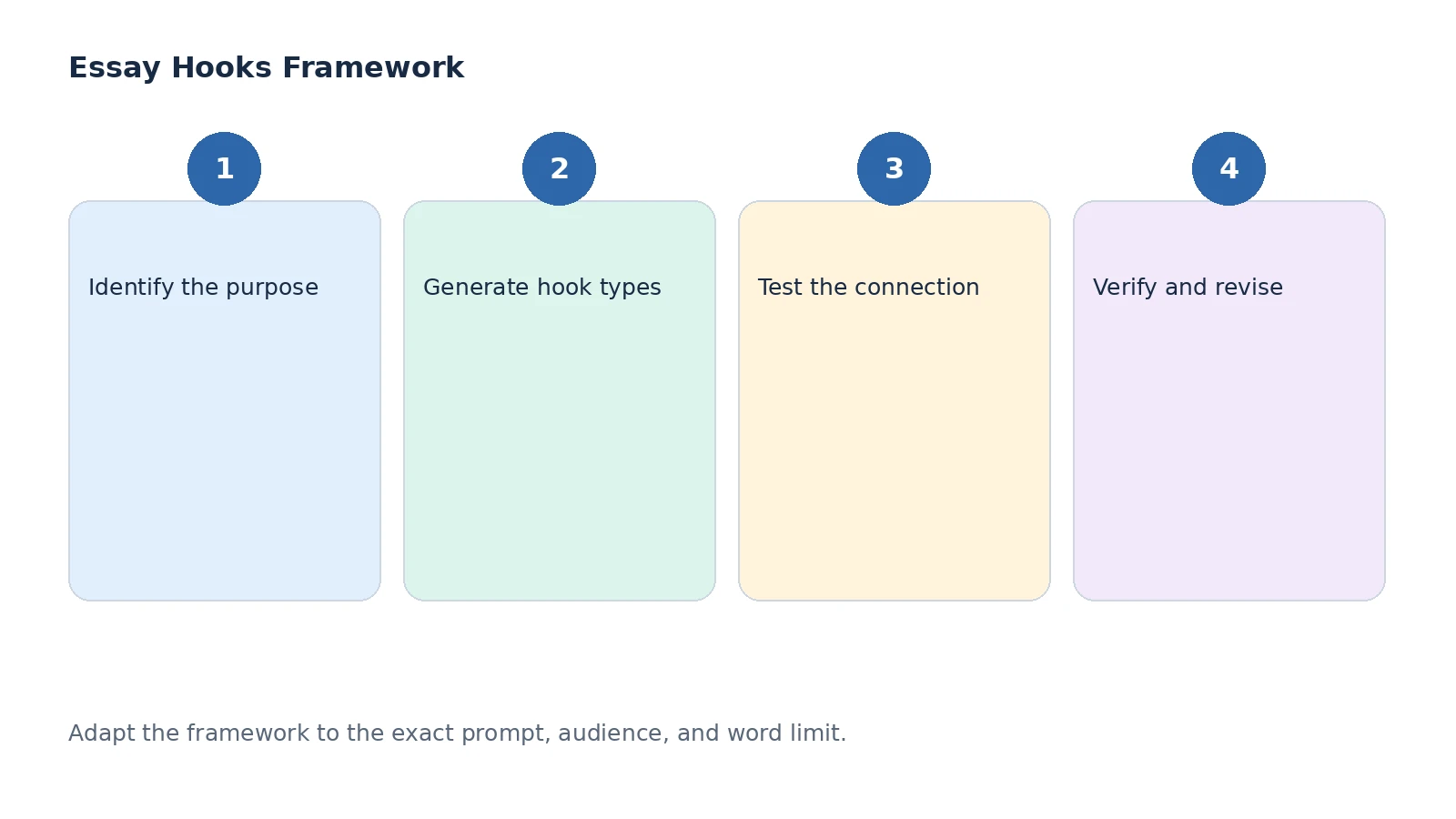
Step-by-step method
1. Identify the thesis
Know the destination before choosing the opening.
2. Generate options
Try a focused problem, contrast, scene, question, statistic, definition tension, and direct statement.
3. Test relevance
Write the next two sentences after each option.
4. Verify
Check quotations, statistics, dates, and source details.
5. Choose clarity
Select the opening that best serves the essay, not the cleverest sentence.
Worked examples
Poor
Since the dawn of civilization, people have valued education.
Good
Online education gives students more flexibility.
Excellent
Recorded lectures remove the classroom clock, but they also remove the moment when a confused student can interrupt.
Scene hook
Before the first child arrived, I moved the library’s smallest chairs into a circle and placed one book in the center.
Definition tension
Academic independence is often described as working alone, but responsible independence may depend on knowing when to use support.
Seven useful hook types
| Type | Best use |
|---|---|
| Focused problem | Argument, policy, and research |
| Contrast | Comparison and analysis |
| Brief scene | Personal and narrative |
| Precise question | When the essay answers it |
| Statistic | When verified and interpreted |
| Definition tension | Conceptual essays |
| Direct statement | When the issue is compelling |
Common mistakes
Using a fake quotation
Verify every quotation.
Starting too broadly
Begin near the issue.
Choosing unrelated drama
Connect the hook to the thesis.
Using an empty question
Ask only when the paper answers it.
Trying too hard to sound clever
Prefer relevance and clarity.
Need personalized writing support?
Submit the complete prompt, rubric, required sources, citation style, and deadline through the StudyDoll order page. Use support according to your institution’s academic-integrity rules and review the final work carefully.
How to revise a essay hook
Revise purpose and structure before proofreading. Compare the section with the prompt and thesis, identify the job of every paragraph, and remove material that does not advance the paper.
Read the section beside what comes before and after it. The connection should be visible. Add explanation where readers would otherwise need to infer why a detail matters.
Then edit for specificity, concision, grammar, citation, and formatting. Read aloud and complete one final proof after the complete document layout is stable.
Using AI and feedback responsibly
AI may help generate revision questions, identify repetition, or organize material you provide. It should not invent sources, quotations, experiences, data, grades, or instructor requirements. Follow the institution’s policy and verify every factual claim.
Ask reviewers where they became confused, what they understood the main point to be, and which sentences felt repetitive. Keep ownership of every final change.
Common professor comments
Too broad: narrow the subject, population, time, or claim. Needs analysis: explain how the evidence supports the point. Weak transition: name the actual logical relationship. Repetitive: keep the strongest version and use the saved space for development.
People-first page quality
Answer the main question early, use descriptive headings, provide original examples, connect readers to relevant internal resources, and add visuals only when they teach. Keep titles and descriptions accurate rather than sensational.
Use meaningful alt text, preserve stable URLs, check mobile readability, and verify that every link and downloadable resource works. Remove editor-only notes before publishing.
Editable planning template
Prompt or paragraph question:
Working thesis:
Section purpose:
Necessary evidence or context:
Main analytical move:
Transition or final connection:
Revision priority:
Download the free essay hooks planning worksheet (PDF)
Frequently asked questions
Does every essay need a hook?
Every introduction needs a relevant opening, not a gimmick.
Can I use a statistic?
Yes when it is current, credible, and interpreted.
Can a hook be several sentences?
Yes, but keep it concise.
Can I use dialogue?
It can work in personal or narrative writing.
Should I write it first?
Draft one early if useful, but finalize it after the paper’s direction is clear.
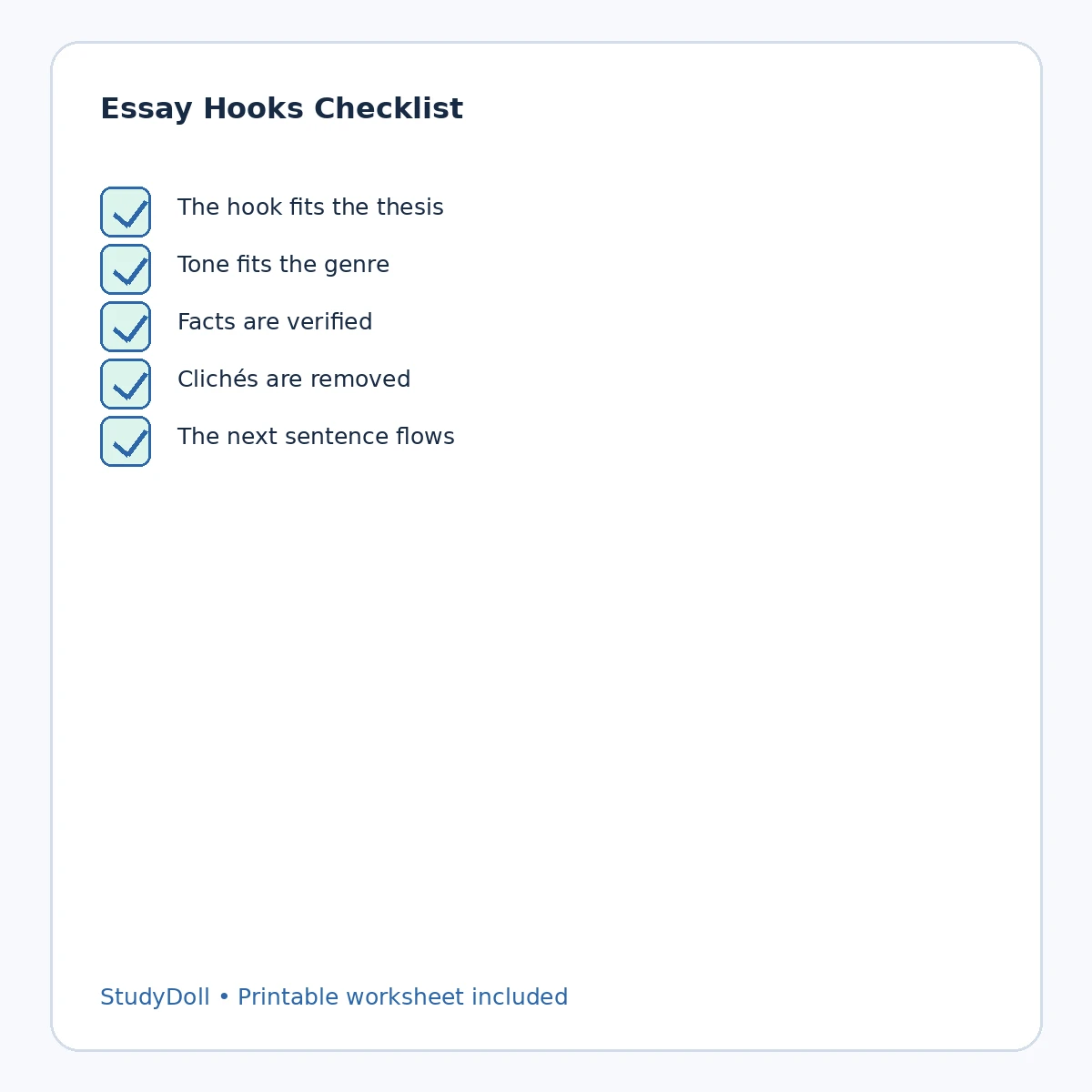
Final checklist
- The hook fits the thesis
- Tone fits the genre
- Facts are verified
- The opening begins near the topic
- Clichés are removed
- Curiosity is useful
- The next sentence flows
- The hook is original
Related StudyDoll guides
- Essay introduction — shows how to continue after the hook
- Thesis statement — provides the destination
- Personal essay — supports scene openings
Practice and self-grading
Choose one paragraph from an earlier paper and label the function of every sentence. Mark opening, context, claim, evidence, analysis, qualification, transition, and repetition. Revise sentences whose function is unclear.
Write the same function for a different topic. This transfer exercise shows whether the skill can adapt beyond one memorized template.
| Criterion | Developing | Strong |
|---|---|---|
| Purpose | The section names a topic | The section performs one clear job |
| Development | Details appear without explanation | Evidence and examples are interpreted |
| Coherence | Connections are implied | Relationships are named accurately |
| Specificity | Language is broad | Claims define subject, condition, and significance |
Efficient workflow
- Decode the prompt and task verb.
- Write the focused question and working answer.
- Plan the section’s exact purpose.
- Draft without polishing every sentence.
- Reverse-outline and strengthen explanation.
- Proofread and verify requirements.
WordPress publication review
Check the H1, slug, SEO title, meta description, table of contents, images, alt text, PDF link, internal links, and order link. Preview desktop and mobile, then open the public URL after publication.
Practice and self-grading
Choose one paragraph from an earlier paper and label the function of every sentence. Mark opening, context, claim, evidence, analysis, qualification, transition, and repetition. Revise sentences whose function is unclear.
Write the same function for a different topic. This transfer exercise shows whether the skill can adapt beyond one memorized template.
| Criterion | Developing | Strong |
|---|---|---|
| Purpose | The section names a topic | The section performs one clear job |
| Development | Details appear without explanation | Evidence and examples are interpreted |
| Coherence | Connections are implied | Relationships are named accurately |
| Specificity | Language is broad | Claims define subject, condition, and significance |
Efficient workflow
- Decode the prompt and task verb.
- Write the focused question and working answer.
- Plan the section’s exact purpose.
- Draft without polishing every sentence.
- Reverse-outline and strengthen explanation.
- Proofread and verify requirements.
WordPress publication review
Check the H1, slug, SEO title, meta description, table of contents, images, alt text, PDF link, internal links, and order link. Preview desktop and mobile, then open the public URL after publication.
Practice and self-grading
Choose one paragraph from an earlier paper and label the function of every sentence. Mark opening, context, claim, evidence, analysis, qualification, transition, and repetition. Revise sentences whose function is unclear.
Write the same function for a different topic. This transfer exercise shows whether the skill can adapt beyond one memorized template.
| Criterion | Developing | Strong |
|---|---|---|
| Purpose | The section names a topic | The section performs one clear job |
| Development | Details appear without explanation | Evidence and examples are interpreted |
| Coherence | Connections are implied | Relationships are named accurately |
| Specificity | Language is broad | Claims define subject, condition, and significance |
Efficient workflow
- Decode the prompt and task verb.
- Write the focused question and working answer.
- Plan the section’s exact purpose.
- Draft without polishing every sentence.
- Reverse-outline and strengthen explanation.
- Proofread and verify requirements.
WordPress publication review
Check the H1, slug, SEO title, meta description, table of contents, images, alt text, PDF link, internal links, and order link. Preview desktop and mobile, then open the public URL after publication.
Practice and self-grading
Choose one paragraph from an earlier paper and label the function of every sentence. Mark opening, context, claim, evidence, analysis, qualification, transition, and repetition. Revise sentences whose function is unclear.
Write the same function for a different topic. This transfer exercise shows whether the skill can adapt beyond one memorized template.
| Criterion | Developing | Strong |
|---|---|---|
| Purpose | The section names a topic | The section performs one clear job |
| Development | Details appear without explanation | Evidence and examples are interpreted |
| Coherence | Connections are implied | Relationships are named accurately |
| Specificity | Language is broad | Claims define subject, condition, and significance |
Efficient workflow
- Decode the prompt and task verb.
- Write the focused question and working answer.
- Plan the section’s exact purpose.
- Draft without polishing every sentence.
- Reverse-outline and strengthen explanation.
- Proofread and verify requirements.
WordPress publication review
Check the H1, slug, SEO title, meta description, table of contents, images, alt text, PDF link, internal links, and order link. Preview desktop and mobile, then open the public URL after publication.
Practice and self-grading
Choose one paragraph from an earlier paper and label the function of every sentence. Mark opening, context, claim, evidence, analysis, qualification, transition, and repetition. Revise sentences whose function is unclear.
Write the same function for a different topic. This transfer exercise shows whether the skill can adapt beyond one memorized template.
| Criterion | Developing | Strong |
|---|---|---|
| Purpose | The section names a topic | The section performs one clear job |
| Development | Details appear without explanation | Evidence and examples are interpreted |
| Coherence | Connections are implied | Relationships are named accurately |
| Specificity | Language is broad | Claims define subject, condition, and significance |
Efficient workflow
- Decode the prompt and task verb.
- Write the focused question and working answer.
- Plan the section’s exact purpose.
- Draft without polishing every sentence.
- Reverse-outline and strengthen explanation.
- Proofread and verify requirements.
WordPress publication review
Check the H1, slug, SEO title, meta description, table of contents, images, alt text, PDF link, internal links, and order link. Preview desktop and mobile, then open the public URL after publication.
Practice and self-grading
Choose one paragraph from an earlier paper and label the function of every sentence. Mark opening, context, claim, evidence, analysis, qualification, transition, and repetition. Revise sentences whose function is unclear.
Write the same function for a different topic. This transfer exercise shows whether the skill can adapt beyond one memorized template.
| Criterion | Developing | Strong |
|---|---|---|
| Purpose | The section names a topic | The section performs one clear job |
| Development | Details appear without explanation | Evidence and examples are interpreted |
| Coherence | Connections are implied | Relationships are named accurately |
| Specificity | Language is broad | Claims define subject, condition, and significance |
Efficient workflow
- Decode the prompt and task verb.
- Write the focused question and working answer.
- Plan the section’s exact purpose.
- Draft without polishing every sentence.
- Reverse-outline and strengthen explanation.
- Proofread and verify requirements.
WordPress publication review
Check the H1, slug, SEO title, meta description, table of contents, images, alt text, PDF link, internal links, and order link. Preview desktop and mobile, then open the public URL after publication.
Practice and self-grading
Choose one paragraph from an earlier paper and label the function of every sentence. Mark opening, context, claim, evidence, analysis, qualification, transition, and repetition. Revise sentences whose function is unclear.
Write the same function for a different topic. This transfer exercise shows whether the skill can adapt beyond one memorized template.
| Criterion | Developing | Strong |
|---|---|---|
| Purpose | The section names a topic | The section performs one clear job |
| Development | Details appear without explanation | Evidence and examples are interpreted |
| Coherence | Connections are implied | Relationships are named accurately |
| Specificity | Language is broad | Claims define subject, condition, and significance |
Efficient workflow
- Decode the prompt and task verb.
- Write the focused question and working answer.
- Plan the section’s exact purpose.
- Draft without polishing every sentence.
- Reverse-outline and strengthen explanation.
- Proofread and verify requirements.
WordPress publication review
Check the H1, slug, SEO title, meta description, table of contents, images, alt text, PDF link, internal links, and order link. Preview desktop and mobile, then open the public URL after publication.
Practice and self-grading
Choose one paragraph from an earlier paper and label the function of every sentence. Mark opening, context, claim, evidence, analysis, qualification, transition, and repetition. Revise sentences whose function is unclear.
Write the same function for a different topic. This transfer exercise shows whether the skill can adapt beyond one memorized template.
| Criterion | Developing | Strong |
|---|---|---|
| Purpose | The section names a topic | The section performs one clear job |
| Development | Details appear without explanation | Evidence and examples are interpreted |
| Coherence | Connections are implied | Relationships are named accurately |
| Specificity | Language is broad | Claims define subject, condition, and significance |
Efficient workflow
- Decode the prompt and task verb.
- Write the focused question and working answer.
- Plan the section’s exact purpose.
- Draft without polishing every sentence.
- Reverse-outline and strengthen explanation.
- Proofread and verify requirements.
WordPress publication review
Check the H1, slug, SEO title, meta description, table of contents, images, alt text, PDF link, internal links, and order link. Preview desktop and mobile, then open the public URL after publication.
Practice and self-grading
Choose one paragraph from an earlier paper and label the function of every sentence. Mark opening, context, claim, evidence, analysis, qualification, transition, and repetition. Revise sentences whose function is unclear.
Write the same function for a different topic. This transfer exercise shows whether the skill can adapt beyond one memorized template.
| Criterion | Developing | Strong |
|---|---|---|
| Purpose | The section names a topic | The section performs one clear job |
| Development | Details appear without explanation | Evidence and examples are interpreted |
| Coherence | Connections are implied | Relationships are named accurately |
| Specificity | Language is broad | Claims define subject, condition, and significance |
Efficient workflow
- Decode the prompt and task verb.
- Write the focused question and working answer.
- Plan the section’s exact purpose.
- Draft without polishing every sentence.
- Reverse-outline and strengthen explanation.
- Proofread and verify requirements.
WordPress publication review
Check the H1, slug, SEO title, meta description, table of contents, images, alt text, PDF link, internal links, and order link. Preview desktop and mobile, then open the public URL after publication.
Practice and self-grading
Choose one paragraph from an earlier paper and label the function of every sentence. Mark opening, context, claim, evidence, analysis, qualification, transition, and repetition. Revise sentences whose function is unclear.
Write the same function for a different topic. This transfer exercise shows whether the skill can adapt beyond one memorized template.
| Criterion | Developing | Strong |
|---|---|---|
| Purpose | The section names a topic | The section performs one clear job |
| Development | Details appear without explanation | Evidence and examples are interpreted |
| Coherence | Connections are implied | Relationships are named accurately |
| Specificity | Language is broad | Claims define subject, condition, and significance |
Efficient workflow
- Decode the prompt and task verb.
- Write the focused question and working answer.
- Plan the section’s exact purpose.
- Draft without polishing every sentence.
- Reverse-outline and strengthen explanation.
- Proofread and verify requirements.
WordPress publication review
Check the H1, slug, SEO title, meta description, table of contents, images, alt text, PDF link, internal links, and order link. Preview desktop and mobile, then open the public URL after publication.
Practice and self-grading
Choose one paragraph from an earlier paper and label the function of every sentence. Mark opening, context, claim, evidence, analysis, qualification, transition, and repetition. Revise sentences whose function is unclear.
Write the same function for a different topic. This transfer exercise shows whether the skill can adapt beyond one memorized template.
| Criterion | Developing | Strong |
|---|---|---|
| Purpose | The section names a topic | The section performs one clear job |
| Development | Details appear without explanation | Evidence and examples are interpreted |
| Coherence | Connections are implied | Relationships are named accurately |
| Specificity | Language is broad | Claims define subject, condition, and significance |
Efficient workflow
- Decode the prompt and task verb.
- Write the focused question and working answer.
- Plan the section’s exact purpose.
- Draft without polishing every sentence.
- Reverse-outline and strengthen explanation.
- Proofread and verify requirements.
WordPress publication review
Check the H1, slug, SEO title, meta description, table of contents, images, alt text, PDF link, internal links, and order link. Preview desktop and mobile, then open the public URL after publication.
Practice and self-grading
Choose one paragraph from an earlier paper and label the function of every sentence. Mark opening, context, claim, evidence, analysis, qualification, transition, and repetition. Revise sentences whose function is unclear.
Write the same function for a different topic. This transfer exercise shows whether the skill can adapt beyond one memorized template.
| Criterion | Developing | Strong |
|---|---|---|
| Purpose | The section names a topic | The section performs one clear job |
| Development | Details appear without explanation | Evidence and examples are interpreted |
| Coherence | Connections are implied | Relationships are named accurately |
| Specificity | Language is broad | Claims define subject, condition, and significance |
Efficient workflow
- Decode the prompt and task verb.
- Write the focused question and working answer.
- Plan the section’s exact purpose.
- Draft without polishing every sentence.
- Reverse-outline and strengthen explanation.
- Proofread and verify requirements.
WordPress publication review
Check the H1, slug, SEO title, meta description, table of contents, images, alt text, PDF link, internal links, and order link. Preview desktop and mobile, then open the public URL after publication.
Practice and self-grading
Choose one paragraph from an earlier paper and label the function of every sentence. Mark opening, context, claim, evidence, analysis, qualification, transition, and repetition. Revise sentences whose function is unclear.
Write the same function for a different topic. This transfer exercise shows whether the skill can adapt beyond one memorized template.
| Criterion | Developing | Strong |
|---|---|---|
| Purpose | The section names a topic | The section performs one clear job |
| Development | Details appear without explanation | Evidence and examples are interpreted |
| Coherence | Connections are implied | Relationships are named accurately |
| Specificity | Language is broad | Claims define subject, condition, and significance |
Efficient workflow
- Decode the prompt and task verb.
- Write the focused question and working answer.
- Plan the section’s exact purpose.
- Draft without polishing every sentence.
- Reverse-outline and strengthen explanation.
- Proofread and verify requirements.
WordPress publication review
Check the H1, slug, SEO title, meta description, table of contents, images, alt text, PDF link, internal links, and order link. Preview desktop and mobile, then open the public URL after publication.
Practice and self-grading
Choose one paragraph from an earlier paper and label the function of every sentence. Mark opening, context, claim, evidence, analysis, qualification, transition, and repetition. Revise sentences whose function is unclear.
Write the same function for a different topic. This transfer exercise shows whether the skill can adapt beyond one memorized template.
| Criterion | Developing | Strong |
|---|---|---|
| Purpose | The section names a topic | The section performs one clear job |
| Development | Details appear without explanation | Evidence and examples are interpreted |
| Coherence | Connections are implied | Relationships are named accurately |
| Specificity | Language is broad | Claims define subject, condition, and significance |
Efficient workflow
- Decode the prompt and task verb.
- Write the focused question and working answer.
- Plan the section’s exact purpose.
- Draft without polishing every sentence.
- Reverse-outline and strengthen explanation.
- Proofread and verify requirements.
WordPress publication review
Check the H1, slug, SEO title, meta description, table of contents, images, alt text, PDF link, internal links, and order link. Preview desktop and mobile, then open the public URL after publication.
Practice and self-grading
Choose one paragraph from an earlier paper and label the function of every sentence. Mark opening, context, claim, evidence, analysis, qualification, transition, and repetition. Revise sentences whose function is unclear.
Write the same function for a different topic. This transfer exercise shows whether the skill can adapt beyond one memorized template.
| Criterion | Developing | Strong |
|---|---|---|
| Purpose | The section names a topic | The section performs one clear job |
| Development | Details appear without explanation | Evidence and examples are interpreted |
| Coherence | Connections are implied | Relationships are named accurately |
| Specificity | Language is broad | Claims define subject, condition, and significance |
Efficient workflow
- Decode the prompt and task verb.
- Write the focused question and working answer.
- Plan the section’s exact purpose.
- Draft without polishing every sentence.
- Reverse-outline and strengthen explanation.
- Proofread and verify requirements.
WordPress publication review
Check the H1, slug, SEO title, meta description, table of contents, images, alt text, PDF link, internal links, and order link. Preview desktop and mobile, then open the public URL after publication.
Practice and self-grading
Choose one paragraph from an earlier paper and label the function of every sentence. Mark opening, context, claim, evidence, analysis, qualification, transition, and repetition. Revise sentences whose function is unclear.
Write the same function for a different topic. This transfer exercise shows whether the skill can adapt beyond one memorized template.
| Criterion | Developing | Strong |
|---|---|---|
| Purpose | The section names a topic | The section performs one clear job |
| Development | Details appear without explanation | Evidence and examples are interpreted |
| Coherence | Connections are implied | Relationships are named accurately |
| Specificity | Language is broad | Claims define subject, condition, and significance |
Efficient workflow
- Decode the prompt and task verb.
- Write the focused question and working answer.
- Plan the section’s exact purpose.
- Draft without polishing every sentence.
- Reverse-outline and strengthen explanation.
- Proofread and verify requirements.
WordPress publication review
Check the H1, slug, SEO title, meta description, table of contents, images, alt text, PDF link, internal links, and order link. Preview desktop and mobile, then open the public URL after publication.
Practice and self-grading
Choose one paragraph from an earlier paper and label the function of every sentence. Mark opening, context, claim, evidence, analysis, qualification, transition, and repetition. Revise sentences whose function is unclear.
Write the same function for a different topic. This transfer exercise shows whether the skill can adapt beyond one memorized template.
| Criterion | Developing | Strong |
|---|---|---|
| Purpose | The section names a topic | The section performs one clear job |
| Development | Details appear without explanation | Evidence and examples are interpreted |
| Coherence | Connections are implied | Relationships are named accurately |
| Specificity | Language is broad | Claims define subject, condition, and significance |
Efficient workflow
- Decode the prompt and task verb.
- Write the focused question and working answer.
- Plan the section’s exact purpose.
- Draft without polishing every sentence.
- Reverse-outline and strengthen explanation.
- Proofread and verify requirements.
WordPress publication review
Check the H1, slug, SEO title, meta description, table of contents, images, alt text, PDF link, internal links, and order link. Preview desktop and mobile, then open the public URL after publication.
Practice and self-grading
Choose one paragraph from an earlier paper and label the function of every sentence. Mark opening, context, claim, evidence, analysis, qualification, transition, and repetition. Revise sentences whose function is unclear.
Write the same function for a different topic. This transfer exercise shows whether the skill can adapt beyond one memorized template.
| Criterion | Developing | Strong |
|---|---|---|
| Purpose | The section names a topic | The section performs one clear job |
| Development | Details appear without explanation | Evidence and examples are interpreted |
| Coherence | Connections are implied | Relationships are named accurately |
| Specificity | Language is broad | Claims define subject, condition, and significance |
Efficient workflow
- Decode the prompt and task verb.
- Write the focused question and working answer.
- Plan the section’s exact purpose.
- Draft without polishing every sentence.
- Reverse-outline and strengthen explanation.
- Proofread and verify requirements.
WordPress publication review
Check the H1, slug, SEO title, meta description, table of contents, images, alt text, PDF link, internal links, and order link. Preview desktop and mobile, then open the public URL after publication.
Practice and self-grading
Choose one paragraph from an earlier paper and label the function of every sentence. Mark opening, context, claim, evidence, analysis, qualification, transition, and repetition. Revise sentences whose function is unclear.
Write the same function for a different topic. This transfer exercise shows whether the skill can adapt beyond one memorized template.
| Criterion | Developing | Strong |
|---|---|---|
| Purpose | The section names a topic | The section performs one clear job |
| Development | Details appear without explanation | Evidence and examples are interpreted |
| Coherence | Connections are implied | Relationships are named accurately |
| Specificity | Language is broad | Claims define subject, condition, and significance |
Efficient workflow
- Decode the prompt and task verb.
- Write the focused question and working answer.
- Plan the section’s exact purpose.
- Draft without polishing every sentence.
- Reverse-outline and strengthen explanation.
- Proofread and verify requirements.
WordPress publication review
Check the H1, slug, SEO title, meta description, table of contents, images, alt text, PDF link, internal links, and order link. Preview desktop and mobile, then open the public URL after publication.
Practice and self-grading
Choose one paragraph from an earlier paper and label the function of every sentence. Mark opening, context, claim, evidence, analysis, qualification, transition, and repetition. Revise sentences whose function is unclear.
Write the same function for a different topic. This transfer exercise shows whether the skill can adapt beyond one memorized template.
| Criterion | Developing | Strong |
|---|---|---|
| Purpose | The section names a topic | The section performs one clear job |
| Development | Details appear without explanation | Evidence and examples are interpreted |
| Coherence | Connections are implied | Relationships are named accurately |
| Specificity | Language is broad | Claims define subject, condition, and significance |
Efficient workflow
- Decode the prompt and task verb.
- Write the focused question and working answer.
- Plan the section’s exact purpose.
- Draft without polishing every sentence.
- Reverse-outline and strengthen explanation.
- Proofread and verify requirements.
WordPress publication review
Check the H1, slug, SEO title, meta description, table of contents, images, alt text, PDF link, internal links, and order link. Preview desktop and mobile, then open the public URL after publication.