Introduction
A confusing assignment prompt can make a simple task feel much larger than it is. Many students open a blank document too soon, write a few paragraphs, then realize the instructions asked for a different kind of thinking, a specific source type, a rubric connection, or a submission format they missed.
This guide shows you how to read an assignment prompt before you start writing. You will learn how to identify the action verb, topic, scope, evidence rules, citation style, word count, deadline, rubric priorities, and final submission requirements. The goal is not to overthink the prompt. The goal is to turn it into a clear work plan before research and drafting begin.
For related planning support, you can also use StudyDoll guides on organizing research sources, editing and proofreading, research support, and the Academic Integrity Policy.
Key Takeaways
- An assignment prompt is more than a topic; it usually contains the task, scope, evidence rules, format, deadline, and grading priorities.
- The command word matters because analyze, evaluate, summarize, compare, and reflect ask for different kinds of thinking.
- The rubric should shape your outline before you draft, especially when criteria have different point values.
- Turning the prompt into a checklist reduces missed requirements and helps you ask better clarification questions.
- Good prompt reading supports academic integrity because you know what work is expected before seeking help.
What an Assignment Prompt Is
An assignment prompt is the written instruction set for the work you need to produce. It might appear as a paragraph in a syllabus, a document in the learning-management system, a discussion-board instruction, a project brief, a case scenario, or a rubric attached to the task. A strong prompt tells you what to do, what topic to address, what evidence to use, how to format the final product, and how the work will be evaluated.
The most important thing to remember is that a prompt is not just a subject. A prompt that says “analyze communication barriers in a patient-education scenario” is not asking for a general paper about communication. It is asking for analysis, a scenario focus, and likely evidence-based support. If you only notice the broad subject, you may write something polished but misaligned.
University writing centers often advise students to slow down and identify the task, audience, purpose, and constraints before drafting. That advice is practical: every later step depends on your interpretation of the prompt.
Why Students Often Misunderstand Prompts
Students usually misread prompts because they are rushing, not because they are careless. A familiar word such as essay, reflection, presentation, case study, or discussion post can make the task feel obvious. The problem is that two assignments with the same label can require different work. One reflection may be personal and narrative; another may require course concepts, evidence, and a future action plan.
Prompts also bury important instructions in ordinary sentences. A line such as “include one counterargument” changes the structure of the paper. A phrase such as “use course readings and at least one outside scholarly source” tells you not to rely only on web searching. A requirement for speaker notes means a slide deck alone is incomplete. Small details often carry grading weight.
Prompts can also feel unclear because instructors write from inside the course context. When that context is fuzzy, convert the prompt into specific questions before guessing.
The Five-Minute Prompt-Reading Method
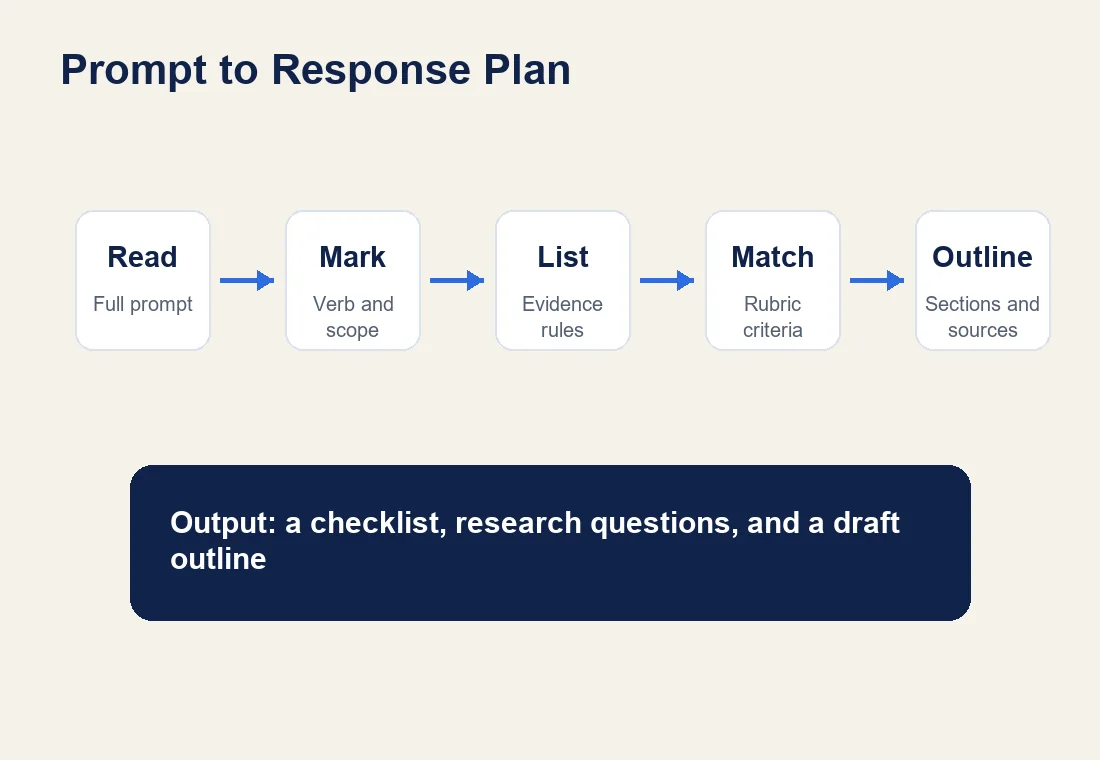
Before you open a blank draft, spend five minutes marking the instructions. Use a printed copy, a PDF comment tool, a notes app, or the top of your planning document. The method is simple: read the whole prompt once, then mark the elements that control your decisions.
| Minute | What to do | Decision you are trying to make |
|---|---|---|
| 1 | Read the full prompt without highlighting. | What is the whole assignment asking for? |
| 2 | Circle command words such as analyze, evaluate, compare, or reflect. | What kind of thinking is required? |
| 3 | Underline topic, scope, population, case, course unit, or time period. | What belongs inside the response? |
| 4 | Mark source, citation, format, length, deadline, and submission rules. | What technical requirements must be met? |
| 5 | Turn every requirement into a checklist item. | What should I verify before submitting? |
Five minutes is not a magic limit. A long capstone brief may require more time. The point is to read for decisions instead of reading for a general impression. If a requirement affects your research, structure, citation style, or submission, it belongs on the checklist.
Identify the Main Task Verb
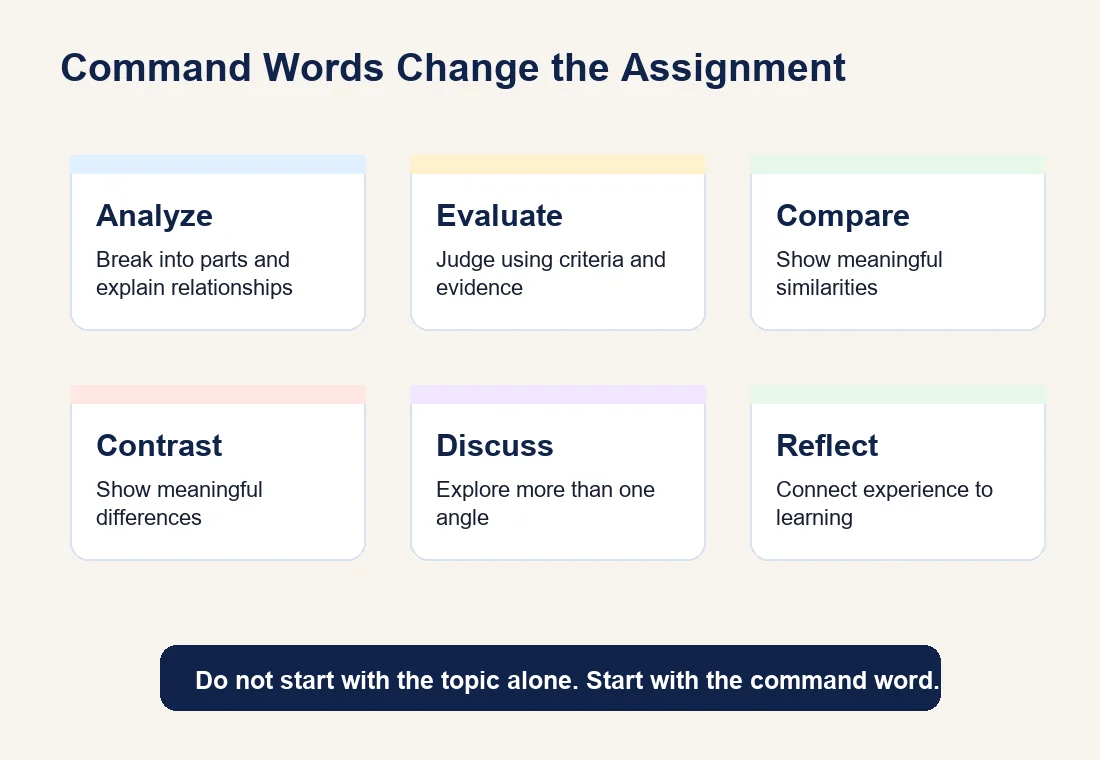
The task verb is often the most powerful word in the prompt. It tells you whether the assignment wants description, analysis, evaluation, comparison, reflection, summary, critique, or discussion. The same topic can produce very different papers when the verb changes.
For example, “describe flexible deadlines” asks you to explain what they are and how they work. “Evaluate flexible deadlines” asks you to judge whether they are effective, probably using criteria. “Compare flexible deadlines and strict deadlines” asks you to organize the paper around similarities and differences. “Reflect on a deadline challenge” asks you to connect experience to learning.
| Command word | Meaning | What the instructor expects | Evidence required | Common mistake |
|---|---|---|---|---|
| Analyze | Break the issue into parts and explain how the parts relate. | A clear explanation of causes, relationships, patterns, or consequences. | Examples, course concepts, source evidence, and your explanation. | Only describing the topic without explaining how or why. |
| Compare | Show meaningful similarities between two or more things. | Points of comparison that help the reader understand significance. | Evidence for each item being compared. | Listing two separate descriptions with no direct comparison. |
| Contrast | Show meaningful differences between two or more things. | Clear differences organized by the same categories. | Evidence for each side of the contrast. | Treating contrast as a general opinion paragraph. |
| Critique | Assess strengths, weaknesses, limits, and usefulness. | Fair judgment supported by criteria and evidence. | Specific examples, standards, or rubric criteria. | Sounding negative without explaining the basis for judgment. |
| Describe | Give an accurate account of features, details, or steps. | Specific, organized details that help the reader picture the subject. | Observed details, course facts, or source information. | Adding unsupported judgment when the task asks for description. |
| Discuss | Explore the issue from more than one relevant angle. | A balanced explanation of key points, tensions, or perspectives. | Examples, course readings, evidence, and transitions. | Writing loosely about anything connected to the topic. |
| Evaluate | Make a judgment using criteria. | A reasoned conclusion about value, effectiveness, or quality. | Criteria, evidence, counterpoints, and a final judgment. | Giving an opinion without criteria. |
| Explain | Make an idea, process, result, or cause understandable. | Clear reasons, sequence, examples, and definitions. | Examples, cause-and-effect logic, or source support. | Assuming the reader already understands the connection. |
| Reflect | Connect experience to learning, course ideas, or future action. | Specific experience, interpretation, concept link, and next step. | Personal example plus course language where required. | Telling a story with no learning insight. |
| Summarize | Condense the main point without adding unnecessary detail. | Accurate main idea, essential support, and neutral wording. | The original text or source being summarized. | Copying the source or adding personal evaluation too early. |
If your prompt has more than one command word, rank them. A sentence may ask you to summarize a case and then evaluate the decision. In that situation, summary is preparation; evaluation is the main task.
Identify the Main Topic
The topic is the subject of the assignment, but it should be written as a complete, focused note. Avoid vague notes such as “leadership” or “online learning.” Instead, combine the topic with the task and context.
Weak topic note: “Write about leadership.” Stronger topic note: “Analyze how leadership communication affected team conflict in the assigned case study.” The second note tells you the subject, task, and boundary.
If you cannot state the topic in one sentence, the prompt may still be unclear. That is the right time to reread the course module, rubric, examples, or instructor announcement. If those do not answer the question, ask for clarification early.
Identify the Required Scope
Scope means the limits of the assignment. It answers what belongs in the response and what should be left out. Scope may be controlled by word count, course unit, case scenario, population, time period, required readings, number of sources, or a specific deliverable.
A 1,500-word essay cannot cover every factor in online learning. It might evaluate one policy, in one context, using a few criteria. A 300-word discussion post cannot cover an entire theory. It might apply one concept to one example and ask a follow-up question.
When scope is too broad, your paper becomes thin because each point gets only a sentence or two. When scope is too narrow, you may struggle to meet the word count. A good scope note protects both depth and relevance.
Identify Required Evidence
Evidence requirements tell you what support the instructor expects. Evidence might include peer-reviewed journal articles, course readings, textbook chapters, case details, professional guidelines, data, interviews, laws, or personal reflection. Not all evidence has the same role.
If the prompt says “scholarly sources,” look for academic books, peer-reviewed articles, or credible university/library resources unless your instructor defines the term differently. If the prompt says “course readings,” do not replace them with outside websites. If it says “current sources,” check whether a date range is given.
| Prompt element | Question to ask | Example | Action required |
|---|---|---|---|
| Task verb | What thinking operation is required? | Evaluate whether flexible deadlines improve learning. | Plan criteria and evidence before drafting. |
| Topic | What subject must the response address? | Flexible deadlines in online courses. | Define the topic in one sentence. |
| Scope | What boundaries limit the assignment? | Online courses, 1,500 words, four scholarly sources. | Exclude unrelated education-policy debates. |
| Evidence | What kind and number of sources are required? | At least four scholarly sources, two peer-reviewed. | Schedule research before outlining. |
| Format | What must the final product look like? | APA 7, Word document, thesis, counterargument. | Build a format checklist. |
| Submission | Where, when, and how is it submitted? | Friday 11:59 p.m. through the course portal. | Check file type and time zone. |
Evidence rules affect the schedule. If you need four scholarly sources and two must be peer-reviewed, research should happen before the outline is final. If you need to cite a specific reading, put that reading in your source tracker immediately.
Identify the Number and Type of Sources
The number of sources matters, but the type matters more. Four sources can mean four peer-reviewed journal articles, four course readings, two course readings plus two outside sources, or a mix of scholarly and professional materials. Count only sources that meet the prompt’s rule.
Build a small source plan before searching. Write down how many sources you need, where they may come from, whether peer review is required, whether publication dates matter, and where each source might support the outline. This prevents last-minute source padding.
For larger projects, use a tracker like the one in How to Organize Research Sources so every source has a purpose before it appears in the draft. A source that does not support a specific section may not belong in the final paper.
Identify Citation Style
Citation style is part of the assignment. APA, MLA, Chicago, and other styles have different expectations for in-text citations, reference entries, titles, headings, and sometimes paper format. Do not wait until the last hour to identify the style.
For APA work, for example, collect author, date, title, source, DOI, URL, and enough information to match in-text citations with references. Official style guidance is useful when instructor rules do not answer a formatting question. If the instructor gives a template, follow the template first.
A prompt may also combine style requirements with source rules. “Use APA 7 and three peer-reviewed sources” means you need both credible research and accurate citation formatting. Missing either one can lower the grade.
Identify Formatting Instructions
Formatting instructions describe the final product. Look for required headings, title page, font, spacing, file type, template, tables, appendices, presentation notes, speaker script, word count, page count, and named sections.
Formatting is not cosmetic when the prompt makes it a requirement. If a nursing assignment provides a care-plan template, using a plain essay may be wrong even if the writing is strong. If a business memo is required, an academic essay may miss the expected audience and structure.
Write formatting rules as checklist items. For example: “Use APA 7 title page,” “submit as .docx,” “include speaker notes,” “stay between 1,200 and 1,500 words,” and “include introduction, analysis, recommendation, and conclusion.”
Identify Word Count or Page Length
Word count helps you decide how much detail each section can hold. A 500-word response needs a narrow point and direct evidence. A 3,000-word paper can support more context, source discussion, counterargument, and revision.
Use word count to plan section weight. If a short discussion post spends half its length summarizing background, there may be no room for analysis. When a prompt gives pages instead of words, check the formatting assumptions because spacing, margins, and title pages can change length.
Identify Deadline and Submission Method
The deadline is more than a date. It can include a time, time zone, staged draft, peer-response window, accepted file type, submission portal, and late policy. A discussion post may require an initial post by Wednesday and replies by Sunday. A project may have a proposal, draft, and final submission.
Write the full deadline in your checklist, including the time zone if one appears. Then add the submission method: Word document, PDF, quiz box, discussion board, slide deck, or portfolio upload. If file type matters, test that you can export the correct format before the deadline.
Connect the Prompt to the Grading Rubric
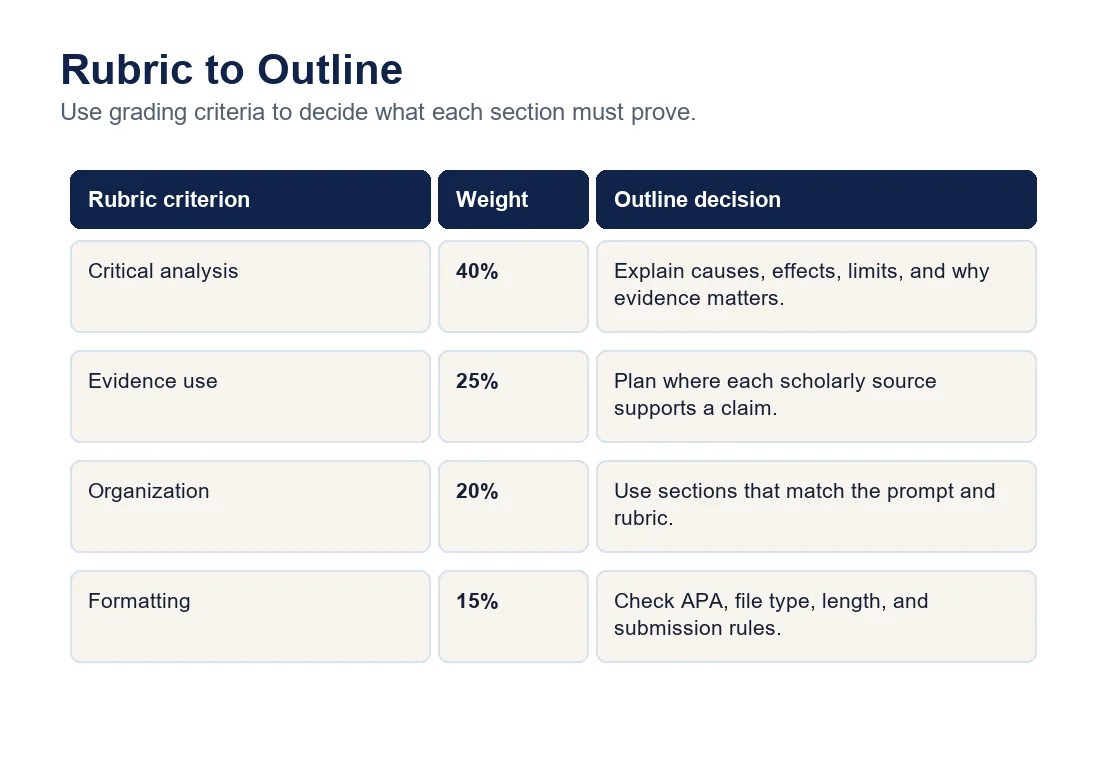
The rubric is the scoring guide. It often clarifies what the prompt only hints at. Read the highest-performance column first, then turn each criterion into a planning question.
If the rubric gives 40 percent to analysis and 15 percent to formatting, spend your planning energy accordingly. Formatting matters, but the bigger risk may be summarizing instead of analyzing.
| Rubric criterion | Weight | Required content | Planned section | Evidence needed |
|---|---|---|---|---|
| Critical analysis | 40% | Criteria for judging flexible deadlines, explanation of effects, counterargument. | Body sections on learning, planning, equity, and limits. | Peer-reviewed articles, course readings, and scenario details. |
| Evidence and sources | 25% | Four scholarly sources with two peer-reviewed journal articles. | Source-backed paragraphs and reference list. | Library database records, DOI/URL, citation notes. |
| Organization | 20% | Clear thesis, logical sections, transitions, conclusion. | Outline based on criteria rather than source order. | Prompt checklist and section map. |
| APA and mechanics | 15% | APA 7 formatting, accurate citations, clean submission. | Final revision and format check. | APA Style guidance and instructor template. |
Turn the Prompt Into a Checklist
A checklist turns instructions into action. Every requirement becomes a line you can verify before submitting.
A practical checklist might include: identify the command word, restate the topic, confirm scope, list required sources, choose citation style, create an outline from rubric criteria, draft a thesis, include a counterargument, check word count, format references, and upload the correct file.
Place the checklist at the top of your planning document and use it again before proofreading. A polished paper that misses a required source, heading, or argument feature is still incomplete.
Turn the Prompt Into Research Questions
Research questions help you search with purpose. Instead of looking for anything related to the broad topic, you search for evidence that answers the assignment’s actual task.
For the flexible-deadline sample prompt, possible research questions include: What does research say about learning outcomes? How do deadlines affect planning and stress? What limits should a fair evaluation include?
These questions can become section headings or source-search terms. They also help you avoid collecting sources that are interesting but irrelevant.
Build a Response Plan Before Researching
A response plan is a short outline built from the prompt, not from whatever sources you find first. Start with the task verb, then choose sections that match the required thinking.
For an evaluation prompt, a response plan might include introduction and criteria, background, evidence for benefits, evidence for limits, counterargument, final judgment, and conclusion. For a comparison prompt, it might be organized by points of comparison. For a reflection prompt, it might move from experience to course concept to future action.
Once the plan exists, research becomes more focused: you are asking what evidence each section needs.
Full Annotated Assignment-Prompt Example
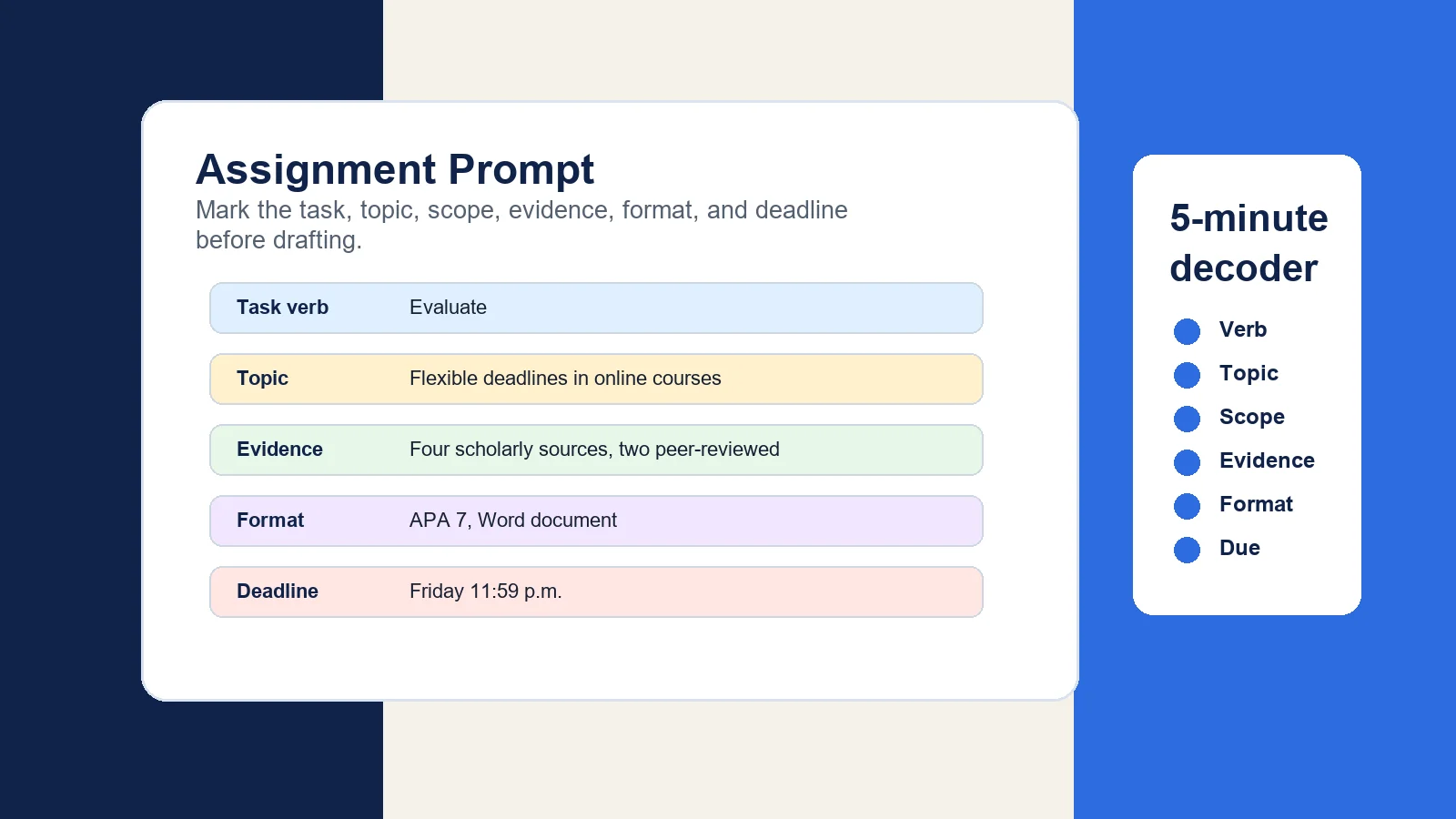
Sample prompt: Write a 1,500-word essay evaluating whether flexible deadlines improve student learning in online courses. Use at least four scholarly sources, including two peer-reviewed journal articles. Your essay should include a clear thesis, address at least one counterargument, and follow APA 7 format. Submit the final paper as a Word document by Friday at 11:59 p.m.
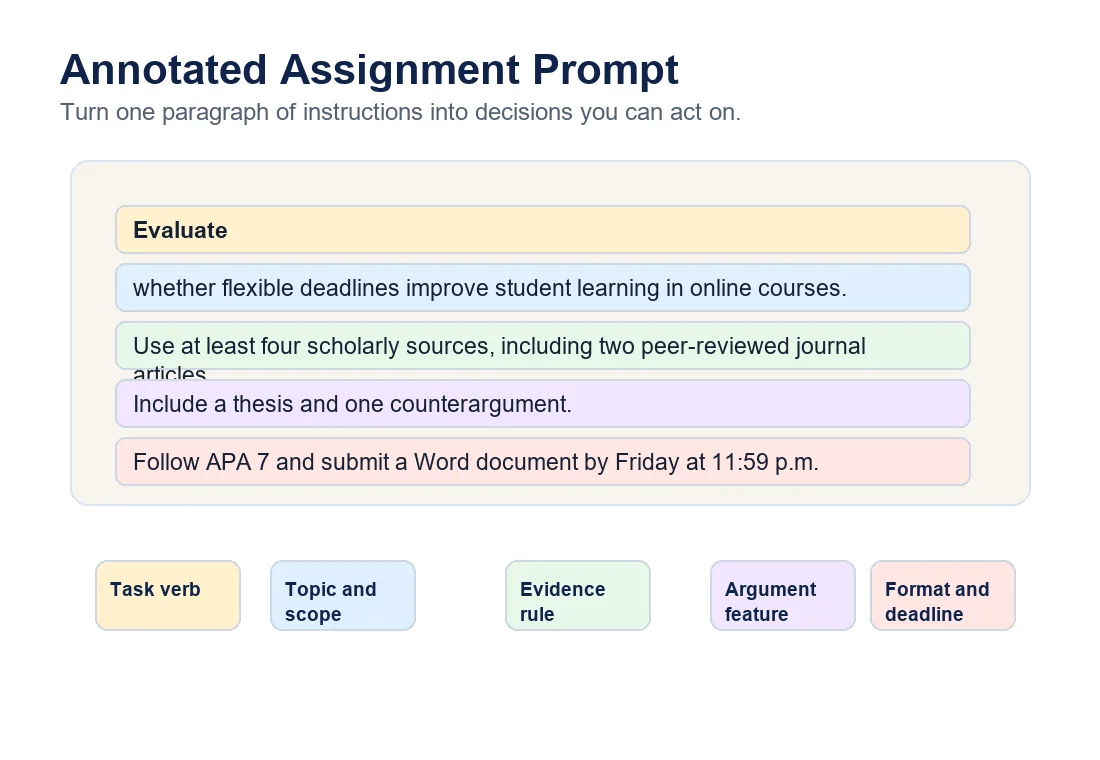
The action verb is evaluate. The topic is flexible deadlines and student learning in online courses. The scope is 1,500 words. The evidence rule is four scholarly sources, including two peer-reviewed journal articles. The format is APA 7, and the submission requirement is a Word document by Friday at 11:59 p.m.
A strong response would not simply list advantages and disadvantages. It would define criteria for improvement, use scholarly evidence, consider a reasonable objection, and make a final judgment. The annotated version turns the prompt into an outline before any drafting begins.
Weak Interpretation Versus Strong Interpretation
A weak interpretation usually notices the topic but misses the work. A strong interpretation identifies the task, requirements, and grading logic.
| Prompt wording | Weak interpretation | Strong interpretation | Why it matters |
|---|---|---|---|
| Evaluate whether flexible deadlines improve student learning. | I will write generally about online learning. | I will judge flexible deadlines using criteria such as learning, planning, stress, and accountability. | The strong version gives the paper a decision-making standard. |
| Use at least four scholarly sources, including two peer-reviewed journal articles. | I can use any four websites. | I need scholarly sources and must verify at least two are peer-reviewed journal articles. | The source rule changes the research plan and timeline. |
| Address at least one counterargument. | I will mention that some people disagree. | I will explain a reasonable objection and respond to it with evidence. | A counterargument needs fair treatment, not a throwaway sentence. |
| Follow APA 7 format. | I will add a references page at the end. | I will check title page, headings, in-text citations, references, spacing, and any instructor rules. | Formatting is part of the assignment, not decoration. |
Analyze Versus Describe
Describe asks what something is like. Analyze asks how it works, why it matters, or how its parts relate. If a prompt asks you to analyze a case, do not spend the whole paper retelling the case. Use description briefly, then explain patterns, causes, effects, or relationships.
Explain Versus Discuss
Explain usually wants clarity about a process, cause, or idea. Discuss usually wants more breadth: several points, perspectives, tensions, or implications. A discussion still needs structure. It is not an invitation to write anything loosely connected to the topic.
Evaluate Versus Summarize
Summarize condenses what a source or situation says. Evaluate makes a judgment using criteria. Many papers need some summary, but if the prompt says evaluate, summary should support the judgment rather than replace it.
Compare Versus Contrast
Compare focuses on similarities; contrast focuses on differences. Many prompts ask for both. The strongest structure uses the same categories for each item so the reader can see meaningful connections.
Reflect Versus Report
A report presents information. A reflection interprets experience and connects it to learning. Academic reflections often still require course concepts, professional standards, or evidence, so do not assume reflection means unsupported personal opinion.
Common Mistakes
The first mistake is starting with sources before understanding the task. Research is useful only when you know what question the sources need to answer. Otherwise, you may collect articles that create extra work but do not support the prompt.
The second mistake is ignoring small requirements. A missing file type, citation style, reply post, template, or counterargument can cost points even when the writing is thoughtful.
The third mistake is treating the rubric as a final proofreading tool. The rubric should shape the outline. If a criterion is heavily weighted, it should receive meaningful space in the response.
The fourth mistake is reading action verbs casually. Describe, analyze, evaluate, compare, discuss, and reflect are not interchangeable. If you are unsure what a verb means in your discipline, ask your instructor how it should be handled.
The fifth mistake is waiting too long to ask for clarification. A specific question such as “Should the two peer-reviewed sources be outside the course readings?” is easier to answer than a broad message saying the whole assignment is confusing.
Final Assignment-Prompt Checklist
- I can state the assignment task in one sentence.
- I have identified the command word and what it requires.
- I know the topic, scope, population, case, or course unit.
- I know how many sources are required and what type they must be.
- I know the required citation style and formatting rules.
- I know the word count or page range.
- I know the deadline, time zone, file type, and submission location.
- I have read the rubric and turned criteria into planning questions.
- I have built an outline that matches the prompt rather than a generic essay structure.
- I have written clarification questions for anything still uncertain.
Downloadable Resource
Use the StudyDoll Assignment Prompt Decoder to turn confusing instructions into a task summary, command-word guide, source checklist, citation checklist, rubric breakdown, research-question planner, and final submission checklist. It is a planning aid, not a substitute for doing your own work.
Download the PDF decoder Download the editable worksheet
FAQ
What should I do if the prompt is vague?
Write down your best interpretation, then ask a specific clarification question. Include the line that confuses you and explain what decision you are trying to make.
Should I follow the prompt or the rubric?
Follow both. If they appear to conflict, ask your instructor. The prompt usually defines the task, while the rubric explains how the work will be evaluated.
Can I use a template?
Yes, if it helps you plan and does not override the assignment instructions. Instructor-provided templates should usually take priority over generic templates.
What if I notice a requirement after drafting?
Pause and revise the plan before polishing sentences. A clean paragraph will not fix a paper that answers the wrong task.
How early should I read the prompt?
Read it as soon as it becomes available. Early reading helps you find source requirements, staged deadlines, unclear wording, and format rules before they become emergencies.
Conclusion
Reading an assignment prompt is the first planning step. A careful review tells you what kind of thinking the assignment requires, what evidence you need, how the final product should look, and how the rubric will judge the work.
Before writing, identify the command word, topic, scope, evidence, citation style, formatting, deadline, and rubric criteria. Then turn those notes into a checklist, research questions, and a response plan. That simple process can prevent the most frustrating revision of all: rewriting because the draft answered a different question.
Sources
- UNC Writing Center: Understanding Assignments
- Purdue OWL: Common Writing Assignments
- APA Style: Reference Examples
- Georgetown University Library: 15 Steps to Good Research
- Cornell Center for Teaching Innovation: Using Rubrics
Still Unsure What Your Assignment Is Asking?
Share your instructions and get help identifying the task, required evidence, structure, and next steps before you begin writing.