Learn how to decode a scholarship prompt, select an authentic story, demonstrate values, discuss financial need, explain funding use, and revise effectively.
Table of Contents
- What is a scholarship essay?
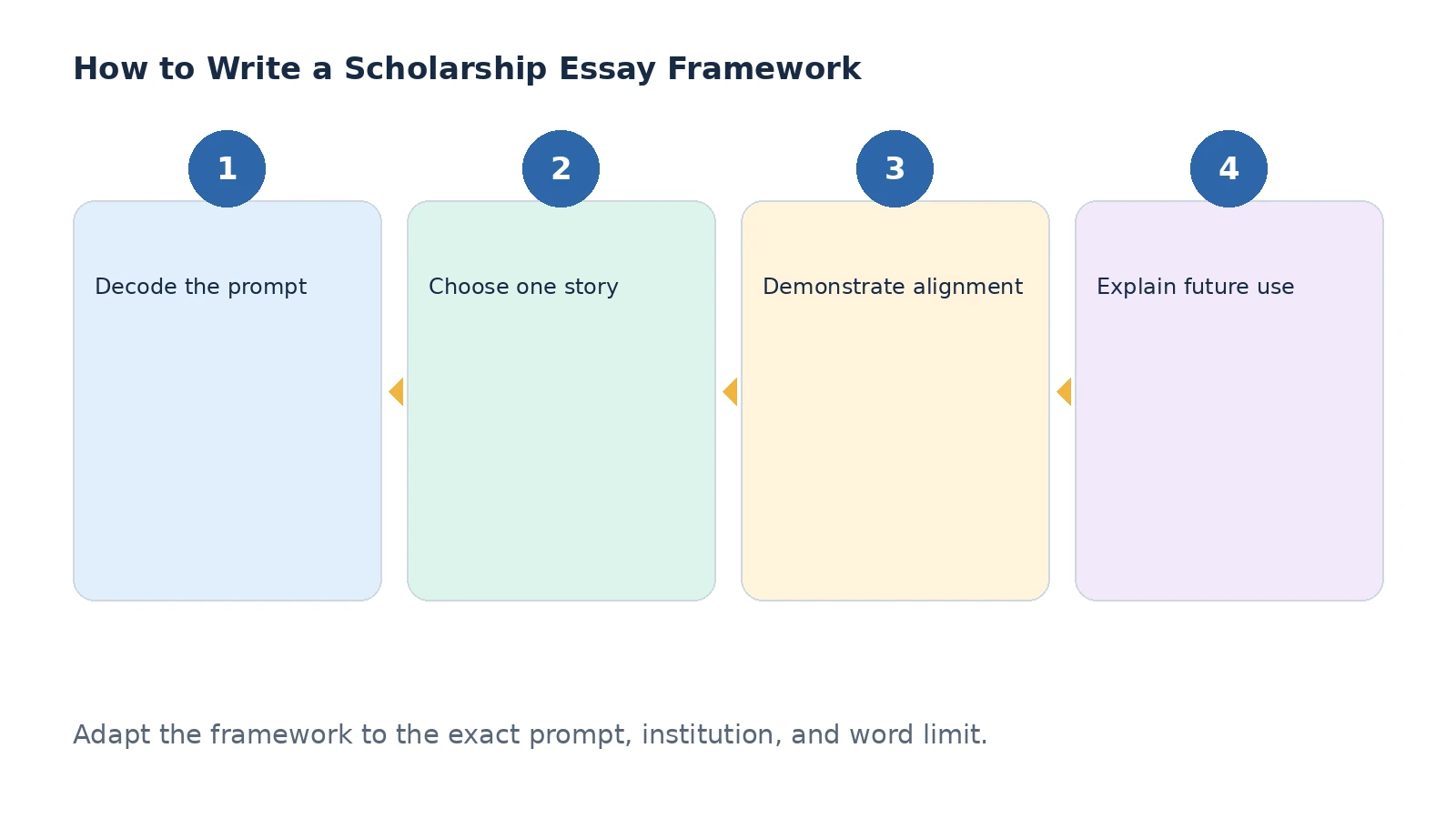
- 1. Decode the prompt and scholarship values
- 2. Choose one focused story
- 3. Write a controlling message
- 4. Scholarship essay structure
- 5. Write an opening that earns attention
- 6. Discuss financial need with dignity and specificity
- Complete scholarship essay example
- 7. Adapt responsibly for multiple scholarships
- Common scholarship essay mistakes
- How to revise a scholarship essay
- Editable scholarship essay template
- Frequently asked questions
- Scholarship essay checklist
- What readers need from this guide
- Four decisions to make before drafting
- Weak and improved approaches
- Paragraph workshop
- Using AI and outside feedback responsibly
- Practice topics and prompts
- StudyDoll internal-linking plan
- On-page quality and SEO review
- Final scholarship essay quality questions
- Expert editorial guidance
- An efficient start-to-finish workflow
- Credibility, privacy, and factual accuracy
- Submission and portal checks
- Expert editorial guidance
- An efficient start-to-finish workflow
- Credibility, privacy, and factual accuracy
- Submission and portal checks
- Expert editorial guidance
- An efficient start-to-finish workflow
- Credibility, privacy, and factual accuracy
- Submission and portal checks
- Expert editorial guidance
- An efficient start-to-finish workflow
- Credibility, privacy, and factual accuracy
- Submission and portal checks
- Expert editorial guidance
- An efficient start-to-finish workflow
- Credibility, privacy, and factual accuracy
- Submission and portal checks
What is a scholarship essay?
A scholarship essay is a focused response that helps a selection committee understand how an applicant’s experiences, values, goals, or plans connect with the purpose of a scholarship. It must answer the exact prompt while giving evidence of qualities the application form cannot fully show.
The strongest essays do not simply announce that the applicant deserves funding. They demonstrate alignment through specific experiences, decisions, growth, and future use of the opportunity.
For story and reflection techniques, review the personal essay guide, narrative essay guide, and reflective essay guide.
1. Decode the prompt and scholarship values
Underline every task in the prompt. A question may ask about leadership, financial need, community impact, a challenge, academic goals, or how funding will be used. Answer all parts explicitly.
Research the scholarship’s mission, eligibility, selection criteria, and sponsoring organization using official information. Look for recurring values, but do not force your story to imitate marketing language. Select genuine evidence that overlaps with the opportunity’s purpose.
| Prompt element | Planning question |
|---|---|
| Experience | Which specific event provides the strongest evidence? |
| Quality | What action demonstrates the quality instead of naming it? |
| Goal | What concrete next step will the scholarship support? |
| Impact | Who benefits, and what realistic result is expected? |
2. Choose one focused story
A resume may contain ten achievements; the essay needs a coherent center. Choose one experience or connected set of moments that answers the prompt and reveals how you think, act, learn, or contribute.
The best story is not always the most dramatic. A sustained tutoring commitment, family responsibility, work challenge, research question, or small act of initiative can be powerful when the essay explains decisions and growth.
3. Write a controlling message
Weak message
I am hardworking and deserve this scholarship.
Improved message
Balancing evening work with community tutoring taught me to turn limited time into reliable service, and this scholarship would allow me to reduce work hours while expanding the literacy project I have already begun.
The improved version connects evidence, quality, and future use of funding. The rest of the essay can prove that message.
4. Scholarship essay structure
- Opening scene: Enter a meaningful moment connected to the prompt.
- Context: Explain the situation and stakes without excessive background.
- Action: Show what you decided and did.
- Growth: Explain what changed in your skills or perspective.
- Alignment: Connect the experience to the scholarship’s values.
- Future use: Explain specifically how the award supports the next step.
- Ending: Return to the central image or forward movement.
5. Write an opening that earns attention
At 6:45 every Tuesday evening, I moved the library’s smallest chairs into a circle before the first reading student arrived. The children thought I was preparing a game. I was also learning how consistency can become a form of leadership.
The opening uses a specific action and creates a question. It avoids quotations, dictionary definitions, and a broad announcement about education.
6. Discuss financial need with dignity and specificity
When the prompt asks about need, explain relevant circumstances without turning the essay into a list of suffering. Show how financial limits affect educational choices, time, transportation, materials, housing, or work hours.
Connect funding to a realistic effect: reducing a shift, purchasing required equipment, completing an unpaid placement, covering transportation, or protecting study time. Do not promise that one award will eliminate every difficulty.
Complete scholarship essay example
The Tuesday Reading Circle
At 6:45 every Tuesday evening, I moved the library’s smallest chairs into a circle before the first student arrived. The children thought I was preparing a game. I was also learning how consistency can become a form of leadership.
I began volunteering after noticing that several children waited in the library while family members finished work. My first plan was ambitious: individual lessons, reading assessments, and weekly worksheets. The students ignored most of it. They wanted stories, competition, and a reason to return.
I changed the program. Each session began with a shared story, followed by short partner reading and a challenge chosen by the group. Attendance became more regular, and two older students began helping younger readers. Leadership, I learned, was less about delivering my original plan than creating a structure other people could use and improve.
I continued the reading circle while working evening shifts to help cover college expenses. The schedule required careful planning, and some weeks I arrived at the library directly from work. The experience strengthened my commitment to education, but it also showed how paid work limits the time available for service and study.
This scholarship would allow me to reduce one weekly shift during the next academic year. I would use that time to complete my education courses and develop reusable reading activities for the library program. The award would not create the commitment; the Tuesday circle already exists. It would give that commitment room to grow.
The smallest chairs still require ten minutes to arrange. They remind me that meaningful leadership often begins before anyone arrives and continues through the willingness to change a plan when the people it serves need something different.
7. Adapt responsibly for multiple scholarships
You can reuse a story or experience, but do not submit one unchanged essay to unrelated prompts. Create a core story bank, then rewrite the framing, examples, alignment, and future-use section for each scholarship.
Track each application in a spreadsheet with the organization, prompt, deadline, word limit, required documents, and final filename. Never assume two portals count words in the same way.
Common scholarship essay mistakes
Repeating the resume
Use the essay to reveal meaning, decisions, and growth behind one or two experiences.
Ignoring the sponsor’s purpose
Show genuine alignment with the scholarship’s stated values and goals.
Using a hardship without reflection
Explain action, learning, and context rather than relying on difficulty alone.
Making vague funding claims
State the specific educational step the award would support.
Submitting one generic essay everywhere
Adapt the response to every prompt and organization.
Need personalized writing support?
Submit the complete prompt, rubric or application instructions, word limit, deadline, and any required background through the StudyDoll order page. Use support in accordance with institutional rules and make sure the final submission remains accurate and authentically yours.
How to revise a scholarship essay
Revise in layers. First confirm that the draft answers the exact prompt and presents the most relevant evidence about the applicant or argument. Remove interesting material that does not serve that purpose.
Next create a reverse outline by describing the job of every paragraph in one sentence. The sequence should reveal development, not a list of accomplishments or repeated claims. Merge overlapping sections and add missing transitions.
Then strengthen specificity. Replace broad claims with scenes, decisions, examples, evidence, or precise language. Finally edit for voice, concision, grammar, word count, formatting, and factual accuracy. Read aloud and obtain feedback from someone who will protect your voice rather than rewrite it into theirs.
Editable scholarship essay template
Scholarship and official mission:
Prompt tasks:
Word limit:
Core quality or value:
Focused story:
Action taken:
Growth or insight:
Evidence of impact:
Specific use of funding:
Ending image or forward step:
Download the free scholarship essay planning worksheet (PDF).
Frequently asked questions
Should I say that I deserve the scholarship?
Demonstrate fit and impact through evidence rather than repeatedly asserting deservingness.
Can I reuse a scholarship essay?
You can reuse material, but adapt the response to the exact prompt and sponsor.
Should I discuss financial need?
Only when the prompt or selection criteria make it relevant.
Can I use humor?
Yes when it is natural, respectful, and does not weaken the seriousness of the response.
How should I end?
Connect the experience to a realistic next step or return to a meaningful opening image.
Scholarship essay checklist
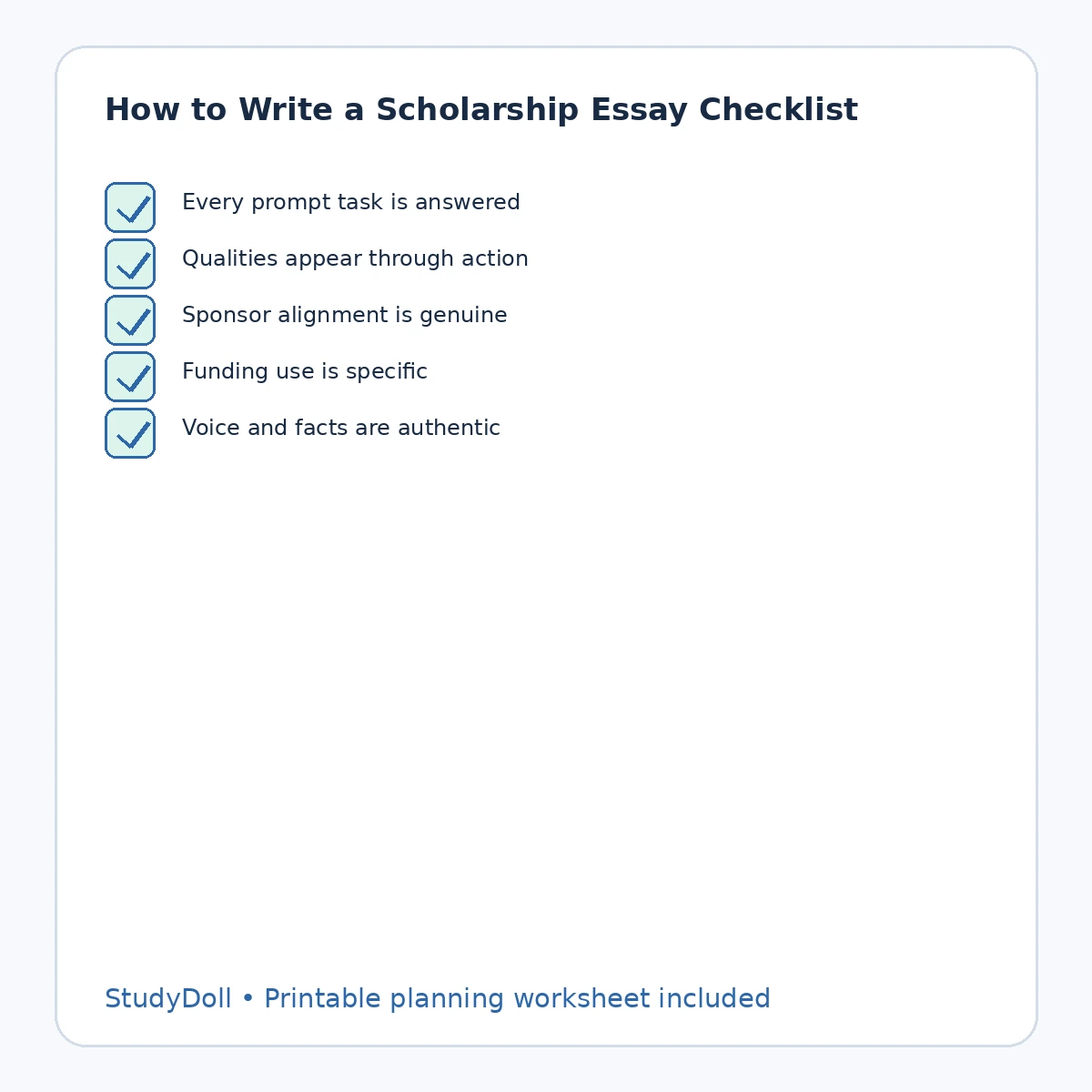
- Every part of the prompt is answered.
- The essay uses one coherent story or message.
- Qualities are demonstrated through action.
- The sponsor’s values are connected naturally.
- Financial need is explained with dignity where relevant.
- The use of funding is specific and realistic.
- The voice remains authentic.
- The word limit and application requirements are followed.
What readers need from this guide
Readers need a method for decoding the prompt, selecting a story, demonstrating values, discussing need, explaining future use, and adapting material without submitting a generic response.
A strong authority page should provide the answer near the top, then help readers brainstorm, select, structure, draft, revise, and submit. Examples should demonstrate decisions rather than give language to copy. Worksheets and graphics should add practical value rather than repeat the article.
Four decisions to make before drafting
| Decision | What to consider |
|---|---|
| Prompt focus | Which exact question and criteria must be answered? |
| Evidence | Which action or result demonstrates the claimed quality? |
| Alignment | How does the story connect naturally with the sponsor's mission? |
| Future use | What specific educational step will funding make possible? |
Write down each decision before drafting. When a paragraph feels difficult, return to this table. The problem is often an unresolved choice about purpose, evidence, audience, or scope rather than a lack of vocabulary.
Weak and improved approaches
| Weak approach | Improved direction |
|---|---|
| I have always been a leader. | Organizing a weekly reading circle taught me to revise a plan around the people it served. |
| This scholarship will change my life. | The award would allow me to reduce one work shift and complete the required unpaid placement. |
| I overcame many challenges. | After losing reliable transportation, I coordinated rides and changed my course schedule to remain enrolled. |
The improved examples are not formulas. They reveal editorial choices such as narrower focus, stronger evidence, clearer causation, or more credible qualification.
Paragraph workshop
Give each paragraph one clear purpose. A paragraph may establish context, develop a scene, explain growth, connect experience to a future goal, address fit, or present a central reason. It should not attempt all of these at once.
Before drafting, write the question the paragraph will answer. After drafting, underline the sentence that answers it. If no sentence does, revise the paragraph’s focus. Read topic sentences in sequence to confirm that the paper develops rather than repeats.
Use paragraph endings to interpret. Do not end immediately after an example. Explain what the event, evidence, or detail reveals and how it advances the central idea.
Using AI and outside feedback responsibly
AI can help brainstorm questions, organize notes, identify repetition, or suggest revision questions. It should not invent experiences, awards, hardships, research findings, or institutional facts. For application writing, the final voice and claims must remain authentic to the applicant.
Do not paste confidential personal information into tools without understanding their privacy practices. Verify all dates, program names, requirements, and factual claims. Follow the relevant institution’s rules about AI-assisted writing and disclosure.
Ask human reviewers to describe their reading experience: where attention dropped, what quality they saw, which transition felt abrupt, or what remained unclear. A reviewer who rewrites every sentence may erase the applicant’s voice.
Practice topics and prompts
- Describe a community contribution that changed your understanding of leadership.
- Explain how financial circumstances have shaped your educational choices.
- Describe a problem you want your education to help address.
- Discuss an experience that demonstrates persistence.
- Explain how this scholarship connects to your next academic step.
- Describe a time you changed your approach after feedback.
Use practice prompts to develop material, not to produce one generic response for every application or assignment. Adapt the final piece to the actual prompt, organization, institution, or audience.
StudyDoll internal-linking plan
- Personal essay guide – helps develop voice and focused reflection
- Narrative essay guide – supports scene and pacing
- How to start an essay – offers relevant opening strategies
Place links where readers naturally encounter the next problem. Descriptive anchor text is more useful than “click here.” Keep the order link inside a clearly labeled support box and a relevant closing context rather than repeating it throughout the article.
On-page quality and SEO review
Use one H1, clear H2 and H3 headings, a working table of contents, readable paragraphs, descriptive internal links, and responsive tables. Keep the primary keyword natural and use related language where it improves clarity.
Use a unique SEO title and meta description that accurately promise the page’s value. Do not guarantee admission, scholarships, grades, or search rankings. Preserve an indexed slug and verify every public URL after publishing.
Preview on desktop and mobile. Confirm that images remain readable, tables do not break the layout, the PDF opens, internal links work, and no editor-only asset instructions remain visible.
Final scholarship essay quality questions
- Does the essay answer every task in the prompt?
- Can the committee see the applicant's qualities through decisions and actions?
- Is the connection to the scholarship genuine rather than copied from its website?
- Is financial need discussed only as specifically as necessary?
- Does the future-use section name a realistic next step?
- Could this essay belong only to this applicant?
Answer each question with evidence from the draft. If the answer is only “yes,” identify the exact paragraph, detail, or sentence that proves it. This turns a generic checklist into an editorial test.
Finally compare the draft with the original prompt or application portal. Confirm the word limit, formatting, deadline, required name fields, file type, and whether the title or references count toward the limit.
Expert editorial guidance
- Demonstrate qualities through choices and sustained actions.
- Connect funding to a specific next step.
- Adapt the essay to the sponsor without imitating its language.
- Use financial context to explain choices rather than seek pity.
- Keep the applicant, not a mentor or family member, at the center.
Apply these principles during revision rather than inserting them mechanically into the final text. The finished scholarship essay should feel focused and natural, not like a visible checklist.
When two recommendations conflict, return to the official prompt and audience. A 250-word response cannot include the same background and development as a 1,000-word response. Preserve the central evidence and insight, then compress context and repetition.
An efficient start-to-finish workflow
- Decode: Separate every prompt task and selection criterion.
- Research: Verify the scholarship mission and rules.
- Select: Choose one story that demonstrates alignment.
- Draft: Connect scene, action, growth, and future use.
- Adapt: Rewrite the framing for the specific scholarship.
- Review: Check authenticity, word limit, and application fields.
Keep brainstorming, drafting, and proofreading distinct when possible. Editing every sentence while discovering the main point can weaken voice and slow progress. Save versions with clear filenames and submit only the final reviewed file.
Credibility, privacy, and factual accuracy
Verify names, dates, program features, award details, course titles, employment responsibilities, and outcomes. Never invent numbers or imply that an activity had an impact you did not measure.
Protect private information about relatives, clients, patients, coworkers, and students. Describe only what is necessary, and distinguish your interpretation from another person’s motives or feelings.
Do not claim that a writing method guarantees selection, funding, admission, or a grade. Strong writing improves communication; the final decision depends on many factors outside the essay.
Submission and portal checks
Confirm whether the portal uses a word limit or character limit, whether spaces count, and whether formatting is preserved. Paste from a plain-text version when the portal introduces strange spacing, then restore paragraph breaks carefully.
Preview the final submission, verify the correct application and prompt, and keep a copy of exactly what was submitted. Do not assume an autosave or confirmation email means every field was complete.
Expert editorial guidance
- Demonstrate qualities through choices and sustained actions.
- Connect funding to a specific next step.
- Adapt the essay to the sponsor without imitating its language.
- Use financial context to explain choices rather than seek pity.
- Keep the applicant, not a mentor or family member, at the center.
Apply these principles during revision rather than inserting them mechanically into the final text. The finished scholarship essay should feel focused and natural, not like a visible checklist.
When two recommendations conflict, return to the official prompt and audience. A 250-word response cannot include the same background and development as a 1,000-word response. Preserve the central evidence and insight, then compress context and repetition.
An efficient start-to-finish workflow
- Decode: Separate every prompt task and selection criterion.
- Research: Verify the scholarship mission and rules.
- Select: Choose one story that demonstrates alignment.
- Draft: Connect scene, action, growth, and future use.
- Adapt: Rewrite the framing for the specific scholarship.
- Review: Check authenticity, word limit, and application fields.
Keep brainstorming, drafting, and proofreading distinct when possible. Editing every sentence while discovering the main point can weaken voice and slow progress. Save versions with clear filenames and submit only the final reviewed file.
Credibility, privacy, and factual accuracy
Verify names, dates, program features, award details, course titles, employment responsibilities, and outcomes. Never invent numbers or imply that an activity had an impact you did not measure.
Protect private information about relatives, clients, patients, coworkers, and students. Describe only what is necessary, and distinguish your interpretation from another person’s motives or feelings.
Do not claim that a writing method guarantees selection, funding, admission, or a grade. Strong writing improves communication; the final decision depends on many factors outside the essay.
Submission and portal checks
Confirm whether the portal uses a word limit or character limit, whether spaces count, and whether formatting is preserved. Paste from a plain-text version when the portal introduces strange spacing, then restore paragraph breaks carefully.
Preview the final submission, verify the correct application and prompt, and keep a copy of exactly what was submitted. Do not assume an autosave or confirmation email means every field was complete.
Expert editorial guidance
- Demonstrate qualities through choices and sustained actions.
- Connect funding to a specific next step.
- Adapt the essay to the sponsor without imitating its language.
- Use financial context to explain choices rather than seek pity.
- Keep the applicant, not a mentor or family member, at the center.
Apply these principles during revision rather than inserting them mechanically into the final text. The finished scholarship essay should feel focused and natural, not like a visible checklist.
When two recommendations conflict, return to the official prompt and audience. A 250-word response cannot include the same background and development as a 1,000-word response. Preserve the central evidence and insight, then compress context and repetition.
An efficient start-to-finish workflow
- Decode: Separate every prompt task and selection criterion.
- Research: Verify the scholarship mission and rules.
- Select: Choose one story that demonstrates alignment.
- Draft: Connect scene, action, growth, and future use.
- Adapt: Rewrite the framing for the specific scholarship.
- Review: Check authenticity, word limit, and application fields.
Keep brainstorming, drafting, and proofreading distinct when possible. Editing every sentence while discovering the main point can weaken voice and slow progress. Save versions with clear filenames and submit only the final reviewed file.
Credibility, privacy, and factual accuracy
Verify names, dates, program features, award details, course titles, employment responsibilities, and outcomes. Never invent numbers or imply that an activity had an impact you did not measure.
Protect private information about relatives, clients, patients, coworkers, and students. Describe only what is necessary, and distinguish your interpretation from another person’s motives or feelings.
Do not claim that a writing method guarantees selection, funding, admission, or a grade. Strong writing improves communication; the final decision depends on many factors outside the essay.
Submission and portal checks
Confirm whether the portal uses a word limit or character limit, whether spaces count, and whether formatting is preserved. Paste from a plain-text version when the portal introduces strange spacing, then restore paragraph breaks carefully.
Preview the final submission, verify the correct application and prompt, and keep a copy of exactly what was submitted. Do not assume an autosave or confirmation email means every field was complete.
Expert editorial guidance
- Demonstrate qualities through choices and sustained actions.
- Connect funding to a specific next step.
- Adapt the essay to the sponsor without imitating its language.
- Use financial context to explain choices rather than seek pity.
- Keep the applicant, not a mentor or family member, at the center.
Apply these principles during revision rather than inserting them mechanically into the final text. The finished scholarship essay should feel focused and natural, not like a visible checklist.
When two recommendations conflict, return to the official prompt and audience. A 250-word response cannot include the same background and development as a 1,000-word response. Preserve the central evidence and insight, then compress context and repetition.
An efficient start-to-finish workflow
- Decode: Separate every prompt task and selection criterion.
- Research: Verify the scholarship mission and rules.
- Select: Choose one story that demonstrates alignment.
- Draft: Connect scene, action, growth, and future use.
- Adapt: Rewrite the framing for the specific scholarship.
- Review: Check authenticity, word limit, and application fields.
Keep brainstorming, drafting, and proofreading distinct when possible. Editing every sentence while discovering the main point can weaken voice and slow progress. Save versions with clear filenames and submit only the final reviewed file.
Credibility, privacy, and factual accuracy
Verify names, dates, program features, award details, course titles, employment responsibilities, and outcomes. Never invent numbers or imply that an activity had an impact you did not measure.
Protect private information about relatives, clients, patients, coworkers, and students. Describe only what is necessary, and distinguish your interpretation from another person’s motives or feelings.
Do not claim that a writing method guarantees selection, funding, admission, or a grade. Strong writing improves communication; the final decision depends on many factors outside the essay.
Submission and portal checks
Confirm whether the portal uses a word limit or character limit, whether spaces count, and whether formatting is preserved. Paste from a plain-text version when the portal introduces strange spacing, then restore paragraph breaks carefully.
Preview the final submission, verify the correct application and prompt, and keep a copy of exactly what was submitted. Do not assume an autosave or confirmation email means every field was complete.
Expert editorial guidance
- Demonstrate qualities through choices and sustained actions.
- Connect funding to a specific next step.
- Adapt the essay to the sponsor without imitating its language.
- Use financial context to explain choices rather than seek pity.
- Keep the applicant, not a mentor or family member, at the center.
Apply these principles during revision rather than inserting them mechanically into the final text. The finished scholarship essay should feel focused and natural, not like a visible checklist.
When two recommendations conflict, return to the official prompt and audience. A 250-word response cannot include the same background and development as a 1,000-word response. Preserve the central evidence and insight, then compress context and repetition.
An efficient start-to-finish workflow
- Decode: Separate every prompt task and selection criterion.
- Research: Verify the scholarship mission and rules.
- Select: Choose one story that demonstrates alignment.
- Draft: Connect scene, action, growth, and future use.
- Adapt: Rewrite the framing for the specific scholarship.
- Review: Check authenticity, word limit, and application fields.
Keep brainstorming, drafting, and proofreading distinct when possible. Editing every sentence while discovering the main point can weaken voice and slow progress. Save versions with clear filenames and submit only the final reviewed file.
Credibility, privacy, and factual accuracy
Verify names, dates, program features, award details, course titles, employment responsibilities, and outcomes. Never invent numbers or imply that an activity had an impact you did not measure.
Protect private information about relatives, clients, patients, coworkers, and students. Describe only what is necessary, and distinguish your interpretation from another person’s motives or feelings.
Do not claim that a writing method guarantees selection, funding, admission, or a grade. Strong writing improves communication; the final decision depends on many factors outside the essay.
Submission and portal checks
Confirm whether the portal uses a word limit or character limit, whether spaces count, and whether formatting is preserved. Paste from a plain-text version when the portal introduces strange spacing, then restore paragraph breaks carefully.
Preview the final submission, verify the correct application and prompt, and keep a copy of exactly what was submitted. Do not assume an autosave or confirmation email means every field was complete.