Learn how to define a problem, design a feasible solution, address costs and objections, plan implementation, evaluate results, and use a printable worksheet.
Table of Contents
- What is a proposal essay?
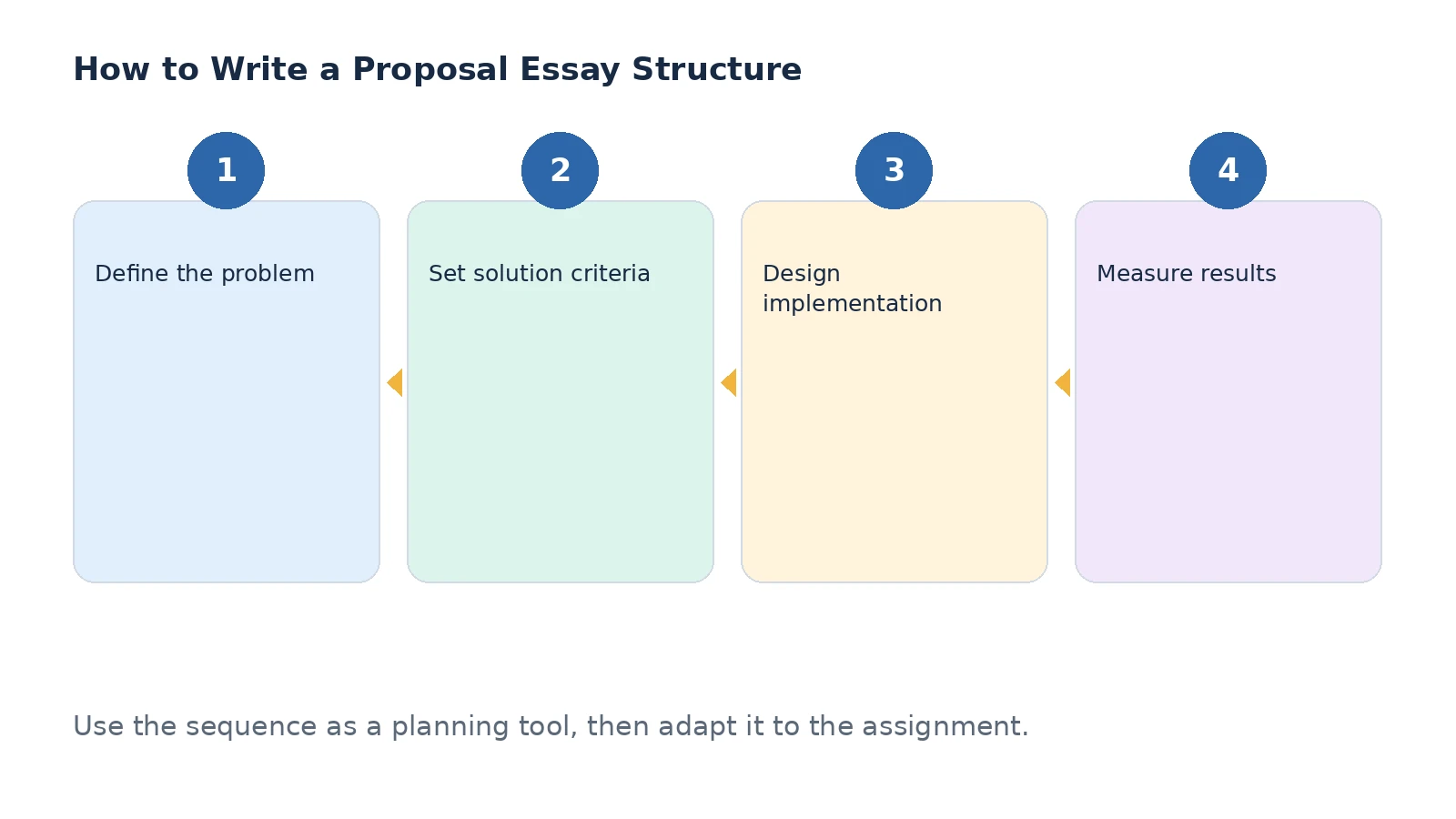
- 1. Define the problem precisely
- 2. Identify the decision-maker
- 3. Establish solution criteria
- 4. Design the solution
- 5. Write a proposal thesis
- 6. Proposal essay outline
- 7. Write the introduction
- 8. Support both the problem and solution
- 9. Explain implementation
- Complete proposal essay example
- 10. Address objections and alternatives
- 11. Create an evaluation plan
- Common proposal-essay mistakes
- How to revise a proposal essay
- Editable proposal essay template
- Frequently asked questions
- Proposal essay checklist
- Advanced quality standards
- What students searching for “proposal essay” usually need
- Key decisions writers must make
- Weak and improved writing examples
- Paragraph workshop
- Using sources without losing the writer’s voice
- Turn the rubric into a revision map
- Topic ideas and practice prompts
- Internal-linking plan for this authority page
- How to use the supplied visual assets
- How to use the printable worksheet
- Five editing layers
- Mobile, accessibility, and on-page SEO checks
- Final publish-readiness review
- How to study the worked example
- Expert editorial notes
- Credibility and editorial trust
- Building a genuinely useful FAQ section
- Final quality questions
- Common misconceptions about the proposal essay
- An efficient start-to-finish workflow
- Publication strategy for StudyDoll
- Additional proposal essay review practice
- Additional proposal essay review practice
What is a proposal essay?
A proposal essay identifies a specific problem, recommends a practical response, and demonstrates that the solution is justified, feasible, and preferable to realistic alternatives.
A proposal is more than an opinion that something should change. It needs evidence about the problem, a clear plan, resources, implementation steps, likely benefits, limitations, and evaluation.
A strong proposal essay begins with the exact assignment. Identify the task verb, audience, word count, required sources, citation style, and rubric. Turn the prompt into one focused question, then design the paper around the answer.
Use the complete essay-writing guide, essay outline guide, and essay introduction guide whenever you need help with the general writing process.
1. Define the problem precisely
“Students are stressed” is too broad. “Many evening students cannot reach tutoring because services close before their classes end” identifies a population, access barrier, and institutional setting.
Establish scope with credible evidence. Explain who is affected, how often, what consequence follows, and why current responses are insufficient. Avoid inflating the problem to make the proposal seem necessary.
2. Identify the decision-maker
A proposal should address an audience capable of acting: a department, university administrator, employer, city council, agency, or community organization. Research the audience’s authority, priorities, constraints, and decision process.
3. Establish solution criteria
Before selecting a solution, define what a successful response must accomplish. Criteria may include effectiveness, equity, cost, speed, sustainability, accessibility, legal compliance, and administrative burden.
4. Design the solution
Explain who will do what, when, where, with which resources, and under whose authority. Include a realistic implementation timeline and identify dependencies.
5. Write a proposal thesis
Weak thesis
The university should improve tutoring.
Improved thesis
The university should pilot two evening virtual tutoring sessions each week for high-enrollment first-year courses because the model addresses a documented scheduling gap, uses existing online systems, and can be evaluated before permanent expansion.
6. Proposal essay outline
- Introduction: present the evening-access problem and thesis.
- Problem evidence: show who is affected and why current hours fail.
- Criteria: accessibility, cost, quality, and feasibility.
- Proposal: define schedule, staffing, training, technology, and promotion.
- Implementation: timeline and responsibilities.
- Budget/resources: identify costs and existing capacity.
- Objections: demand uncertainty, tutor availability, and quality control.
- Evaluation: attendance, satisfaction, outcomes, and cost.
- Conclusion: request a limited pilot.
7. Write the introduction
Evening students often finish class after campus tutoring has closed. The university currently offers online appointment requests, but few same-day options are available outside business hours. The university should pilot two evening virtual tutoring blocks each week for high-enrollment first-year courses because the model addresses a documented scheduling gap, uses existing technology, and can be evaluated before permanent expansion.
8. Support both the problem and solution
Evidence that a problem exists does not automatically prove that the proposed solution will work. Use separate evidence for need, mechanism, feasibility, and expected results.
Local data is particularly valuable: service hours, student schedules, appointment requests, waitlists, surveys, and existing technology. External research can support design principles, but implementation should fit the local context.
9. Explain implementation
| Element | Questions |
|---|---|
| Leadership | Who owns the pilot? |
| Staffing | Who provides service and training? |
| Technology | Which existing platform is used? |
| Timeline | When does recruitment, launch, and review occur? |
| Communication | How will eligible students learn about it? |
| Quality | How will sessions be supervised and improved? |
Complete proposal essay example
A One-Semester Evening Tutoring Pilot
Many evening students complete work and family responsibilities before arriving on campus, yet tutoring services often close before their classes end. This scheduling mismatch limits access to support already funded by the university. The university should pilot two evening virtual tutoring blocks each week for high-enrollment first-year courses because the model addresses a documented access gap, uses existing technology, and can be evaluated before expansion.
The problem is not the complete absence of tutoring. It is that current availability does not match the schedules of a specific student group. Appointment records and student surveys can establish which courses and hours show unmet demand.
The pilot would run for one semester. Trained peer tutors would offer two ninety-minute drop-in blocks through the university’s existing video platform. The tutoring center would select three high-enrollment courses, provide training, and assign a staff coordinator. Faculty would announce the service and include the link in the learning platform.
The proposal limits cost by using current technology and a small course set. Main expenses would involve tutor wages and coordinator time. A pilot avoids committing to permanent staffing before demand is measured.
Potential concerns include low attendance and inconsistent quality. The center can address these through targeted promotion, tutor preparation, observation, and brief student feedback. If use remains low, the university can discontinue or redesign the program without a large sunk cost.
Evaluation should include attendance, repeat use, student satisfaction, tutor reports, cost per contact, and course outcomes where appropriate. The goal is not to prove that tutoring alone changes grades but to determine whether evening access is used and feasible.
A limited pilot is a proportionate response to a clear scheduling gap. It gives evening students a realistic opportunity to use support and gives the university local evidence for the next decision.
10. Address objections and alternatives
Consider doing nothing, expanding existing hours, using asynchronous resources, contracting external services, or redesigning course support. Explain why your proposal performs better against the stated criteria.
11. Create an evaluation plan
Define process measures, short-term outcomes, cost, and decision rules before implementation. Avoid choosing only measures likely to make the proposal look successful.
Common proposal-essay mistakes
Describing a problem without a plan
Specify action, responsibility, timeline, and resources.
Proposing a solution without evidence
Support both need and mechanism.
Ignoring cost and feasibility
Identify resources and realistic constraints.
Using a universal solution
Fit the response to the local context and population.
Skipping evaluation
Explain how decision-makers will know whether the proposal works.
Need personalized academic writing support?
Submit your complete prompt, rubric, source requirements, citation style, and deadline through the StudyDoll order page. Use all support according to your institution’s academic-integrity rules and review the final work carefully.
How to revise a proposal essay
Begin with the prompt and purpose. Confirm that the paper performs the required task, uses a logical structure, and stays within scope. Move, combine, add, or remove sections before editing individual sentences.
Create a reverse outline by describing the job of every paragraph in one sentence. The sequence should show a developing explanation or argument. If two paragraphs perform the same job, combine or differentiate them. If a paragraph has no clear purpose, revise or remove it.
Next inspect evidence, examples, and explanation. Every detail should support a visible claim. Then edit for clarity, concision, grammar, citation, transitions, headings, and formatting. Read aloud and proofread after the final layout is complete.
Editable proposal essay template
Problem:
Affected population:
Decision-maker:
Evidence of need:
Solution criteria:

Proposal:
- Action:
- Responsibility:
- Timeline:
- Resources:
- Communication:
- Quality safeguards:

Alternatives:
Objections and responses:
Evaluation measures:
Decision rule:
Working thesis:
Download the free proposal essay planning worksheet (PDF)
Frequently asked questions
Does a proposal essay need research?
Usually yes. Research should establish the problem and support the solution’s feasibility.
Can I propose a pilot?
Yes. A limited pilot is often more realistic when local evidence is incomplete.
Should I include a budget?
Include at least resource categories and reasonable estimates when cost matters.
How do I address objections?
Represent them fairly and show safeguards, tradeoffs, or limitations.
What makes a proposal feasible?
Clear authority, resources, timeline, implementation details, and evaluation.
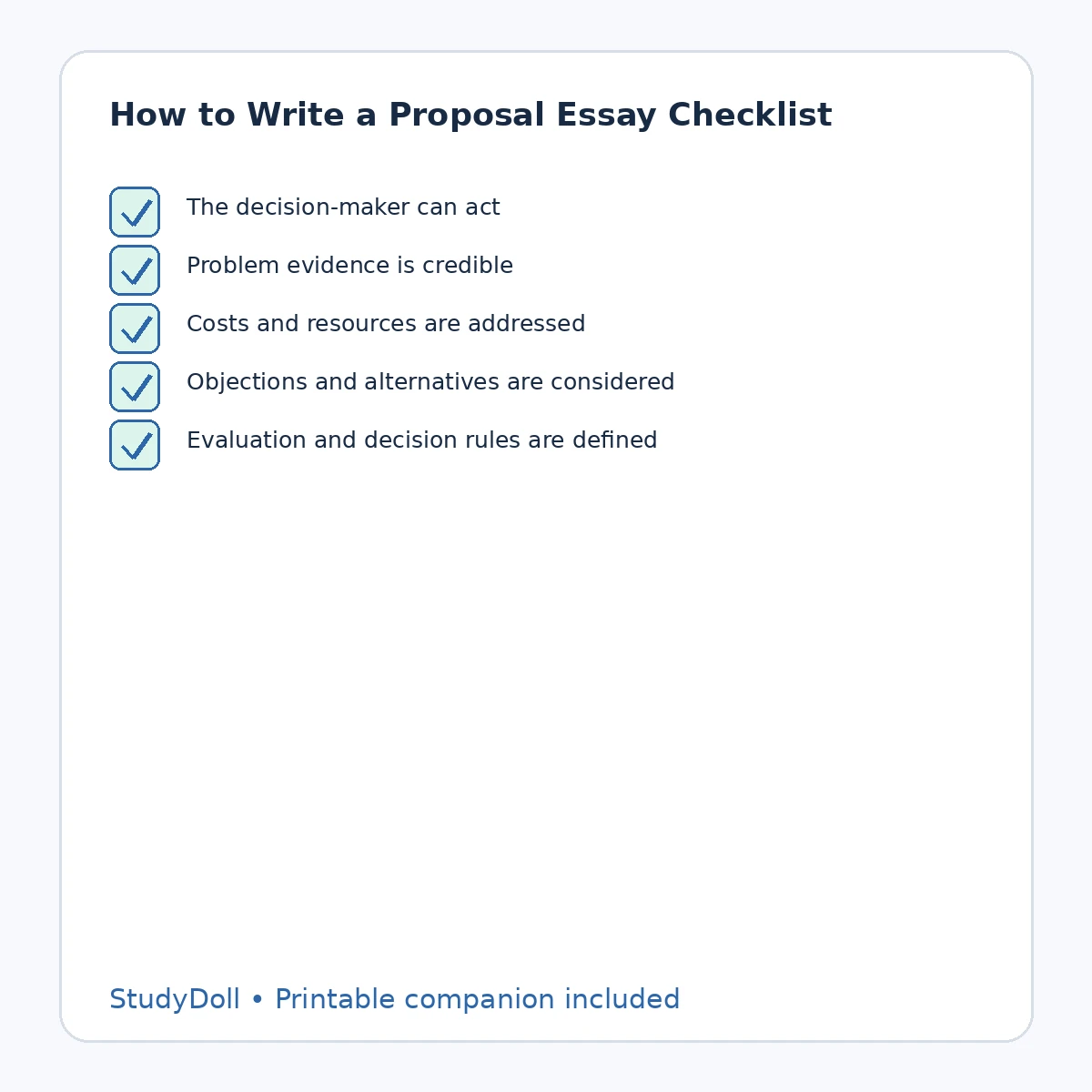
Proposal essay checklist
- The problem is specific and evidenced.
- The audience can act.
- Solution criteria are visible.
- The proposal states who, what, when, and how.
- Resources and costs are addressed.
- Alternatives and objections are considered.
- Implementation is realistic.
- Evaluation measures and decision rules are defined.
Advanced quality standards
A premium proposal resource should include an implementation table, budget worksheet, evaluation matrix, worked example, and downloadable planning template. Original diagrams can show the path from problem evidence to criteria, solution, implementation, and evaluation.
Link to the argumentative essay guide for evidence and counterarguments and the cause-and-effect guide when diagnosing the problem.
What students searching for “proposal essay” usually need
They need to define a real problem, identify a decision-maker, compare solution criteria, design implementation, address costs and objections, and explain how results will be evaluated.
A high-quality guide should answer the main question immediately, then support the reader through planning, drafting, revision, and submission. It should provide a worked example, a usable template, common mistakes, and a clear checklist. Long content is useful only when every section solves a distinct problem.
For SEO and reader experience, place the direct answer and core structure near the top. Use descriptive headings that match real student questions. Add original graphics where a sequence, comparison, or decision is easier to understand visually. Keep promotional material limited to genuinely helpful support points.
Key decisions writers must make
| Decision | What to consider |
|---|---|
| Problem evidence | Whether the need is measured and local enough |
| Decision-maker | Who has authority, budget, and responsibility |
| Feasibility | Resources, timeline, staffing, technology, and legal limits |
| Evaluation | What measures and decision rules determine success |
These decisions should be made before sentence-level drafting. A weak plan often creates a polished paper that performs the wrong task. Return to the prompt whenever a decision becomes uncertain.
Write each decision in your notes and add one sentence explaining why it fits the assignment. This creates a record you can use during revision and helps prevent random structural changes near the deadline.
Weak and improved writing examples
| Weak version | Improved direction |
|---|---|
| The school should offer more help. | The university should pilot two evening virtual tutoring blocks for three high-enrollment courses and evaluate use, cost, and student access after one semester. |
| This solution will fix the problem. | The pilot addresses the scheduling barrier but will not solve every reason students avoid tutoring. |
| The program will be cheap. | The proposal uses existing software, while personnel, training, promotion, and evaluation remain direct costs. |
The improved versions are not formulas to copy. They demonstrate decisions: narrower scope, clearer purpose, more precise language, stronger boundaries, or visible reasoning. Adapt the principle to your own subject.
When revising, highlight vague words such as things, good, bad, important, many, and a lot. Replace them with the specific feature, consequence, audience, quantity, or relationship you mean.