Learn how to explain a process accurately with prerequisites, stages, transitions, decisions, troubleshooting, visuals, a full example, and a printable worksheet.
Table of Contents
- What is a process essay?
- Directional versus informational process essays
- 1. Choose a manageable process
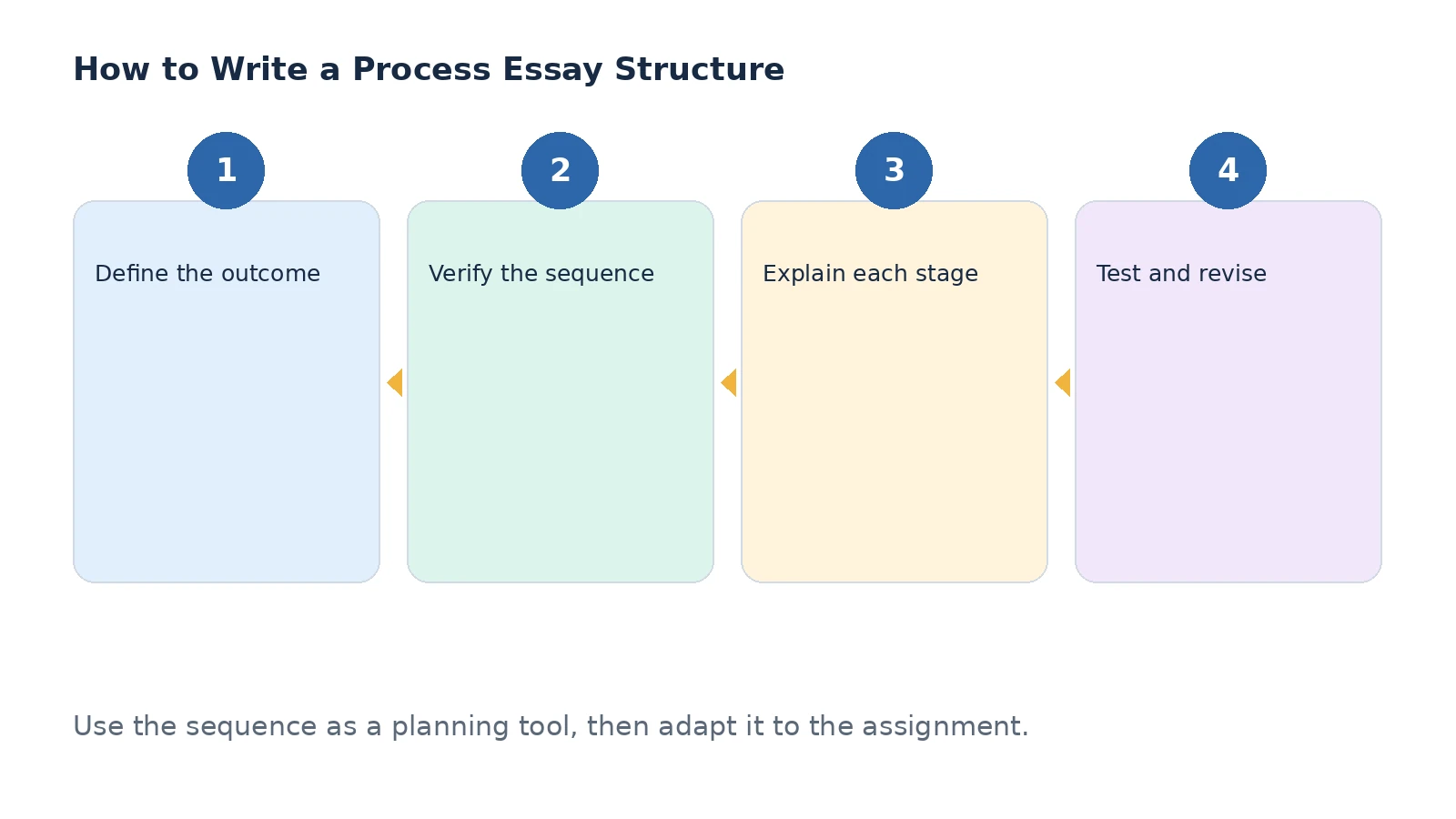
- 2. Verify the sequence
- 3. Write a process thesis
- 4. Build a process outline
- 5. Write a useful introduction
- 6. Explain steps with context
- 7. Use process transitions
- Complete process essay example
- How visuals improve a process essay
- Common process-essay mistakes
- How to revise a process essay
- Editable process essay template
- Frequently asked questions
- Process essay checklist
- Advanced quality standards
- What students searching for “process essay” usually need
- Key decisions writers must make
- Weak and improved writing examples
- Paragraph workshop
- Using sources without losing the writer’s voice
- Turn the rubric into a revision map
- Topic ideas and practice prompts
- Internal-linking plan for this authority page
- How to use the supplied visual assets
- How to use the printable worksheet
- Five editing layers
- Mobile, accessibility, and on-page SEO checks
- Final publish-readiness review
- How to study the worked example
- Expert editorial notes
- Credibility and editorial trust
- Building a genuinely useful FAQ section
- Final quality questions
- Common misconceptions about the process essay
- An efficient start-to-finish workflow
- Publication strategy for StudyDoll
What is a process essay?
A process essay explains how something works or how to complete a task through a clear, accurate, and logically ordered sequence.
Some process essays are directional, guiding readers through steps they can perform. Others are informational, explaining a process such as how a law is enacted, how peer review works, or how a virus spreads. Both require more than a numbered list: readers need purpose, conditions, explanations, and warnings.
A strong process essay begins with the exact assignment. Identify the task verb, audience, word count, required sources, citation style, and rubric. Turn the prompt into one focused question, then design the paper around the answer.
Use the complete essay-writing guide, essay outline guide, and essay introduction guide whenever you need help with the general writing process.
Directional versus informational process essays
| Directional process | Informational process |
|---|---|
| Teaches the reader to perform a task | Explains how a system or event unfolds |
| Often uses commands or direct address | Usually uses explanatory academic tone |
| Requires materials, prerequisites, and warnings | Requires causes, stages, actors, and outcomes |
| Success can often be tested by a result | Success is reader understanding |
1. Choose a manageable process
Select a process that can be explained fully within the word limit. “How to write” is too broad; “how to revise an argumentative thesis after research” is manageable. “How government works” is too broad; “how a bill moves through a state legislature” is more precise.
Identify the reader’s starting knowledge and the desired ending. A beginner may need definitions and materials that an experienced reader already knows. State prerequisites early so readers do not reach step four and discover they lack something essential.
2. Verify the sequence
Do not rely on memory when safety, law, science, technology, or institutional procedures matter. Verify steps with current authoritative sources. Record optional branches, exceptions, and points where the sequence can fail.
For a directional essay, perform or observe the process when possible. Note what seems obvious to an expert but confusing to a beginner. For an informational essay, identify the actors, triggers, stages, decision points, and final outcomes.
3. Write a process thesis
Weak thesis
This essay explains how peer review works.
Improved thesis
Structured peer review improves revision through four connected stages: defining the writer’s goals, recording the reader’s experience, prioritizing higher-order feedback, and converting useful comments into a revision plan.
The improved thesis names the stages and explains the purpose. It prepares readers for a process rather than merely announcing one.
4. Build a process outline
- Define the result or purpose.
- List materials, prerequisites, actors, or conditions.
- Break the process into major phases.
- Add necessary substeps and decision points.
- Explain why each major stage matters.
- Identify warnings, mistakes, and troubleshooting.
- Show how readers can confirm completion or understand the outcome.
Test the outline by following only the headings. If a necessary action or explanation is missing, fix the plan before drafting.
5. Write a useful introduction
State what the process accomplishes, who needs it, and what conditions matter. Avoid spending several paragraphs on history unless that history explains the current process.
Peer review becomes useful when it is treated as evidence about a reader’s experience rather than free proofreading. A structured review moves through goal-setting, reader response, prioritized feedback, and writer decision-making. Following those stages helps writers receive specific information without surrendering ownership of the draft.
6. Explain steps with context
Begin each section with the action or stage, then explain its purpose, method, expected result, and common difficulty. Use consistent grammatical form in headings. If one heading begins “Identify the goal,” avoid changing the next to “Sources should be collected.”
Include time, quantity, tools, examples, or decision rules when they affect success. Replace “wait a while” with a meaningful condition. Replace “use enough evidence” with an explanation of what enough means for the specific task.
7. Use process transitions
Useful transitions include first, before, after, meanwhile, once, next, during, if, unless, finally, and as a result. Use them to clarify sequence and condition, not simply to decorate every sentence.
For parallel actions, explain whether they occur simultaneously or in either order. For branching processes, use clear if-then language or a small decision table.
Complete process essay example
How to Turn Peer Feedback Into a Revision Plan
Peer feedback is most useful when the writer converts comments into decisions rather than accepting or rejecting them immediately. A dependable revision process has four stages: identifying the draft’s goals, sorting comments by importance, diagnosing the underlying reader problem, and creating specific revision actions.
First, return to the prompt and thesis before reading every comment. Write down what the paper is supposed to accomplish and which rubric categories matter most. This step prevents a minor grammar comment from receiving more attention than a missing argument or requirement.
Second, sort feedback into categories: purpose and thesis, organization, evidence and analysis, clarity, citation, and proofreading. Group similar comments from different readers. Repeated confusion in one section usually signals a real reader problem even when reviewers suggest different solutions.
Third, separate the problem from the proposed fix. A reviewer may say, “Move this paragraph,” but the underlying problem may be an unclear topic sentence or missing transition. Take the reading difficulty seriously, then choose the solution that best serves the essay.
Finally, rewrite feedback as actions: narrow the thesis, move the cost paragraph after the access section, add evidence for the second claim, define a term, or correct APA references. Complete higher-order actions before sentence editing. The result is a revision plan that preserves writer ownership while using feedback as evidence.
How visuals improve a process essay
A flowchart can clarify sequence and branching. A timeline can show stages over time. A checklist can help readers confirm prerequisites and completion. An annotated screenshot may help with software procedures, provided it is current, accessible, and legally reusable.
Every visual should have a descriptive filename, useful alt text, and a caption when context is needed. Do not repeat the entire paragraph inside the image.
Common process-essay mistakes
Skipping prerequisites
Tell readers what they need before step one.
Listing actions without explanation
Explain why each stage matters and what result it produces.
Using vague measurements
Provide meaningful conditions, quantities, or examples.
Ignoring branches and errors
Include troubleshooting where failure is predictable.
Assuming expertise
Define specialized terms and explain hidden decisions.
Need personalized academic writing support?
Submit your complete prompt, rubric, source requirements, citation style, and deadline through the StudyDoll order page. Use all support according to your institution’s academic-integrity rules and review the final work carefully.
How to revise a process essay
Begin with the prompt and purpose. Confirm that the paper performs the required task, uses a logical structure, and stays within scope. Move, combine, add, or remove sections before editing individual sentences.
Create a reverse outline by describing the job of every paragraph in one sentence. The sequence should show a developing explanation or argument. If two paragraphs perform the same job, combine or differentiate them. If a paragraph has no clear purpose, revise or remove it.
Next inspect evidence, examples, and explanation. Every detail should support a visible claim. Then edit for clarity, concision, grammar, citation, transitions, headings, and formatting. Read aloud and proofread after the final layout is complete.
Editable process essay template
Process and audience:
Desired outcome:
Prerequisites/materials:
Working thesis:

Introduction
- Purpose and reader need:
- Scope and conditions:
- Thesis with main stages:

Stage 1
- Action:
- Why it matters:
- Expected result:
- Common error:

Stage 2
- Action:
- Why it matters:
- Decision point:

Final stage
- Completion test:
- Troubleshooting:

Conclusion
- What the completed process achieves:
Download the free process essay planning worksheet (PDF)
Frequently asked questions
Can a process essay use numbered steps?
Yes, especially for directional tasks, unless the assignment requires traditional paragraphs.
Does it need a thesis?
Yes. The thesis should state the process, purpose, and often the main stages.
Can I use “you”?
Direct address is common in instructional writing but may be restricted in formal academic assignments.
How many steps should I include?
Use the number required by the real process. Combine trivial actions and separate complex decisions.
Should I include warnings?
Yes when safety, quality, accuracy, or common failure is involved.
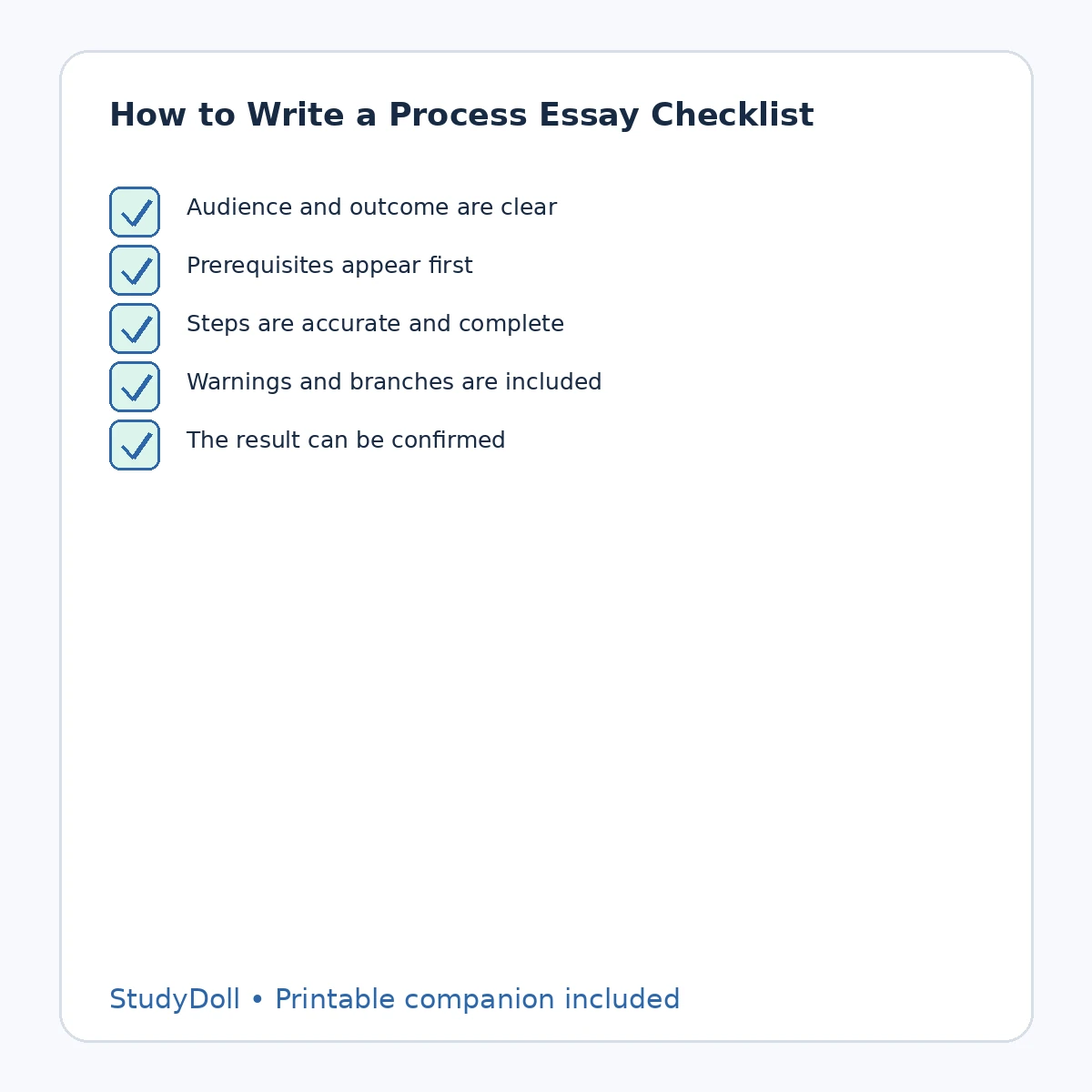
Process essay checklist
- The audience and outcome are clear.
- The sequence is accurate and complete.
- Prerequisites appear before the steps.
- Each stage includes explanation.
- Transitions clarify sequence and conditions.
- Branches and common errors are addressed.
- Visuals add understanding.
- The conclusion confirms the result.
Advanced quality standards
Test a directional essay by asking a representative reader to follow it. Record where the reader pauses, makes an incorrect assumption, or needs missing information. Revise the instructions rather than blaming the reader. For an informational process, ask whether every stage has a clear cause, actor, and consequence.
A premium guide can also include a downloadable worksheet, flow diagram, worked example, common-failure table, and links to related guides. Link to the expository essay guide when readers need broader explanation skills and the outline guide during planning.
What students searching for “process essay” usually need
They need to know the difference between directional and informational processes, how to select and verify steps, how to explain decisions, and how to avoid a bare numbered list.
A high-quality guide should answer the main question immediately, then support the reader through planning, drafting, revision, and submission. It should provide a worked example, a usable template, common mistakes, and a clear checklist. Long content is useful only when every section solves a distinct problem.
For SEO and reader experience, place the direct answer and core structure near the top. Use descriptive headings that match real student questions. Add original graphics where a sequence, comparison, or decision is easier to understand visually. Keep promotional material limited to genuinely helpful support points.
Key decisions writers must make
| Decision | What to consider |
|---|---|
| Audience level | What the reader already knows and what must be defined |
| Sequence | Which steps are required, optional, simultaneous, or conditional |
| Detail | What measurements, examples, and warnings affect success |
| Completion | How the reader knows the process worked |
These decisions should be made before sentence-level drafting. A weak plan often creates a polished paper that performs the wrong task. Return to the prompt whenever a decision becomes uncertain.
Write each decision in your notes and add one sentence explaining why it fits the assignment. This creates a record you can use during revision and helps prevent random structural changes near the deadline.
Weak and improved writing examples
| Weak version | Improved direction |
|---|---|
| Do the research. | Identify a focused question, evaluate sources using stated criteria, and record evidence in a source log. |
| Next, complete the task. | After drafting the body, compare the result with the stated outcome and troubleshoot missing stages. |
| Wait for some time. | Wait until the stated condition occurs, such as the document saving successfully or the mixture reaching the required temperature. |
The improved versions are not formulas to copy. They demonstrate decisions: narrower scope, clearer purpose, more precise language, stronger boundaries, or visible reasoning. Adapt the principle to your own subject.
When revising, highlight vague words such as things, good, bad, important, many, and a lot. Replace them with the specific feature, consequence, audience, quantity, or relationship you mean.
Paragraph workshop
Every paragraph should answer one question. Before drafting, write that question above the paragraph. After drafting, underline the sentence that answers it. If no sentence does, the paragraph may contain background without a point.
A useful development pattern is purpose, evidence or detail, explanation, limitation, and connection. The exact form changes by genre, but readers should never be left to guess why a paragraph exists.
Test paragraph order by reading only the topic sentences. They should form a logical compressed version of the article. Then read only the final sentences. They should show development rather than repeated summary.
Paragraph length should follow complexity. A short paragraph can emphasize a key warning, while a longer paragraph may be needed to explain a mechanism or example. Avoid breaking paragraphs only to make the page look easier; every break should signal a change in purpose.
Using sources without losing the writer’s voice
Use sources to provide definitions, evidence, context, models, or alternative views. Organize the article around the reader’s questions and your claims, not around a sequence of source summaries.
Introduce the source, present only the relevant material, cite it, and explain its role. A citation at the end of a paragraph does not automatically show which sentences came from the source or why they matter.
Keep a source log containing the full citation, key claim, page or paragraph number, source type, limitations, and intended use. Mark copied language with quotation marks immediately. This prevents accidental plagiarism and makes final citation checks faster.
When information may have changed, use current authoritative sources and include the date in the discussion. When the topic is based on a primary text or personal experience, avoid adding outside sources merely to make the paper look researched if the assignment does not require them.
Turn the rubric into a revision map
Copy each rubric category into a table and record where the draft demonstrates it. If the rubric rewards analysis, identify the paragraphs where explanation goes beyond description. If it rewards organization, mark the thesis, topic sentences, and transitions. If it rewards evidence, list the support used for each major claim.
Allocate words according to scoring weight. Writers often spend too much space on background because it is easy to draft, then rush the analysis or application that carries more points. A word budget corrects this imbalance before it becomes difficult to fix.
Use the rubric language to check the draft, but remove mechanical references from the final prose. The reader should experience a coherent process essay, not a visible checklist of scoring boxes.
Topic ideas and practice prompts
- How to evaluate an academic source
- How peer review improves a draft
- How to create an annotated bibliography
- How a bill becomes law
- How to turn a rubric into a revision plan
- How to conduct an informational interview
- How online payments are processed
- How to prepare a research presentation
Before selecting a topic, test whether it fits the assigned length, evidence requirements, and audience. A strong topic gives you a focused question, not merely an interesting subject.
For practice, write three possible questions for one topic and compare them. The question that creates the clearest purpose and manageable scope is usually the best starting point.
Internal-linking plan for this authority page
- Essay outline guide – helps readers plan stages before drafting
- Expository essay guide – supports clear explanation
- Complete essay guide – covers research, drafting, and revision
Internal links should appear where the reader naturally needs the next resource. Avoid placing a large block of unrelated links solely for SEO. Descriptive anchor text helps both readers and search engines understand the destination.
The StudyDoll order page should be linked in a clearly labeled support box and, when appropriate, in the final next-step section. Repeating the same sales link in every paragraph would reduce trust and distract from the educational purpose.
How to use the supplied visual assets
The featured image introduces the topic and should be set as the WordPress featured image. The structure infographic belongs near the planning or outline section, where it can reduce cognitive load. The checklist graphic belongs near the final review so readers can use it as a quick summary.
Use the supplied WebP files rather than converting them to larger formats. Keep filenames unchanged, add the supplied alt text, and do not place important information only inside the image. The article must remain understandable to readers using screen readers or with images disabled.
Check mobile display after insertion. If a graphic contains text, make sure it remains readable without requiring horizontal scrolling. Do not stretch a square checklist image into a wide banner.
How to use the printable worksheet
The process worksheet helps readers define an outcome, list prerequisites, map stages, record decision points, and create a completion test. It can be printed or completed digitally before drafting.
Link the PDF after the editable template or outline section using clear anchor text. Open the uploaded PDF once to confirm it downloads correctly. A downloadable resource can increase repeat visits and backlinks when it provides a genuinely reusable tool rather than a copy of the article.
Five editing layers
- Assignment fit: Does the draft perform the exact required task?
- Structure: Does every section have a clear purpose and logical position?
- Development: Are examples, evidence, and explanations sufficient?
- Style: Are sentences direct, varied, and appropriate for the audience?
- Proofreading: Are grammar, citation, spelling, links, and formatting correct?
Complete the layers in order. Proofreading a section that later needs to be removed is inefficient. Save earlier drafts so you can recover material, but make the final file easy to identify.
Mobile, accessibility, and on-page SEO checks
Use one H1, descriptive H2 and H3 headings, short readable paragraphs, useful lists, and tables with proper header rows. Keep the primary keyword natural. Do not repeat it in every heading or force it into sentences where a pronoun or related phrase is clearer.
Write a unique SEO title and meta description that accurately promise the article’s value. Do not guarantee grades or rankings. Preserve existing indexed URLs. Use descriptive image filenames and alt text, compress assets, and verify that the table of contents links to the correct sections.
Check that the call to action is visually distinct but not intrusive. Educational value should dominate the page. A reader who does not order should still leave with a complete, trustworthy resource.
Final publish-readiness review
Preview the article on desktop and mobile. Click the table of contents, internal links, order link, and PDF download. Confirm that the featured image crops well, supporting images appear in the intended positions, and tables do not break the layout.
Search the visible page for editor-only notes, image instructions, placeholder text, duplicated headings, broken HTML, and unclosed tags. Confirm the word count, slug, SEO fields, author information, and last-updated date.
After publication, open the public URL in a new tab. A successful WordPress update does not always guarantee that the public page displays correctly. Check the page as a reader would.
How to study the worked example
The complete example in this guide is not included as a model to copy word for word. Study the decisions behind it. Identify the focused question, controlling claim, paragraph sequence, evidence or details, transitions, limitations, and conclusion. Then mark how each paragraph contributes to the whole.
In the peer-feedback example, notice that every stage produces a specific output: goals, categorized comments, diagnosed reader problems, and revision actions. The example explains why the sequence matters instead of presenting four arbitrary steps.
Create a two-column annotation. In the left column, copy a short sentence or paragraph feature. In the right column, explain its function. Examples of useful functions include defining scope, creating tension, naming a decision rule, showing a mechanism, establishing a boundary, or returning to an opening image.
After annotation, apply the same functions to a new topic. This transfer step is more valuable than imitating vocabulary or sentence length.
Expert editorial notes
- Distinguish required steps from optional advice.
- Place warnings before the action they affect.
- Define completion conditions rather than ending after the last action.
- Use parallel headings and consistent terminology.
- Test the procedure with a reader who matches the intended audience.
These notes should guide revision rather than appear mechanically in the finished paper. The goal is a natural, coherent process essay that demonstrates control without calling attention to every technique.
When two guidelines conflict, return to the prompt, audience, and purpose. For example, a concise assignment may require fewer examples than a comprehensive online authority guide. Adapt the depth without removing the essential reasoning.
Credibility and editorial trust
For a public StudyDoll article, show who created or reviewed the resource, include a meaningful last-updated date, and cite authoritative sources when factual claims require them. Avoid fake expert quotations, invented statistics, or unsupported claims that the method guarantees a grade.
Examples should be clearly labeled as illustrative when they are invented for teaching. When an article discusses changing rules, software, law, health, or policy, verify the current information before publication and update the page when conditions change.
Keep the educational article distinct from the service offer. The reader should receive a complete answer without ordering. The order link offers additional personalized support, not access to information intentionally withheld from the guide.
Building a genuinely useful FAQ section
FAQ questions should address real uncertainties not already answered fully in the main text. Good questions clarify edge cases, assignment variation, tone, source use, length, and structure. Avoid repeating the H1 as a question or adding one-sentence answers solely to increase keyword coverage.
Answer directly in the first sentence, then add necessary qualification. Keep each answer self-contained because search engines may display it separately. Do not use FAQ schema for promotional questions or content that is not visibly present on the page.
Review the FAQ after drafting the article. Remove questions that the body now answers completely and add questions raised by the worked example or checklist.
Final quality questions
- Can a beginner follow the sequence without hidden knowledge?
- Does each major stage explain purpose and expected result?
- Are branches, prerequisites, and errors visible?
- Can the reader confirm successful completion?
- Do the visual and PDF resources add information rather than duplicate text?
Answer each question with evidence from the finished article. A simple “yes” is not enough during editing. Identify the exact section, sentence, example, or asset that demonstrates the standard.
Finally, compare the public page with the original assignment or content brief. The strongest long article is still unsuccessful if it solves a different problem from the one readers searched for.
Common misconceptions about the process essay
A process essay is just a list of steps
A strong essay explains prerequisites, purposes, choices, expected results, and failure points.
Every step must have the same length
Complex stages deserve more explanation than simple actions.
Transitions alone create organization
The sequence must be logically accurate before transition words can clarify it.
The writer does not need research
Current and authoritative verification is essential when procedures involve safety, law, science, technology, or institutional rules.
Misconceptions often come from applying one familiar school template to every assignment. Treat the assignment instructions and rubric as the controlling authority. A useful online guide should teach adaptable principles rather than pretend one formula is universal.
An efficient start-to-finish workflow
- Decode: Identify audience, outcome, scope, and required format.
- Map: List prerequisites, major stages, branches, and completion conditions.
- Verify: Check sequence and details using observation or authoritative sources.
- Draft: Explain one stage at a time with purpose, action, and result.
- Test: Ask a representative reader to follow or reconstruct the process.
- Revise: Fix hidden knowledge, vague conditions, and missing troubleshooting.
- Publish: Insert assets, verify links, and check mobile display.
Keep the stages separate enough to protect your attention. Drafting while repeatedly checking grammar can interrupt reasoning. Researching without a focused question can produce excessive notes. Proofreading before structural revision can waste effort on sentences that will later be removed.
When the deadline is close, shorten the time spent in each stage rather than skipping planning or revision entirely. A five-minute outline and one focused reverse-outline pass are still better than drafting without direction.
Publication strategy for StudyDoll
This article should function as part of a connected essay-writing knowledge hub. Keep the URL stable, use a unique title and meta description, and connect the guide to its closest parent and supporting pages. Add only links that help the reader solve the next problem.
Use the supplied original images and PDF rather than generic stock assets. The feature graphic creates visual identity, the structure graphic teaches the method, the checklist supports quick review, and the worksheet encourages practical application. Together, these assets make the page more useful and more linkable.
After publication, check the page in Google Search Console when available, confirm indexing, monitor queries and click-through rate, and update weak sections based on real reader behavior. Do not change the slug casually after indexing. Improve the title, introduction, examples, or internal links before considering a URL change.
The process page should become the central internal-link destination for later guides about source evaluation, annotated bibliographies, peer review, and research workflows.